BY AARDE WRITES for WEEKLY VOLCANO 1/23/26 |
Dear Aarde,
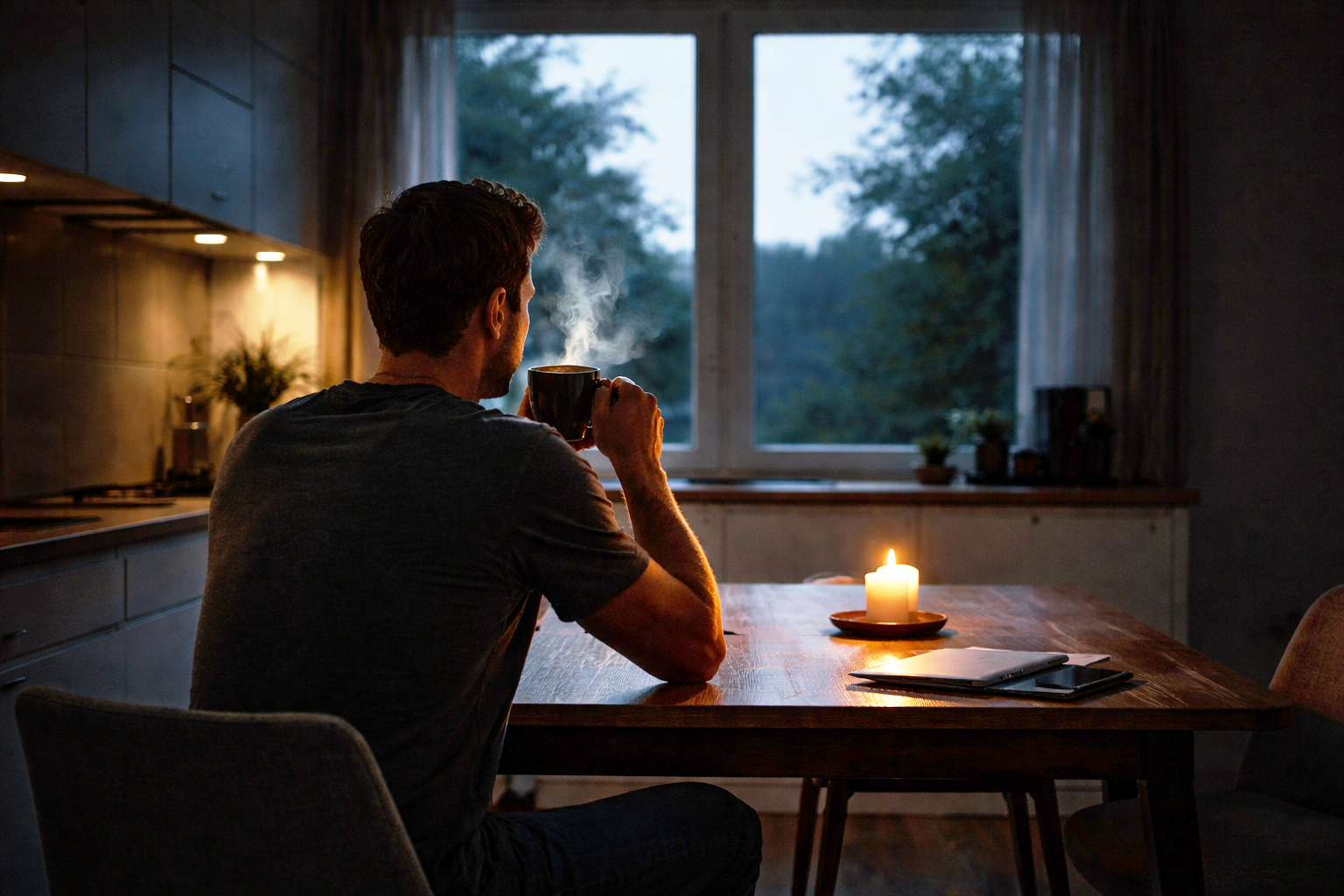
I’m looking for some feedback on a recent experience, one that felt small on the surface but expansive once I allowed myself to sit with it. I woke up, as I usually do, to my alarm and quietly made my way to the kitchen to make a pot of coffee. It was still dark out, the kind of dark that feels complete rather than empty, and I had no desire to turn on any lights. Typically, I turn on a few here and there so I can function without stubbing a toe or fumbling for the counter. This time, though, I felt a strong sense of respect for the darkness that surrounded me. It wasn’t fear or hesitation. It felt more like reverence.
I made the coffee by feel, guided only by muscle memory and the faint glow from the gas range. Then I sat in silence, cup in hand, drinking slowly. I wasn’t thinking about anything in particular. I wasn’t meditating or trying to be present. I was simply there, surrounded by the dark, listening to the quiet hum of the house at rest.
When my wife came in, she was startled to see me sitting so still, in the dark, looking at nothing. When she asked why I hadn’t turned on a light, all I could say was that I couldn’t bear to. It was as if the idea of an electrical buzz unsettled me. Not just the visual intrusion, but the sound and sensation of having the lights on felt invasive in a way I couldn’t articulate. So we sat together in the dark until the outside light was enough for us to begin our days.
I’m not sure if this will continue or why it happened in the first place. What are your thoughts?
Signed,
Low Light
Dear Low Light,
First, I want to acknowledge the recognition you gave your inner self. You felt strongly about protecting your energetic experience, and you listened. That matters. Your reaction was not avoidance. It was attunement. You noticed a subtle internal boundary and chose not to override it out of habit or obligation. That kind of listening is uncommon in a culture that rewards constant stimulation, productivity, and responsiveness. We are often taught, implicitly, that discomfort should be resolved quickly and that stillness is wasted time. You chose to pause. Just as the pounce is imperative for survival, so is the pause.
I’ll preface the rest of this by saying I’m no scientist, certified life coach, licensed therapist, professor, or official advice giver. I am, however, alive, and I have been paying attention. It does not feel far-fetched to consider that humans are collectively overloaded. We live on a broad spectrum. Some are focused on survival, others on thriving, but all of us do so amid relentless noise. We move through cities thick with tension, absorb anger and grief through our screens, and witness terror unfold in real time. Even when we are safe, our bodies often do not register that safety. We carry opposing frequencies, constant alerts, and emotional whiplash.
People are looking, consciously or not, for ways to convert this accumulated anxiety into something survivable. Some choose isolation, retreating inward to protect the quiet they can find. Others build community, seeking regulation through connection. Some turn to meditation, prayer, or breathwork. Others return to art, music, or physical labor they once loved but set aside. All of these are efforts to create space where the nervous system can recalibrate. Even when we appear functional, the body may still be holding unprocessed stress. Moments like the one you described can be the psyche’s way of releasing pressure without asking permission.
What your inner spirit communicated was not new. It was ancient. For most of human history, mornings did not begin with alarms, overhead lighting, and glowing screens. They began gradually, with firelight and birds at dawn. That respect for the darkness suggests memory deeper than intellect, something encoded rather than learned. Your experience reflects a biological and spiritual rhythm that modern life rarely allows us to access. By disrupting our circadian rhythms, the body’s natural 24-hour cycle, we have slowly trained ourselves to move against our own signals.
Artificial light, sound, and electricity are not neutral to the body, even if they feel normal. In moments of overload, the nervous system may reject additional input. Darkness, in that context, becomes regulating. It can feel grounding, protective, and restorative. Choosing not to flip the switch was a quiet refusal of immediacy and productivity. It was a small act with meaning. Sitting in the dark was not passive. It was an act of presence. You were not checking out. You were checking in. There is power in stepping away, even briefly, from the constant state of being “on.” There is power in letting the day arrive.
Your wife joining you transformed the moment from solitary to shared. No explanation was required. There was no need to justify what you were feeling. You simply existed together in the same rhythm. That kind of nonverbal attunement builds trust and safety in a relationship. It communicates support without language and comfort without fixing. That deserves acknowledgment.
It is also worth saying that not every intense or unfamiliar experience needs interpretation or repetition to be valid. This may have been a single point of recalibration rather than a new rule for living. Curiosity is more useful than concern here. The moment offers information. Gather it gently. Notice what felt nourishing, what felt protective, and what felt true. Let future mornings respond in their own way.
If you would like a gentle practice to explore this further, consider beginning each morning for one week by lighting a single beeswax candle. Carry it from room to room as you move through your early tasks. The presence of an open flame naturally slows the body. Once the sun has risen, you might journal about the experience. You may gain insight into changes your inner self is asking for, ones only you can provide. This may require waking slightly earlier than usual. You may find it shapes the tone of the entire day. Another option is experimenting with light bulbs designed to support circadian rhythms.