BY SUZY STUMP for WEEKLY VOLCANO 3/13/26 |
In Tacoma, art does not always wait for our attention politely inside galleries. Sometimes it appears on a street corner, tucked into a doorway or resting quietly where someone might stumble across it during an ordinary day. For Tacoma artist Michael Darling, those moments of discovery are part of the point.
Darling has built a reputation for creating work that lives both inside galleries and out in the world. His artwork appears in formal exhibitions, but just as often surfaces unexpectedly around Tacoma as what he calls “gifts.” Each piece becomes a quiet exchange of an idea between artist and a stranger.
That sense of openness begins with how Darling thinks about creativity itself.
“Kids make art purely for fun,” he says. “And they haven’t been told any rules. I think the older they get the less important creativity becomes in the world around them. They aren’t encouraged to explore and play as much. So they lose it.”
The observation sits at the center of how Darling approaches his work. Rather than chasing a rigid idea of what art should be, he tries to preserve the curiosity and freedom that come naturally to children. That mindset allows ideas to arrive in unexpected ways. His thoughts and emotions are conveyed through colorful visuals, often using recognizable symbolism and faces, sometimes accompanied by written words.
“I really don’t know,” he says when asked where ideas come from. “It just pops into my head sometimes.”
That spontaneity does not mean the process lacks intention. Darling describes his creative work as a balance between receiving an idea and shaping it into something he wants to share.
“Good question,” he says. “It’s both. An idea just comes out of nowhere. I think what I do is be open to it and receive it, control it and edit it into something I want to show people.”
Darling works across a wide range of mediums, including painting, collage, stencil work, lino carving and drawing. Instead of viewing each medium as fundamentally different, he sees them as tools for expressing the same inner source of ideas and emotion.
“Nothing,” he says when asked what each medium allows him to say that others cannot. “It’s just like different instruments that look different. But it’s all still coming from the same place. Like you could express the same feelings with a guitar solo or a painting. It just comes out different.”
That philosophy extends naturally into Darling’s street art. Earlier in his career he described himself as a “tagger,” but the impulse behind his public work has remained consistent.
“My relationship with street art hasn’t changed much,” he says. “It’s still just me wanting to leave messages for people the same as always. I do think about it differently than a gallery because it’s a different setting and a different audience.”
In the gallery, viewers arrive expecting to see art. In the street, people encounter it by accident. Darling embraces that element of surprise.
“I love that it’s a surprise,” he says. “And it forces a reaction. I just like to imagine someone seeing something and stopping and thinking about it and relating to it in some way.”
While galleries gather artwork into one place for collectors and dedicated art audiences, Darling sees street pieces as something more like personal notes left for the wider world.
“Galleries are cool for people to come and see a collection all together,” he says. “But that’s for art collectors and stuff. But things in the street are like little messages for the world.”
Over the years, Darling has left hundreds of small works scattered throughout Tacoma. He thinks of them simply as an exchange between artist and audience.
“Well it’s just that, gifts,” he says. “I know they end up where they should somehow. Every time.”
The responses he receives from strangers reinforce that belief.
“I can’t tell you how many messages I have got from people that just find something and tell me that it seems it was made for them,” he says. “They connect to it. And that means we’ve touched each others heart. And that’s really all you could ask for as an artist.”
Once a piece is placed, Darling does not track where it goes or who might eventually discover it.
“It’s just a good feeling that I want over and over,” he says. “And no. I don’t really ever wonder where they end up after I leave it. I just leave it and forget it.”
The city itself plays a large role in that process. Tacoma’s creative culture has long been shaped by do-it-yourself spaces, independent galleries and artists who help one another grow. Darling sees that support system as one of the city’s greatest strengths.
“Tacoma really loves art obviously,” he says. “If you want to be an artist here and you’re serious, you can do it. The people will pay attention and support you. Other more established artists will teach you and give you advice.”
Unlike larger art markets where gatekeeping can define opportunities, Darling believes Tacoma offers room for experimentation and authenticity.
“There are no gatekeepers here,” he says. “It’s very easy to express yourself in Tacoma. I don’t know if it would be like that in other cities.”
That freedom has allowed him to develop a body of work that blends imagery and language, sometimes pulling phrases from poetry, music, movies or conversations overheard in everyday life. Even Darling admits he does not always fully analyze where those themes originate.
“I don’t think I consciously explore those ideas,” he says when asked about recurring themes like childhood innocence or love. “I think those just must be the things that need to come out of me.”
The same instinct guides how he thinks about identity as an artist. Darling resists the idea that painting and storytelling belong in separate categories.
“I’ve never really thought about that,” he says when asked whether he is primarily a visual artist who writes or a storyteller who uses images. “But I would say both equally. I couldn’t be one without the other.”
His favorite work changes constantly as new pieces emerge.
“Whatever I’m working on today,” he says with a laugh. “It changes constantly. My favorite painting is always the last one.”
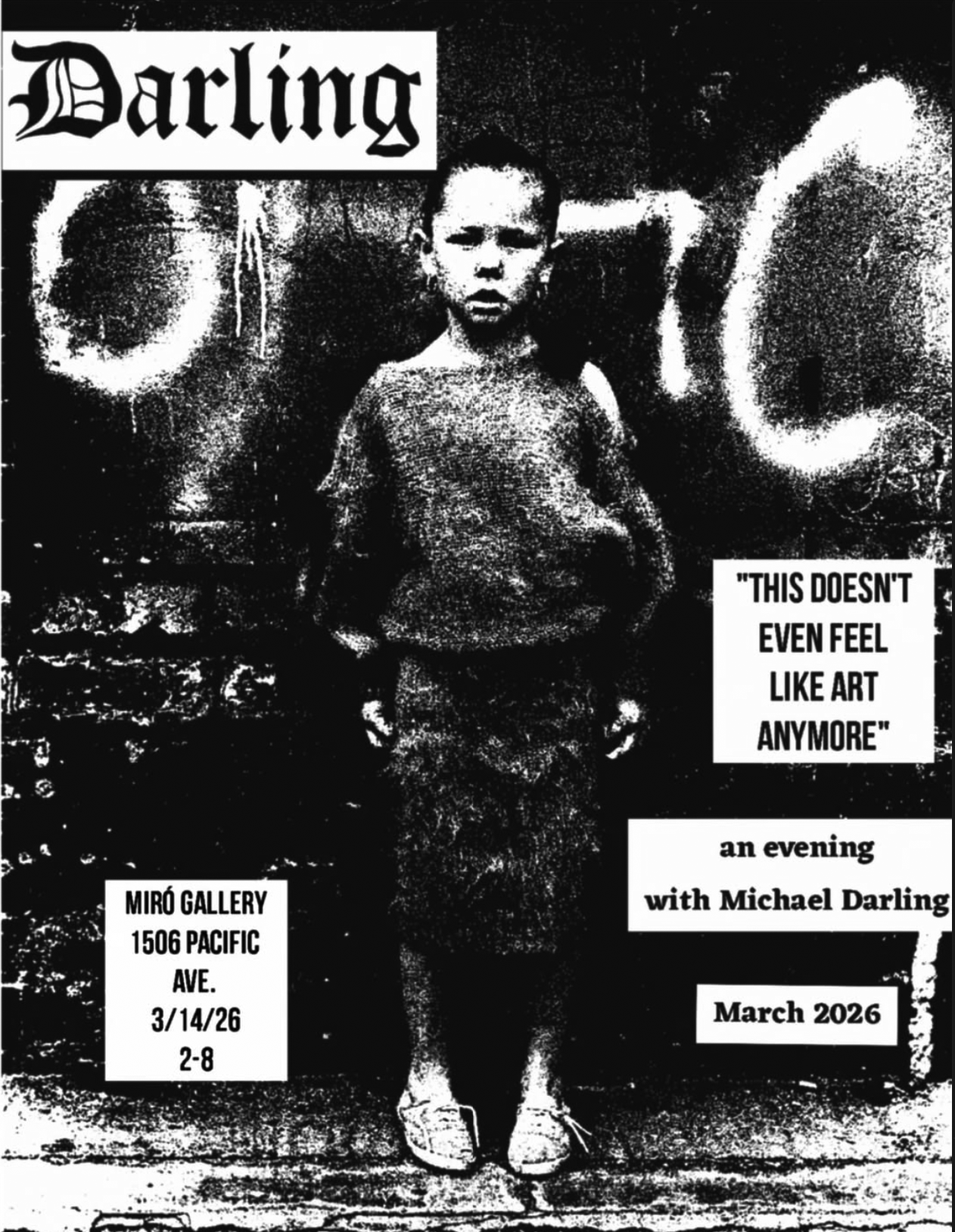
That sense of motion continues this month as Darling presents a new exhibition at Mirò Gallery titled This Doesn’t Even Feel Like Art Anymore. The show invites visitors to experience a collection of original works created by the Tacoma artist while gathering with the creative community that helped shape his journey.
The exhibition, held at the downtown Tacoma gallery on Pacific Avenue, is designed as an open celebration of creativity and connection. For Darling, that sense of shared experience remains the most meaningful part of making art.
If someone wanted to understand the spirit behind his work, he offers an answer that blends humor with imagination.
“To find the spirit of my work,” he says, “follow the second star to the right and straight on till morning.”
To follow Michael Darling’s work online, find him on Facebook and on Instagram at @michaeldarlingart.
This Doesn’t Even Feel Like Art Anymore opening reception with artist Michael Darling; Mirò Gallery; Sat., March 14; 2 to 8 p.m.; 1506 Pacific Ave., Tacoma; free.