BY YAYOI LENA WINFREY for WEEKLY VOLCANO 3/6/26 |
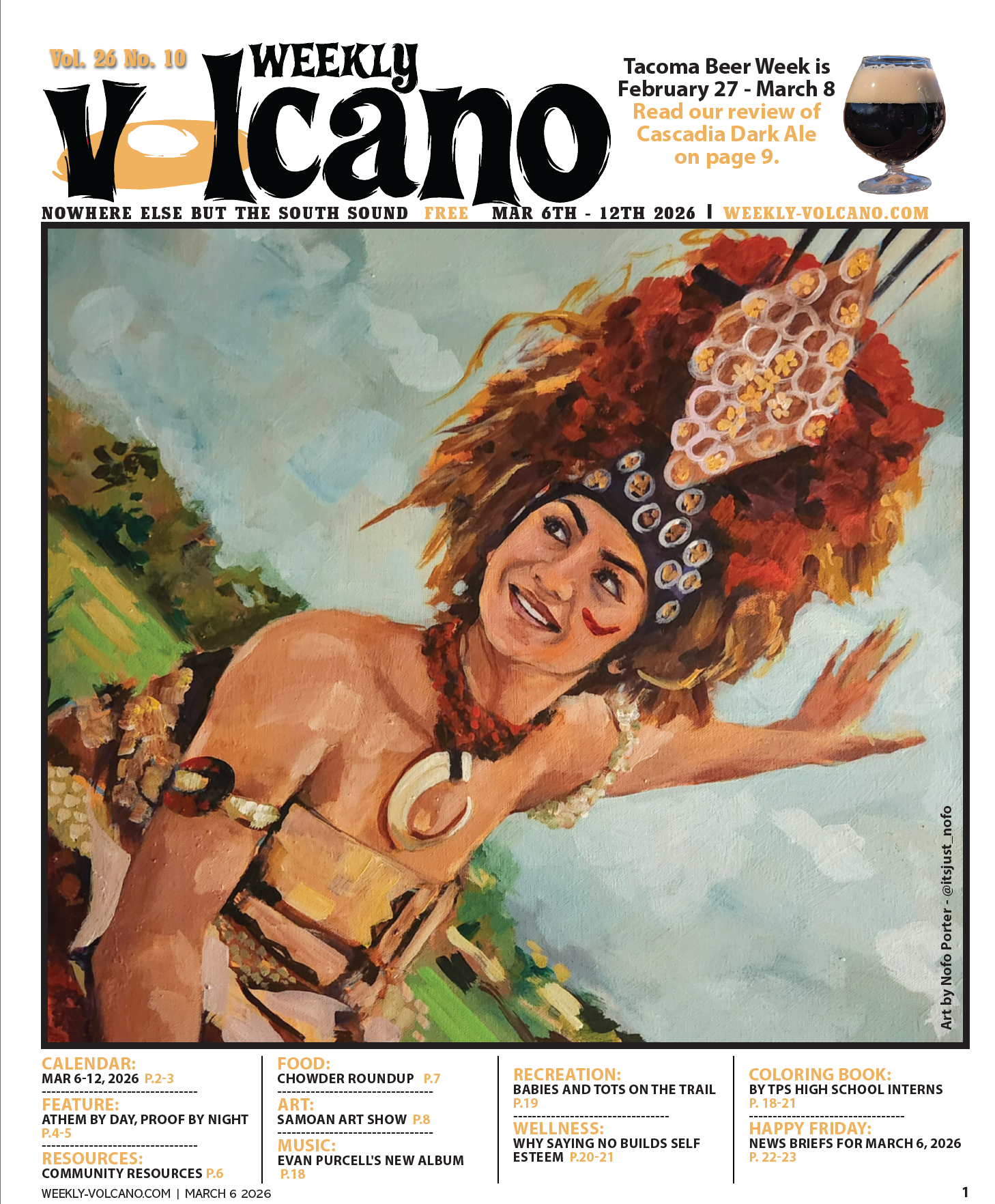
Two local artists with Samoan ancestry will have their work displayed at Asian Pacific Cultural Center’s Jade Choe Gallery starting March 7. While both artists integrate striking Samoan imagery in their creations, each one’s compositions are completely unique.
Hawai‘i-born Nofo Porter spent their childhood growing up in the South Puget Sound cities of Kent, Lacey, Lakewood and Tacoma.
“My dad joined the U.S. Army from American Samoa,” says Porter, “and so my siblings and I were born in the different duty stations he was assigned to along the way.”
As a self-described “queer” person, Porter has experienced their share of rejection.
“Feeling accepted as a whole within the Samoan community is complicated for me,” they explain, “and being queer doesn’t make it simpler.”
Still, Porter wouldn’t exchange their Samoan heritage for anything.
“The cards that were dealt to me are also dealt to my Samoan community and vice versa by the simple fact that we both exist for each other,” Porter adds.
As a painter, public artist and muralist, Porter blends Samoan culture into every project.
“Of course I am extremely proud of my Samoan people,” Porter explains. “Our resourcefulness and commitment to centering the natural world in our art is something I haven’t always appreciated, but now I find it so meaningful and stunning, honestly.”
Porter says that Samoan art was always in their family home.
“Siapo (tapa cloth made of bark) hanging on the wall, woven mats on the floor, woven fans on end tables, floral prints around the waists of my aunties,” Porter elaborates. “My dad singing and playing his guitar.”
While some of Porter’s public artwork has been described as graffiti, it doesn’t resemble anything that most taggers post on city walls.
“Some people hit the town with a couple of cans of spray paint just to vandalize, maybe as an outlet, and what they put up doesn’t look like art to people,” Porter says. “I hate to see that on residential property or active businesses, but I think it serves up an interesting conversation around public property, systems of power, and who gets to decide what goes where.”
Porter, who has a close relationship with the graffiti community, clarifies their feelings that both illegal tagging and graffiti art “are practiced by people who seem to know what they want to do.”
“But in any case, the friends I’ve made who write really blow my mind,” they add. “They’re usually some of the most generous, supportive, progressive minded people. They’ve put as many hours as I have or more into what they’re doing. They operate on a value system that makes sense to them, and I really mess with that. And, they’re usually able to paint amazing things like lightning fast.”
As for being influenced by their Northwest environment, Porter says that learning more about local Indigenous groups and their histories has become an important aspect of their artistic vision.
“Whenever I have the opportunity to create something, especially when it will be displayed in public,” they say, “it becomes painfully clear that we are on stolen land.”
Porter names David Long, Chris Jordan and Kenji Stoll, who managed the Fabitat creative space for youth on Hilltop, as their favorite artists. They also admire German artist Alpay Efe, who, they note, “has mastered this style of portrait painting that seems effortless and precise.”
Looking forward, Porter says, “I hope my future in art is one that is energizing and supportive to others, with special attention to youth, youth of color, queer and/or Pasifika youth.”
Like Porter, fashion designer and fiber artist Faaana Tili also uses Samoan elements in her work.
Born and raised in Long Beach, California, Tili says that her parents struggled raising five children but had support from their siblings and the Samoan community “through church, local organizations, and close friendships.”
After Tili’s first daughter was born, she felt the need to express her cultural heritage through fashion.
“What began as taking custom orders for puletasi (women’s formal skirt and top), ofutino (shirt), ie faitaga (men’s wraparound skirt), and family sets quickly turned into year-round demand within the Samoan community,” she explains.
Her clients wanted special attire for church, weddings, graduations and, as Tili puts it, “milestone moments.”
“They wanted garments that felt personal and elevated, pieces that honored tradition while standing beautifully in modern spaces,” she adds.
“As more clients requested contemporary designs infused with Samoan prints, motifs, and sacred siapo (tapa cloth made of bark), I began intentionally blending traditional textiles with modern silhouettes,” Tili elaborates. “That fusion became my signature. I realized I wasn’t just creating clothing. I was helping people wear their heritage with pride, in a way that felt current, expressive, and uniquely their own.”
Deeply committed to sustainability, Tili avoids contributing unnecessary waste.
“When I cut fabric, I intentionally save every usable scrap because I’m fully aware of how quickly textile waste accumulates in landfills,” she says.
She uses remnants to create “mosaic-like art pieces, patchwork details, or even fully functional garments,” she adds.
Among the artists Tili admires are Whitney Austin, a North Carolina painter whose bold use of color and brushwork she appreciates. She also applauds “House of Iligaona” in Australia, which, she says, creates clothing “honoring ceremonial tradition while presenting it with elegance and grandeur.”
Tanya Wursig, an Australian painter and resident of Tahiti, is another favorite because of her use of “portraits layered over Polynesian prints.”
“I also admire Cristina Martinez,” Tili adds, “a Seattle-based painter and fashion-focused artist.”
Living in the Pacific Northwest over the past five years has deeply influenced Tili’s art.
“When I moved to Washington, I developed a profound appreciation for nature, the towering evergreens, rivers, lakes, rain, snow, and the clear transition between each season,” she says, adding, “You experience preparation in the fall, stillness in the winter, renewal in the spring, and abundance in the summer.”
She hopes that her art will continue “to embody freedom,” explaining that to her, art is “living without restraints or rigid rules. It is one of the few spaces where people can exist fully as themselves.”
Tili envisions a future where her art expands into “teaching and impacting community,” hoping to give back by sharing her knowledge.
“If my art can not only inspire but also equip others to create boldly and confidently,” she says, “then I will feel that I’ve made a meaningful and lasting impact.”
Samoa | Born Between Oceans: Memory, Mark and Making
Opening Reception: March 7, 3:30 p.m. to 6:30 p.m.
Exhibit dates: March 7 to April 25
Jade Choe Gallery at Asian Pacific Cultural Center, 4851 South Tacoma Way, Tacoma, WA 98409.