BY YAYOI LENA WINFREY for WEEKLY VOLCANO 1/16/26 |
When Kellis Parlett visited Tumwater Gallery, located inside the Copper Wolf Tattoo Studio and Art Gallery in Tumwater/Olympia, she was pleasantly surprised.
Parlett, the curator for Asia Pacific Cultural Center (APCC) in Tacoma, learned that the small gallery run by a tattoo shop never collects a commission from its artists. Instead, owners Aimee Schreiber and Danny Gordo, according to Parlett, “simply want to create more opportunities for artists in this region to show their work to the world.”
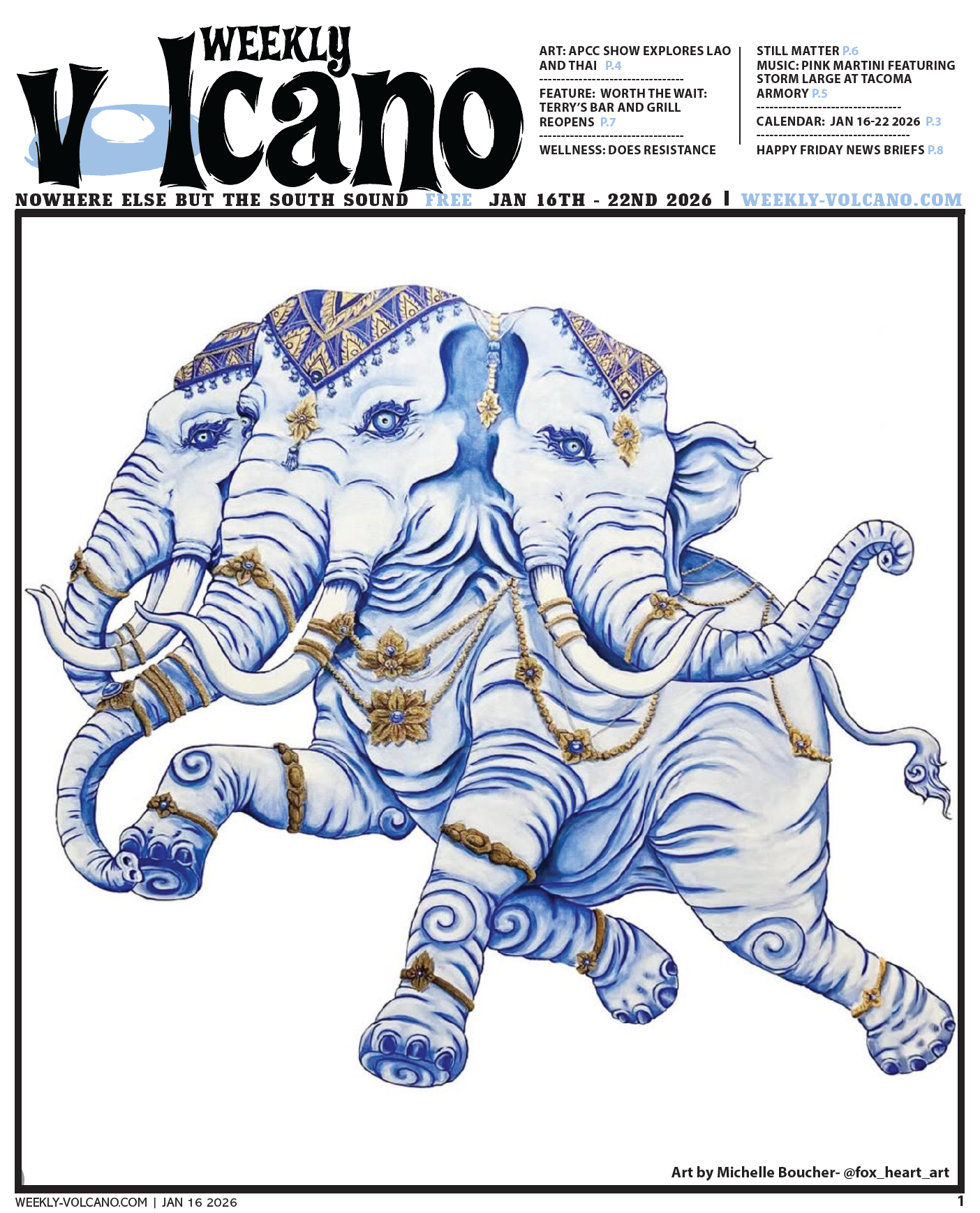
Parlett was further elated upon discovering two new artists focused on cultural identity. While neither was well known, their amazing artwork compelled Parlett to create an exhibit for the Jade Choe Gallery at APCC, called “Lao & Thailand: Between Roots and Becoming.”
Artist Michelle Boucher, who was born in Plattsburgh, New York, is of Thai and white French American descent. Her parents met while her father was stationed in Thailand in the early 1970s.
Being mixed race was sometimes difficult for her.
“Growing up as an Air Force brat, I was exposed to a lot of diversity, but the neighborhoods we lived in were predominantly white,” she explains. “I struggled to connect to both sides of my identity. I didn’t look like anyone else in my family. I wasn’t white enough, Thai enough, or Asian enough.”
Boucher says that other kids often bullied her verbally and called her names.
“During those formative years, those words cut deeply into an already insecure child,” she admits. “I was constantly ‘othered’ or rejected.”
Boucher incorporates elements of her biracial heritage in her artwork, calling it “the absolute beauty of both worlds.”
“When you look at French filigree and scrollwork, it’s surprising how similar and complementary they are to Lai Thai designs and Thai kranoks,” she clarifies. “To me, they feel like a beautiful marriage.”
Calling her artwork “an act of true self-acceptance and reclamation,” she adds, “I own the narrative. I am the liminal.”
Self-taught, Boucher works mostly in watercolor and gold leaf, with some acrylic. She says she’s always loved being creative and, from a young age, experimented with every medium available.
“With art, it was just me and my limitless imagination,” she says.
Her favorite artist is Susan Seddon Boulet, with whom she shares a fondness for mysticism.
“My father bought a print of her work in 1992, and I would just stare at it,” says Boucher. “I had never experienced art that captivated me in that way before. Her subject matter, humans intertwined with their spiritual animal counterparts, spoke directly to me.”
Two years ago, Boucher purchased one of Boulet’s books. It was used, but in fair condition.
“As I flipped through it for the first time, I noticed a Post-it tucked between the pages,” she reveals. “On that page was a handwritten note: ‘For Michelle, who loves bears. Have fun finding out about them. I wish you well, Susan.’ It was signed and dated 1994.”
Boucher found it in 2024.
“It felt like a gift beyond time,” she says, “and it’s now one of my most cherished possessions.”
Boucher says the Pacific Northwest “has her heart” and that living here inspires her.
“The lush forests, the dark, mysterious waters of the Puget Sound, and the ever-present fog feel deeply soothing,” she continues. “There’s something mystical about it all. I feel like this place naturally fosters creativity and community. I’ve met so many like-minded souls here.”
For first-generation Lao American Leslie Khounsombath, Washington is her birthplace, but “The Secret War” greatly influences her artwork.
During the Vietnam War, the CIA secretly engaged Hmong soldiers in Laos to battle communists.
“The reason why it was a secret is because prior to this war, the U.S. had signed a treaty promising not to interfere by warfare in Laos,” she explains.
Because of the unpopularity of the Vietnam War, the war in Laos was kept from the American public.
With maternal ancestry in Paksan and paternal lineage hailing from Pakse, both in Laos, Khounsombath says that “all of my artwork is made in memory of an ancestor, or a memory of being ‘othered’ as a child, my otherness lying in the reality that I am Lao.”
Khounsombath calls her artwork a “reparation” because “it allows me to create and display my own reality, not the distorted history that has been taught or redacted from us,” she says. “It allows me to create a portal in which I am the Historian, I am the News, where I am rested, and my truth is set free.”
Like Boucher, Khounsombath is also self-taught. She uses clay, wood burning, painting, stained glass, and even wicker in her pieces.
However, finding her artist’s voice “required years of therapy, self-reflection, eating disorder treatment, and hard work before all of the accolades came along,” she divulges.
Being an artist takes courage because, she says, “creating while the world is telling you that it is useless, financially non-beneficial, or too idealistic” is hard.
“I have been an artist as young as I can remember,” she continues, “however, my internal healing was the catalyst to break the ceiling, to run toward the unknown with fury.”
Although a self-proclaimed “recovering perfectionist,” Khounsombath admits she never knows how any of her artwork will turn out.
“It is a process of metamorphosis, not a process of perfection,” she adds.
Her “sheroes” are Audre Lorde, Maya Angelou, Tricia Hersey, and her paternal grandmother, Bounleuth Khounsombath, all of whom she considers to be “North Stars” in her life.
She envisions a future where she will participate in “grander art installations like Chihuly,” she says. “I love creating large spaces of feeling. I love impact, and I love expression without words.”
“The message of my artwork is to inspire others to listen to their dream, no matter how much or how little they can engage in it day to day,” she declares. “My art has kept me alive. That was always the reason for creating. The accolades, sales, or achievement are a byproduct of that, not the other way around.”
“Lao & Thailand: Between Roots and Becoming” will be at Jade Choe Gallery at Asia Pacific Cultural Center until Feb. 28.