BY DOUG MACKEY for WEEKLY VOLCANO 12/5/25 |
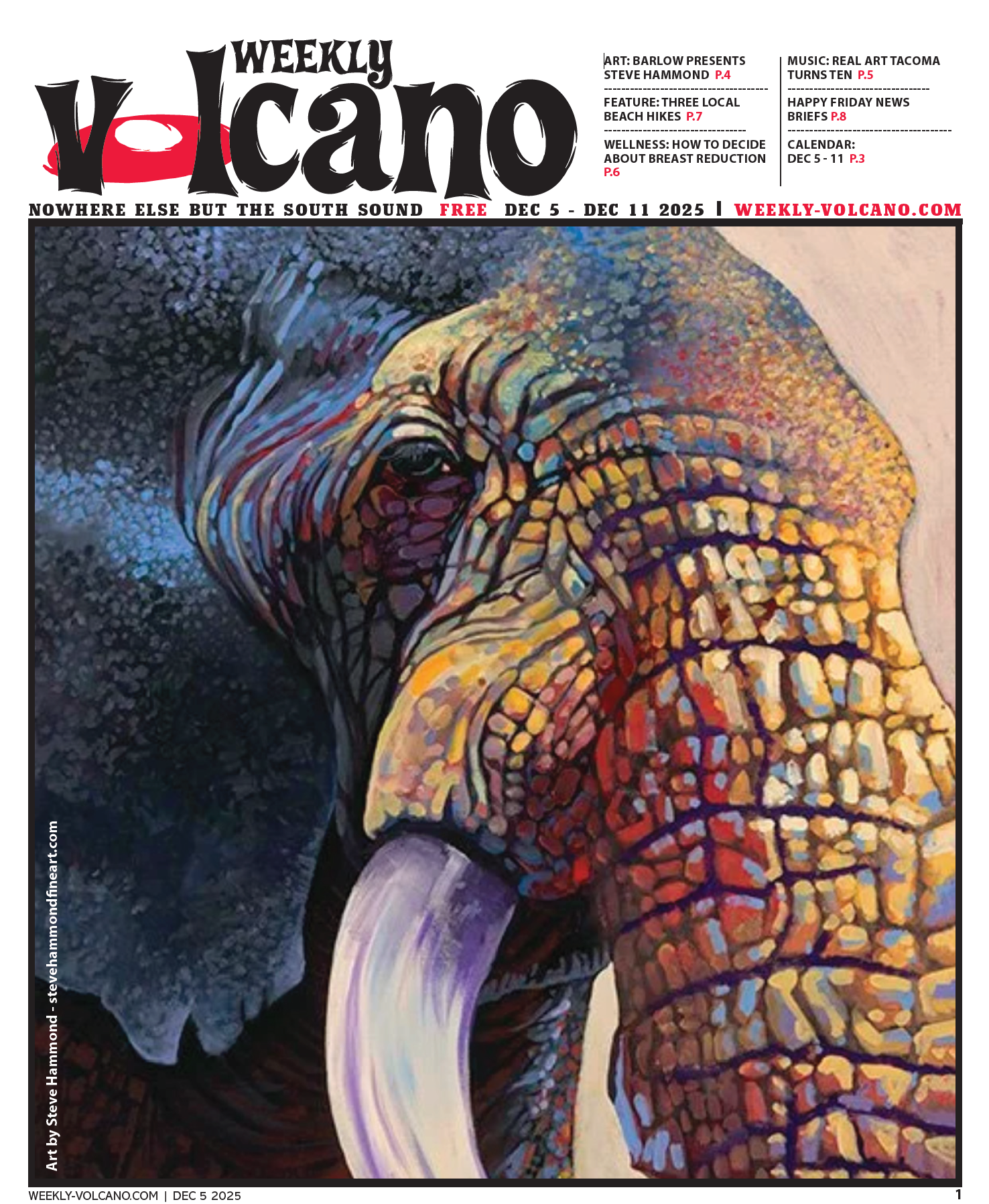
Artist Steve Hammond has built a career fueled by passion, dedication, and an unrelenting pursuit of perfection. Armed with a scratchboard as his canvas and a sharp tool as his instrument, Hammond creates work that draws viewers in and holds their gaze.
Scratchboard is a meticulous medium, striking in its visual contrast, where images are revealed by scratching away a dark surface to expose the light layer beneath. With each stroke, Hammond breathes life into intricate details, capturing the essence of people and animals in a way that mesmerizes the viewer. The result is a powerful blend of precision and emotion: artwork that feels both timeless and alive.
When viewers encounter Hammond’s work, which can be viewed on his website (stevehammondfineart.com) and at Barlow Gallery in Tacoma, he hopes for one primary reaction: “I’ve never seen something like this before.” Scratchboard is a lesser-known medium, and the intricacy and vibrancy of his work often leave viewers transfixed. “That’s a very common response,” he says. “It’s very rewarding.”
His journey as an artist began much earlier than the meticulous black-and-white works he is best known for today. “When I was nine years old,” he recalls, “I did a painting of a Native American chief, and I was like, ‘Wow. This is better than my dad could ever do.’” Hammond’s father was “a decent artist,” he adds, but that small five-by-five-inch acrylic painting sparked a lifelong passion. Though the piece has long since vanished, the sense of identity and purpose it inspired held fast.
Living in the Pacific Northwest has shaped Hammond’s work in a practical way. “Because it’s cloudy,” he jokes, “I spend a lot of time in the studio, not surfing.” The weather drives him inward, physically and creatively, offering long stretches of uninterrupted time in service to the demanding medium, though he works in vibrantly colored acrylics as well.
Hammond’s creative process in scratchboard begins with challenge. “I’m always looking for really difficult images to do,” he says. The medium itself, built on subtractive technique, patience, and exacting detail, lends itself to drama. “My art isn’t for the faint of heart,” Hammond explains. “It explores complex human emotions and the untamed beauty of wildlife, striving to evoke strong reactions and leave a lasting impression.” Gravitating toward subjects that are not passive, his “portraits must convey a reaction,” something that makes viewers wonder who the person is or what they are feeling.
One of Hammond’s most surprising portraiture experiences came with a piece he titled Pow Wow. With only 30 days to complete a 16-by-20-inch scratchboard, an unusually short deadline for work that typically takes him two to three months, he began rendering the image of a cowboy but realized halfway through the process that the subject was “way too difficult for what I was trying to do.” He pivoted instead, switching to a pow wow participant, and the result stunned even him. “When I got done, I absolutely loved it,” he says. “A nice surprise.”
Perhaps Hammond’s most poignant portrait piece is of a homeless man titled Dignity. Few people know that half the proceeds from that piece go to a Portland sock company that supplies the valued items to local homeless shelters. He has sold three versions of the subject thus far, each sale contributing to the cause. “Their number one ask is socks,” he notes. “I donate half of my funds from those pieces.”
Portraits naturally draw viewers in, but he feels animals carry a distinctive magic. “Animals really strike people,” he stresses. “Animals that have motion of some kind, that are doing something, I think are always better.”
Of all the reactions he has received, though, the most meaningful come from owners’ responses to a combination of animals and portraiture. His pet portraits number “around 30.” “I’ve never given a pet portrait to someone where they didn’t cry,” he says. The emotional bond between people and their animals, combined with Hammond’s hyper-detailed depiction, especially of the eyes, creates a moment that is intimate and unforgettable. “They’ve never seen their animal in art,” he explains. “They cry every time.”
Of his contemporaries in the global scratchboard community, Hammond singles out Canadian artist Lori Dunn as a favorite. Dunn, one of the leading figures in the medium, works primarily in cross-hatching, “a speed version” of scratchboard, Hammond explains, while he uses stippling. Dunn once told him he is “one of the best stipplers” she has ever met, a compliment he returns in full regarding her cross-hatching mastery.
The globally recognized artist he most admires is John Singer Sargent, the legendary Edwardian painter known for his technical mastery and the grand manner of his portraiture. “My favorite artist by far,” Hammond says.
Hammond’s next major undertaking will be the largest scratchboard he has ever created, a four-by-five-foot pow wow scene. It will take him five to six months and demand the full reach of his technical skill. For context, his “standard” pieces, often around 24 by 36 inches, take three to four months.
Nothing in scratchboard moves quickly. But patience is part of the art. In a world that thrives on speed, Steve Hammond is perfectly content to work one precise stroke at a time, revealing light out of darkness.
To learn more about the event at Barlow Gallery in Tacoma on December 20, contact info@barlowgallery.com or visit BarlowGallery.com.