In a world of social media highlights and rising costs, it is easy to lose track of what financial “normalcy” actually looks like. For many in Pierce County, our perception of wealth and poverty is shaped by our immediate social circle or the loudest headlines. However, the data from the U.S. Census Bureau’s American Community Survey tells a more nuanced and ultimately more hopeful story about the South Sound’s economy.
Pierce County is currently home to over 924,000 residents and approximately 360,000 households. The median household income sits at $96,632, meaning the “middle” of our community is earning just under six figures. At the same time, about 9% of residents (roughly 80,000 people) live below the federal poverty line. While that represents thousands of our neighbors facing significant struggle, it also means that more than nine out of ten households are navigating life above that threshold.
The gap between perception and reality often comes down to the “Broad Middle.” Meaning the 50% of our community that isn’t in crisis but isn’t wealthy, either. Understanding this larger picture is the first step in moving from financial anxiety to agency.
The Power of Individual Data
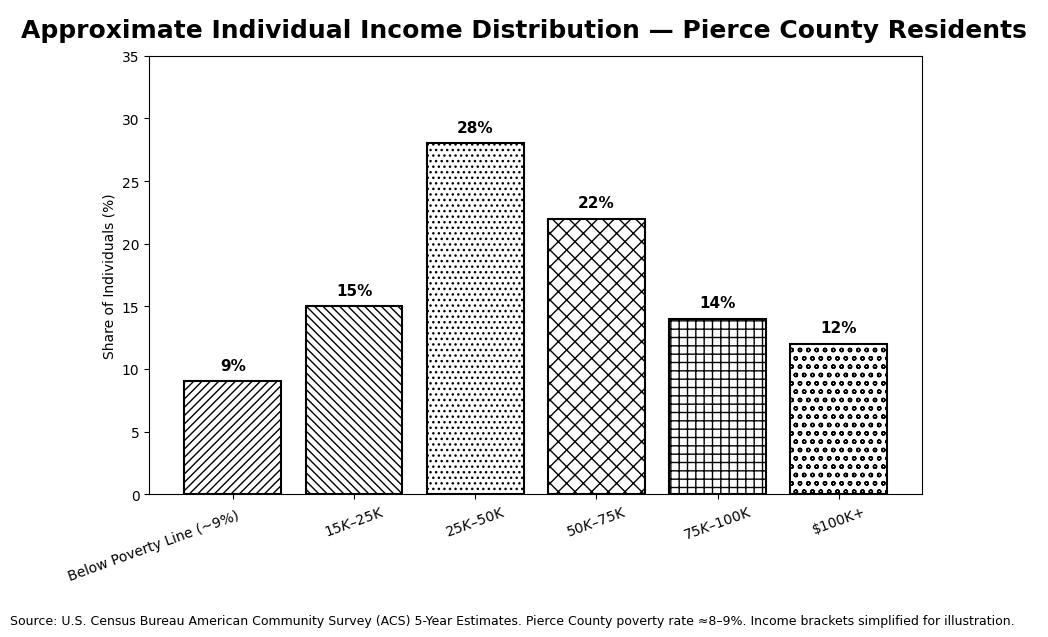
When we look at the accompanying chart, we are looking at individual income, not household income. This is a critical distinction. Household data often combines two or more earners, which can obscure what a single worker actually brings home.
The chart reveals that the most common experience in Pierce County is an individual income between $25,000 and $75,000. This is the engine of our local economy. Seeing these numbers helps de-stigmatize the struggle; if you aren’t earning six figures as an individual, you are part of the vast majority.
Reframing the Ladder
Rather than viewing income as a fixed label, the data suggests we should view it as a ladder. Economic mobility is a lived reality in Washington state, where early-career roles often serve as the first rung toward middle-income stability. Poverty is a financial condition at a specific moment in time, not a permanent identity.
The key to climbing is recognizing that the next rung is closer than it feels. For someone currently earning under $25,000, the goal isn’t an overnight leap to the top; it’s a strategic move into the $45,000–$60,000 range.
In Pierce County, these jumps are powered by specific industries that value skills over four-year degrees.
Local Paths to the Next Rung
Our region is unique because of its industrial and medical core. While “tech” gets the headlines in Seattle, Pierce County’s ladder is built on Skilled Trades, Healthcare Support, and Logistics. These fields are actively seeking workers and offer clear, upward trajectories:
* Skilled Trades: Electrical work, plumbing, and welding remain in high demand. An apprentice in these fields often starts at a wage that already sits on the second or third rung of the ladder, with “journey-level” earners often crossing into the top 15% of individual earners.
* Healthcare Support: From phlebotomy to nursing assistants, our local hospital systems are the county’s largest employers. These roles offer a foot in the door to a recession-proof career path.
* Specialized Logistics: Given the Port of Tacoma’s influence, certifications in supply chain management or heavy equipment operation can lead to rapid income increases.
Taking the First Step
Inspiration without a roadmap is just a daydream. To move between the brackets shown on the chart, Pierce County residents have access to some of the best-funded support systems in the state:
Bates & Clover Park Technical Colleges: These institutions are the primary “ladder builders” for the South Sound, offering short-term certificates specifically designed to meet the needs of local employers.
WorkSource Pierce: Located on Market Street in Tacoma, this hub offers more than just job listings; it provides career coaching and connections to “earn-while-you-learn” apprenticeships that pay you to gain a new skill.
The Eastside Training Center: a satellite campus of Clover Park Technical College located in the heart of Tacoma’s Salishan neighborhood is a neighborhood-focused resource that helps residents in Tacoma’s Eastside and South End access free or low-cost training in high-wage trades like HVAC and construction.
Financial progress rarely happens in a single bound. It is the result of identifying where you are on the map, looking at the rung immediately above you, and reaching for a local resource to help you bridge the gap. Your current bracket is not a destination. It is simply where you are starting today.