BY KEELIN EVERLY-LANG for WEEKLY VOLCANO 5/1/26 |
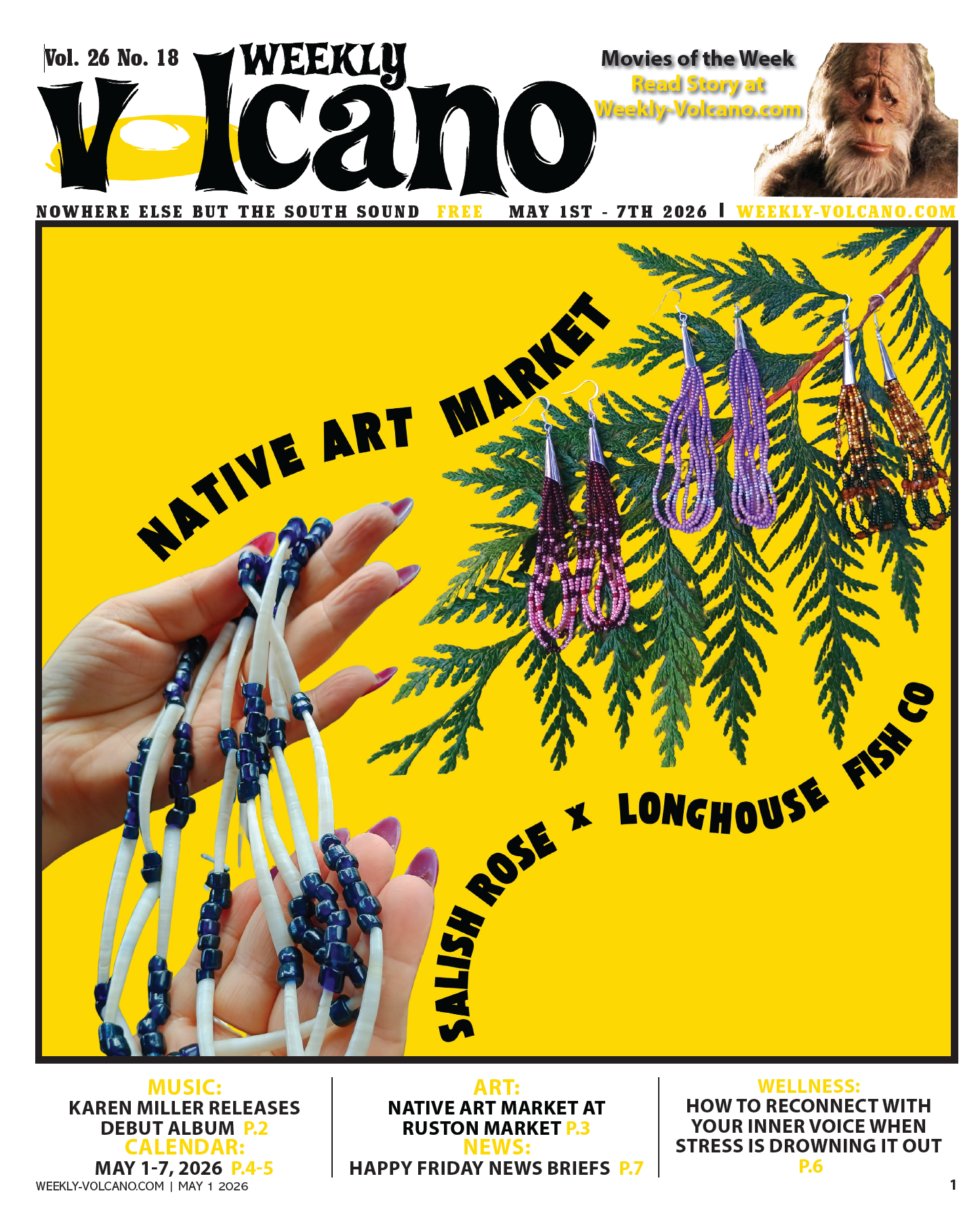
Over ten thousand years of living history and modern artistic expression will be open to the public in the first Native Art Market at the Waterfront Market at Ruston from 11 a.m. to 4 p.m. on May 2 at 5101 Yacht Club Road in Tacoma.
Although it is the first of its kind to take place at the Waterfront Market, it represents more than a century of Native communities selling skillfully and beautifully crafted items at similar markets in this area. This market will feature original works by Native artists in all price ranges, including jewelry, cards, drums, paintings, prints, carvings, weaving, textiles, clothing, botanicals, dolls, clay works and more.
Frybread tacos and smashburgers will fuel shoppers from local chef and food truck Beaston’s Grill.
Organized by Desiree Rose Fagan of Salish Rose Events and Tristian Shulman of Longhouse Fish Company, it represents a new iteration of a long history.
You may recognize Shulman or the name Longhouse Fish Company from his locally sourced salmon as a current tenant at the Waterfront Market.
Fagan is Duwamish and Tulalip and is a descendant of Chief Seattle. An artist in her own right, she creates jewelry and plant medicines. As Native artists, Fagan said “our work is ancestral, rooting from a deep cultural knowledge that has been passed down from generation to generation.”
In her earrings, necklaces and bracelets, Fagan uses traditional materials and aesthetics as much as possible, including fire-polished glass beads, mother-of-pearl and cedar.
One special material she utilizes is called dentalium, a shell that has been used in regalia and as currency in the region.
“It’s not the easiest thing to work with, actually, because you have to clean them, you have to sand them. They’re delicate, but they’re also really hardy…you have to wear a mask because the dust is toxic,” Fagan explained. Despite the challenge, she loves working with the material.
At markets, Fagan often finds herself explaining what dentalium is to visitors who stop by her table because many people are not familiar with it.
Sharing this history and knowledge can take a lot of energy but is an important part of what she does.
“I come from a storytelling family… there’s a lot of energy that goes into it because I want everyone to feel welcome who comes to my table,” Fagan said. “I like to share knowledge, I want everyone to know what I know. I’m not gatekeeping anything because that’s not our way.”
For Fagan, sharing abundance is an essential cultural value, whether that means sharing knowledge or sharing gifts with the community.
“We are potlatch people. And the word potlatch means to give.”
“Our belief is when the Creator would bless you with an abundance, it was your responsibility to give it. You keep what you need for your family, but if you were blessed with abundance, that’s not for you to keep. So there’s a big difference there, with a Western mindset and a traditional Coast Salish potlatch lifestyle,” Fagan said.
The potlatch tradition is still practiced today, especially during annual canoe journeys and other gatherings like weddings and funerals.
Having an abundance or a knowledge of something helpful and not sharing that with the community can actually make that person sick, Fagan explained.
In the context of colonization, sharing traditional arts can also bring challenges when non-Native people take advantage and try to profit off these ancestral practices.
Fagan has run into this issue locally, including an individual who used the word Duwamish in his marketing and sold art modeled after traditional Coast Salish design, despite having no Coast Salish or Indigenous ancestry. For this reason, organizing Native art markets requires some discernment and screening practices to make sure that the crafts being presented are authentic.
At the upcoming Native Art Market, Fagan said she and the other organizers follow the Indian Arts and Crafts Act guidelines.
Originally passed in 1935 and renewed in 1990, the Indian Arts and Crafts Act “is a truth-in-advertising law that prohibits misrepresentation in the marketing of Indian art and craft products within the United States,” according to the Department of the Interior.
Even a first-time violation of this law can be punishable by a fine of $250,000. Taking traditional and cultural practices without permission or consent, especially for profit, is called cultural appropriation. The opposite of this is cultural appreciation and is encouraged.
“The Native art market is welcome and open to everyone…sometimes I’ve even had that question, actually,” Fagan said, referring to non-Native people asking whether they are allowed to attend.
The answer is a resounding yes, and visitors are encouraged to learn about the items they purchase and the makers who created them.
A good way to support is to remember the name of the creator or the name of that artist’s business so that when wearing or using those items, they can share that information with those who ask.
“You’re actually modeling their work. And that, in my opinion, that’s fully just supportive. That’s not appropriation,” Fagan said.
For the Waterfront Market, the opportunity to host this event is a special one.
“We recognize the deep, ongoing history of Native communities and are grateful for the opportunity to help create a safe space that celebrates Native culture, artistry and voices,” Marketing Manager for the Waterfront Market Halie Franceschina told Weekly Volcano.
“This event is not only a market, but a meaningful gathering that highlights the beauty, creativity and resilience within the community,” Franceschina added.