BY AVERY GOODSTINE for WEEKLY VOLCANO 6/12/2026 |
With a new countywide game reminiscent of the annual Monkeyshines tradition, Visit Tacoma-Pierce County is hoping to provide a true Pacific Northwest experience for visitors coming to the area for the 2026 FIFA World Cup soccer games.
From June 1 to July 13, people are invited to search Pierce County for hidden blown-glass medallions. Along with more than 1,000 medallions, there will be a limited number of glass floats that earn the finder a special prize pack from the Puyallup Tribe Fan Zone in Tacoma. Every day, a small batch of medallions will be hidden.
At the Tribal Administration Building, located at 3001 Puyalupabsh St., fans of all ages will gather to watch the games on June 15, 19, 24, 26, and July 1 and 6.
“We have a strong belief here that Seattle will be the soccer center for all the World Cup, but Pierce County will be the place where people come to see the Northwest that people are expecting,” said Matt Wakefield, chief marketing and data officer for Visit Tacoma-Pierce County.
The medallions and floats are hidden across the county and will be in areas catered toward visitors, Wakefield said. Think places like museums, parks, scenic spots and viewpoints, and county events like Rhubarb Days, Meeker Days, and the Wilkeson handcar races.
While the Art of the Game scavenger hunt is focused on giving visitors a true PNW experience, Wakefield said they know local monkeyshiners are getting in on the action too.
“We also know that there’s a huge glass art-hunting community here, and they’re already very involved in this, and they’re very aware of what’s happening,” he said. “So if we can bring some joy to them as well, that makes us overjoyed too.”
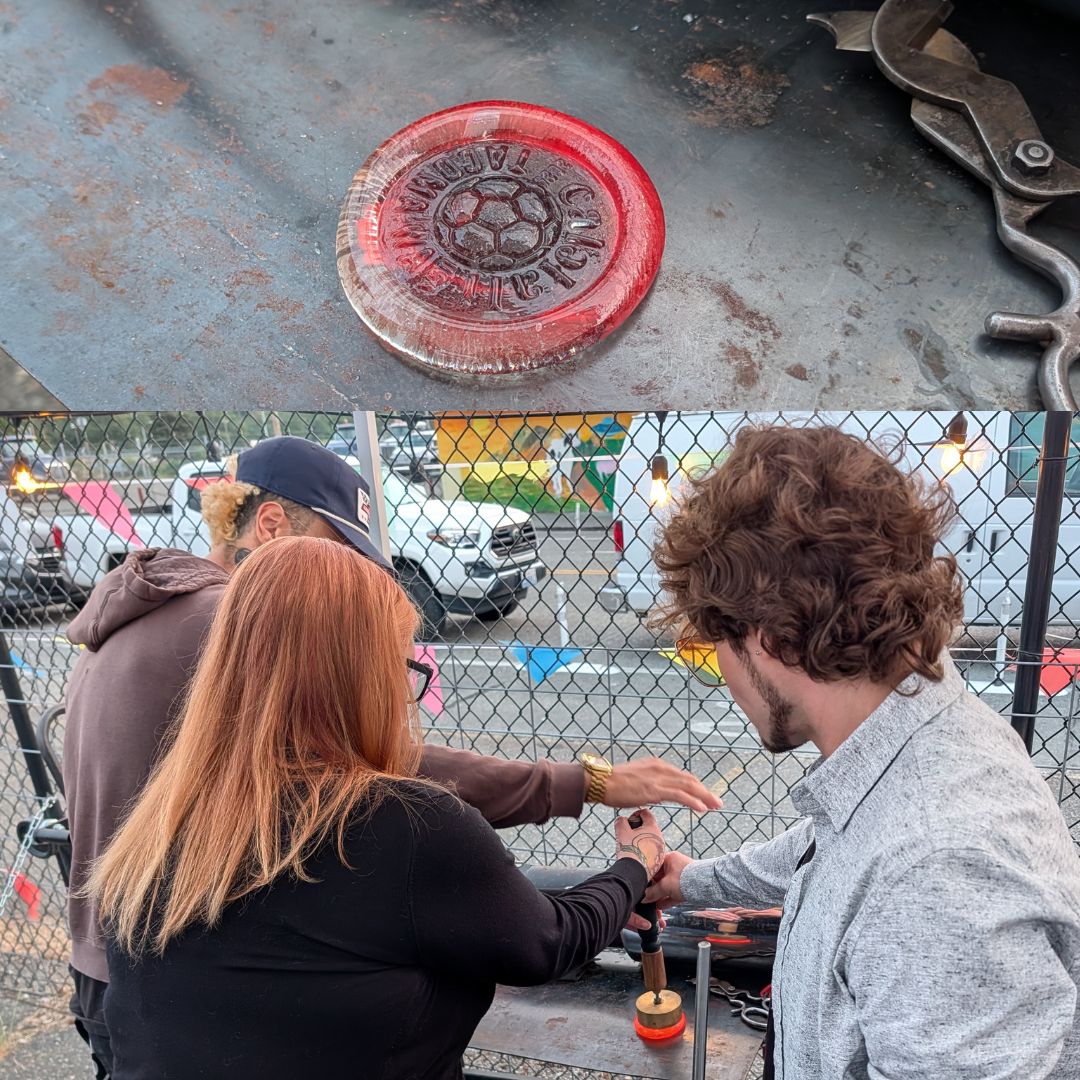
Seekers will know they found an Art of the Game medallion from the specially designed stamp and the QR code on the back.
With the Puyallup Tribe being the first Indigenous group to be a title sponsor of the World Cup, the Art of the Game logo features the Lushootseed word “caləɫali,” pronounced tsuh-LUH-ah-lee, which translates to “Land of the Lakes,” a general term for the city of Tacoma. Lushootseed, also known as Puget Salish, is spoken by most of the Indigenous tribes throughout Puget Sound.
The teal, indigo, and bright green color palette for the medallions was also carefully crafted to represent Seattle’s World Cup colors.
Anthony Remick of Puget Sound Glassblowing made a majority of the medallions and floats for the scavenger hunt. He said he was first asked to be a part of the project about a year ago, and the logo and color scheme took about six months to finalize.
Because he’s been involved with Monkeyshines since he was a preteen, Remick said he’s especially excited to be part of Art of the Game. He said as a kid he dreamed of having his own glassblowing studio, and now “it feels really good” to be a part of the community in this way.
At the Tacoma Night Market on May 30, Remick brought his mobile glassblowing equipment so that community members could try their hand at making some of the medallions.
“I like to call it the superhero effect,” Remick said. “You go out there, and, you know, not everyone knows who made it, but you’re lucky enough to stumble upon one. It’s a nice little treasure hunt.”
To make a medallion, a mound of soft glass is heated to around 2,000 degrees and rolled in colored glass granules. A chunk of the red-hot, glowing glass is cut off to be heated and flattened with a blowtorch. Then, it’s stamped and placed aside to cool.
“It’s been a fun process, and it’s been a really exciting project to be working on, and it was exciting to be able to be here with the community, having them be a part of it too,” he said, “because Monkeyshines is a big thing here, but it’s always been traditionally done by the studios around here in the area … so it’s very exciting for people to come out, be a part of it, make them, and then, you know, you don’t get to keep it, but you get to go out there and try to find the one you made.”
Wakefield said getting the locals involved by having them help create the medallions was an important part of the project as a whole. Having something made by a local that gets taken home by someone who isn’t from here adds another layer to the game.
“The public can participate and make something that goes out into the world that gets shared with someone who could be here from overseas, they could be here from across the country, or they could just be one of their neighbors,” Wakefield said. “So it’s from here, but it’s a gift to everyone.”
Another aspect of the game is to share some information on Tacoma’s rich glassblowing history. Tacoma is the only city with two museums dedicated to the craft, the Tacoma Art Museum and Museum of Glass, which are connected by the Dale Chihuly Bridge of Glass.
Born in Tacoma, Chihuly is a legendary glass artist who revolutionized the studio glass movement by elevating it into fine art. He’s a co-founder of the Museum of Glass, and his legacy is seen on almost every corner in downtown Tacoma.
Outside the museum, Chihuly’s work can be found at the old Union Station, now the courthouse, the Snoqualmie Library at the University of Washington Tacoma, and The Swiss Pub, among other places.
“I love the fact that this is not just the glass that we’re sharing, but the glass-hunting culture and the glassblowing itself,” Wakefield said. “All of it’s something we can share with people who are visiting, because if they find it, they’re given an idea of how special it is when they click on the QR code that goes to the web page for it. They’ll start to get an understanding of how much of a homegrown art and homegrown idea the hunt is.”