BY MATT KITE for WEEKLY VOLCANO | 7/3/2026
Chester Rito feels most at home when he’s telling a story. No surprise, then, that his first post-retirement gig didn’t stick.
“I was out of a job,” says Rito, 81, from his station behind home plate at Cheney Stadium. “I was retired. I was getting bored. I drove a bus for Pierce Transit for a while. That was hard work. Couldn’t tell any stories. So I called the Rainiers, who I knew were hiring in the early spring of 2010, and I asked the young lady on the phone if there were any jobs, and she said, ‘Yes, do you have any experience?’ And I said, ‘Well, not a lot of being an usher, but I did grow up in Brooklyn watching Jackie Robinson play baseball.’ What I didn’t know was that she was Ben Cheney’s niece, so I came in. Over on Union, they had an office over there. Spoke with her a couple of hours and got hired, and I’ve been here ever since.”
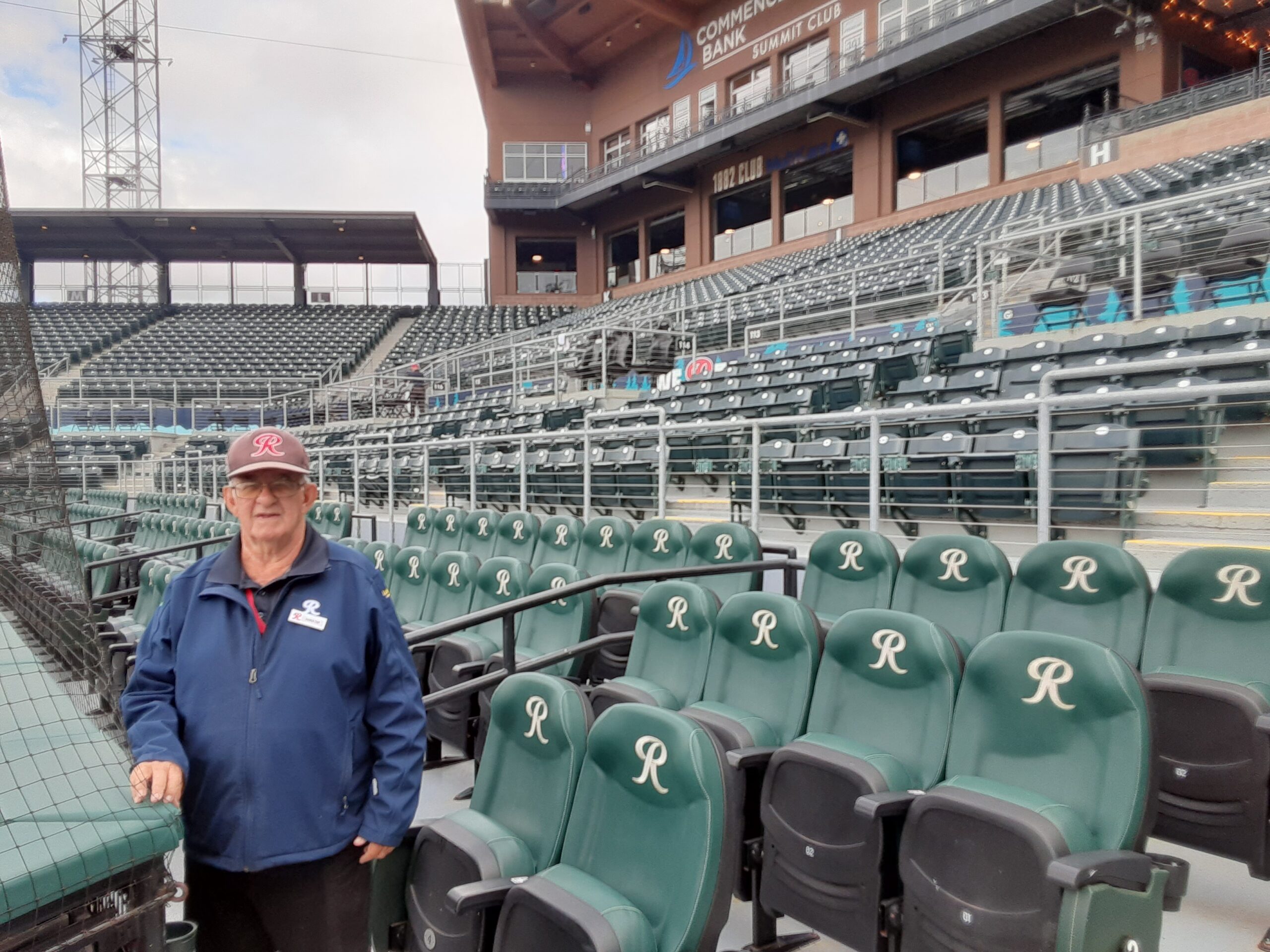
Technically speaking, Rito is an usher. Whenever the Tacoma Rainiers play a home game at Cheney Stadium, baseball fans can find him behind home plate, where he guides ticket holders to their seats, provides security, and monitors the seats in his designated area.
“I work right here,” he says while gesturing to the best seats in the stadium. “One hundred and seventy-six seats behind home plate.”
In less than one hour, the gates will open and fans will begin streaming inside the stadium. Rito has just enough time to wax poetic about the job he loves.
“We have two functions,” he says. “We take care of the people in our section, make sure they’re enjoying themselves, and we guard the dugout. People get so excited they walk out the entrance and right into the dugout without even realizing it. That’s a no-no. We’re part security. The biggest thing is we make sure people have a good time. We’re here to keep order, but we’re here to have fun. I can’t stop talking sometimes. I tell them there are three rules: have fun, this is not a day to go on a diet, and if you see the food back there, you’ll understand, and just enjoy yourself.”
But more than an usher, Rito is a storyteller, a spinner of yarns, a veritable fount of all things baseball. Call him the Bard of Cheney Stadium.
During our brief interview, he reaches back into the annals of baseball history and chronicles several stories. Some events helped shape the game. Others amount to pure entertainment. Rito tells each story with a twinkle in his eye and the youthful enthusiasm of someone who grew up watching the game in Brooklyn.
Rito came of age in the 1950s, during the heyday of baseball in the Big Apple. Until 1958, three major-league baseball teams called New York City home: the Yankees, the Giants, and the Dodgers. The latter were Rito’s team. He watched them play at Ebbets Field in the Flatbush neighborhood of Brooklyn. The Dodgers’ legendary lineup included not only Jackie Robinson but Hall of Famers like Gil Hodges and Roy Campanella.
“For nine or ten years, the World Series was in New York every year,” he says. “Right up to 1958.”
After the end of the 1957 season, the Giants moved to San Francisco, and Rito’s beloved Dodgers relocated to Los Angeles.
Suddenly, New York was without a National League team. That didn’t change until the league expanded in 1962, when the Mets franchise was born.
“I came from Ebbets Field and wound up at Cheney Stadium,” Rito says. “And that’s not a bad thing.”
Rito moved with his aptly named wife, Rita, to the West Coast, and the couple eventually settled in Tacoma in 1977. They bought a home in Lakewood and have been there ever since.
“I was a ruthless commission salesman, absolutely ruthless,” says Rito, who sold furniture for JCPenney for the better part of three decades. “I never did what I was supposed to do, but I managed to make a living, raise a family, and spend twenty-nine years there.”
These days, he hasn’t so much retired as found his true calling. Get him talking, and he’ll tell the story of Robert Cotter, an eleven-year-old Phillies fan who, in 1922, insisted on keeping a foul ball he caught and spent the night in jail as a result. After news of his mistreatment made headlines around the country, baseball adopted a custom that has remained ever since: Foul balls and home run balls are souvenirs to be taken home, not returned to the team.
He’ll tell the story of how the Pittsburgh Pirates beat the Yankees in the 1960 World Series after Bill Mazeroski’s walk-off homer. Or he’ll tell origin stories, like who became the first team to use a tarp to cover the infield during a rain delay or how the first Louisville Slugger was made.
Inevitably, he’ll quote some of the best players to have played the game. Willie Stargell once quipped that the umpire says, “Play ball,” not “Work ball.” And Rogers Hornsby, when asked about what he did in the offseason, famously said, “I stare out the window and wait for spring.”
Some of Rito’s stories sound improbable, but they’re true. Alvin Dark, manager of the San Francisco Giants in the early 1960s, joked that humans would put a man on the moon before pitcher Gaylord Perry ever hit a home run. Sure enough, twenty minutes after Neil Armstrong and Buzz Aldrin set foot on the moon in 1969, Perry hit his first big-league dinger. He managed just five more during his twenty-two-year career.
Although his wife prefers golf to baseball, Rito says he couldn’t do his job without her.
“The nights I get home at eleven-thirty, or the mornings I’ve got to get ready for work,” he says, “whatever it is, she’s there by my side.”
He also praises the Rainiers organization, which he says is top-notch from ownership on down. It takes a lot of work to prepare the stadium for every game, Rito points out, and the tireless crew behind all the fun never wavers.
So far, the 2026 season has been full of highlights. Infielder Colt Emerson earned a record contract before being sent up to the Mariners, and Mariners star catcher Cal Raleigh rehabbed from an injury in Tacoma long enough to hit several home runs, including a grand slam.
Whether it’s surprising young fans with baseball cards or talking to their parents about their favorite game-related memories, Rito finds himself invigorated by every Rainiers homestand. Every game is a little different, and every day provides fodder for a new story.
“Here at the ballpark,” he says, “you’re talking about a community. You might be sitting next to the CEO of a company. You might be sitting next to a plumber or electrician or a teacher. But the common thread is baseball, and you come in here into the stadium and you leave the world outside for just a few hours and just focus. One of the things about baseball, there’s a kid in all of us until the day we die.”
It should go without saying that Rito has no plans to retire.
“Someday it will be, ‘That’s enough,’” he says, “and it will be somebody else’s turn, but it’s tough to leave.”