BY KEELIN EVERLY-LANG for WEEKLY VOLCANO | 7/3/2026
Local artists Anida Yoeu Ali and Jesi Vega spent the past year exploring how to map the history of Tacoma’s art scene through the memories of living artists mapped onto both time and space.
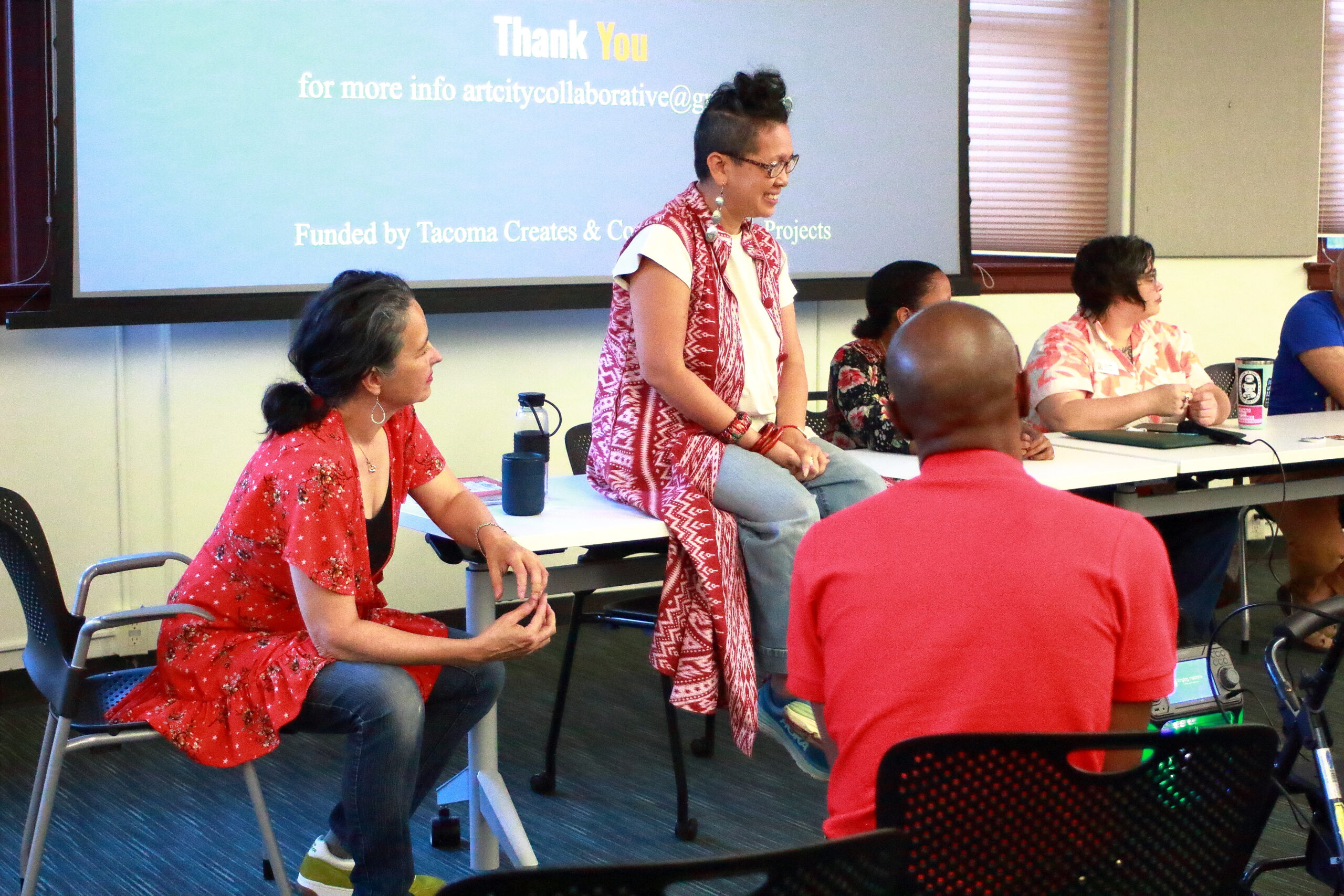
On June 16, the duo presented their ArtCity Tacoma Mapping Project to an enthusiastic audience at the downtown Tacoma library.
The project began with identifying artists who could act as a starting place in exploring this history.
Each artist was interviewed by Ali and Vega and asked to share their ten most memorable art events and provide corresponding artifacts when they could.
The result is a collection of memories mapped both onto the geographic area of Tacoma and onto a timeline, allowing various frameworks to travel through their experiences.
The first version of this project is a test and a beginning, and both artists were clear that they want to do more but need more support and funding to do so.
When they first set out to identify the artists they would like to start with, they collected a list of more than 100.
As they gathered suggestions through their interviews, that list has now grown to more than 1,000. They ultimately landed on 16 artists that they interviewed and asked for their top ten artistic experiences in the city. These memories are what ultimately made it on the map.
The goal of the project is “not only to illustrate the deeply interconnected nature of the city’s arts communities, but also to begin documenting the stories, relationships, and knowledge that have largely existed within informal and fleeting conversations,” they shared in a description of the project.
ArtCity itself was originally conceived by Ali after she relocated to Tacoma, Washington, in 2016.
At the event, Ali and Vega shared the story of how they came to start this mapping project.
“During her time living and working in Tacoma, she heard stories of an eclectic and vibrant arts scene, from heads rolling down city streets to a jam-packed party with live graffiti writers inside a small storefront. She was struck by the range and creativity of these experiences, even when they existed in fragmented or fleeting forms,” the collaborative shared in their bio.
As she deepened her relationship to the city’s art scene, she began noticing a “recurring pattern of burnout among arts and event organizers.”
This made her wonder if there was a way artists could build on each other’s work and artistic projects to support sustainable growth and community of arts rather than each artist having to “reinvent the wheel” each time.
After crossing paths with Vega, the two began to explore alternative forms of artistic ecosystems, and Ali led a trip with several other Tacoma-based artists to Yogyakarta, Indonesia, to explore “a non-Western model of a thriving city that actively centers its creative economy.”
This trip “proved catalytic and offered new frameworks for imagining a more sustainable and interconnected arts landscape in Tacoma.”
All of this led them to the mapping project.
Mapping artistic experience makes the landscape of the art community visible and could also be a way to find areas that are underserved by artistic activities.
Having a visual timeline and awareness of our artistic history means the community has something to build on.
Putting the two together gives the artistic community of Tacoma a shared ground to stand on and a way to put together a collective memory rather than relying only on individual experiences and silos of knowledge.
“We experienced so much in Indonesia that we started to think about … what would happen if we could fully understand the amazing art history that has not been made visible here?” Ali said during the presentation.
Say an artist is putting together an event but is new to the industry or area, or just unaware of the history because it is scattered and tucked away in people’s memories and attics.
Having a comprehensive and interactive historical archive and memory bank can help that artist have access to examples of other successful projects to refer to in grant proposals and when pitching plans to collaborators.
It is also an impactful way to deepen the impact of these artistic endeavors and provide inspiration for future generations to carry them forward, allowing for a continuous and shared conversation rather than a chorus of monologues.
“What we wanted to do was think about the economic growth and what it means to be a unified community … the idea of dreaming together,” Ali said. “The most important thing is, how do we move forward together, and is it possible? We know that it’s very complex, racially, class-wise, with gender issues, we have a lot, especially in America.”
Stepping out of the country, Ali said, “it almost feels like things are a little bit less burdensome, a little easier to breathe, almost, but when you come into America, there’s a system you’re kind of automatically plugged into and imposed upon, and so the question that I have is, can we move forward? But everybody knows that you can only move forward if you know your history.”
Four of the artists who participated in the project were also part of the community event on June 16. Panelists included Umi Wagoner, Tony Gomez, Katy Evans, and Joy Muhammad.
Reflecting on the experience, all four panelists said it was a good reminder of the importance of archiving their own work and lived experiences as they go. Looking toward the future, each panelist also mentioned their desire to add to the workforce development and infrastructure building for future generations of artists.
In a follow-up email to the participating artists after the event, Ali said, “it felt like the conversation needed to go much longer and further. There was so much excitement from the audience to continue this project and many audience members articulated the importance of this kind of project.”
For now, she and Vega are going to “take some time to rest, recoup, and then debrief together about next steps for both the mapping initiative and for the ArtCity Collaborative. This is not the end and we are deeply inspired by everything we’ve heard from each of you during our sit-down ‘talk story’ sessions.”
You can explore the ArtCity Tacoma Mapping Project and learn more about the ArtCity Collaborative at artcitytacoma.com.
A livestream covering almost the whole event can be found at Tinyurl.com/yms98zdm.