BY KORBETT MOSESLY
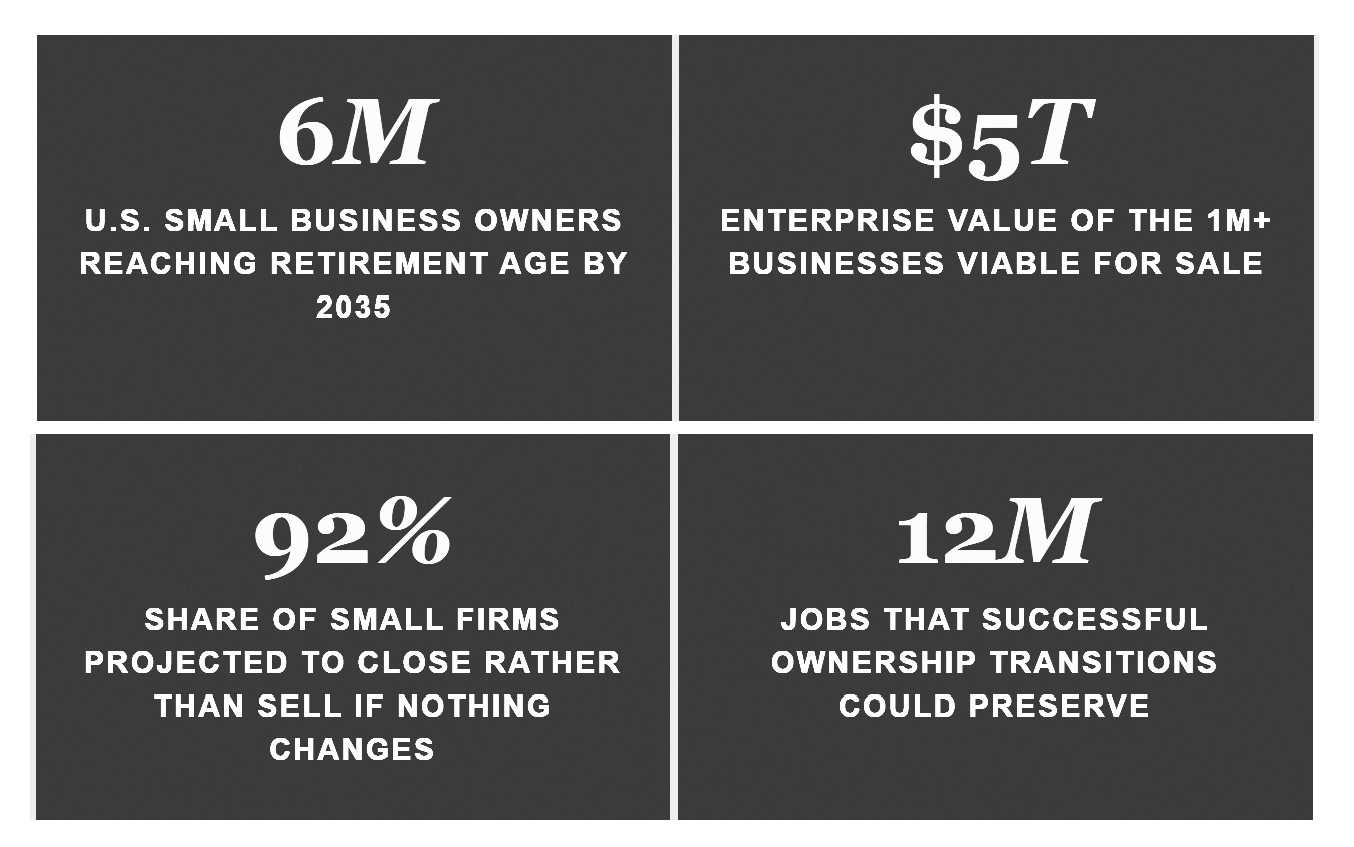
Six million small-business owners will hit retirement age by 2035, and without intervention, most of their businesses will close, not sell.
A new Washington-based pilot, Proffer Market, is betting that the capital and expertise to keep those businesses local already exist. The missing piece is connection.
Somewhere in Washington right now, a business owner is putting off a conversation they know they need to have. Not because the business is failing; it isn’t. Because after twenty or thirty years of building it, the question of what comes next feels too big and too lonely to start.
Across town, someone else is wondering what it would take to own a business like that one. Not to launch something from scratch, but to step into something real, with customers who already show up and a place in the neighborhood that already exists. They don’t know where to begin either.
Those two people are the whole story. What happens when they never find each other is what the numbers describe.
Without intentional action, many viable small businesses may close rather than transfer ownership.
McKinsey Institute for Economic Mobility, 2026
McKinsey’s researchers also name who has the most to gain if transitions work: communities long underrepresented among business owners. Every retiring owner is a potential opening for a first-time buyer who was never going to get startup capital, but might get acquisition financing for a business with twenty years of cash flow behind it.
The Market for Selling a Business Wasn’t Built for Main Street
Here is the structural problem: The systems that exist for selling a business (listing sites, traditional brokerage) were designed for larger, cleaner deals.
Private buyers and institutional acquirers chase transactions above the $5 million mark. The barbershop, the HVAC contractor, and the neighborhood restaurant fall below the threshold where anyone gets paid to work through their complexity.
This is not a story about bad programs. It is a coordination gap. The lenders exist: Acquisition financing is a core use of federal small-business lending. The brokers, advisers, and community organizations exist. What has never existed is a place where a retiring owner in Parkland and a prepared buyer in Lakewood can find them, and each other, before the closure decision gets made by default.
SBA 7(a) Loan
The federal government’s main small-business loan program. The Small Business Administration guarantees a portion of a loan made by a bank, which lets lenders say yes to deals they otherwise wouldn’t, including loans to buy an existing business from a retiring owner.
The Lending Capacity Congress Built
The financing that makes a Main Street acquisition possible is not an accident of the market. It is a policy choice with a date on it. On September 27, 2010, President Barack Obama signed the Small Business Jobs Act at the White House, a law that permanently raised the maximum SBA 7(a) loan from $2 million to $5 million, more than doubling the size of the deal a bank could finance with a federal guarantee behind it.
The same law raised microloan limits for entrepreneurs in underserved markets and expanded how many businesses qualified for SBA lending at all. Sixteen years later, that $5 million ceiling is the quiet architecture under nearly every owner-to-buyer transition in this story: It is the reason a first-time buyer with a solid plan can finance the purchase of a $3 million business instead of watching it close.
Which sharpens the point. The credit capacity was built in 2010. The retirement wave was visible for a decade. What was never built is the layer that connects them, and that is the gap a Washington pilot is now testing.
September 27, 2010
President Obama signs the Small Business Jobs Act, permanently raising the maximum SBA 7(a) loan from $2 million to $5 million.
February 2026
The McKinsey Institute for Economic Mobility publishes its Great Ownership Transfer research: six million owners approaching retirement, most businesses projected to close rather than sell.
2026
Proffer Market launches its Washington-only pilot connecting owners, buyers, lenders, brokers, and community organizations.
2035
The retirement wave crests. What share of these businesses transferred, and to whom, will be settled by then.
What Proffer Market Is and What It Isn’t
Proffer Market, launching as a Washington-only pilot, is a community and technology platform connecting the people an ownership transition actually requires: owners thinking about what comes next, aspiring buyers, the lenders who finance acquisitions, licensed brokers, experienced advisers, and the community organizations already doing this work on the ground.
The platform is explicit about its limits, and that candor is worth noting. Proffer Market is not a broker, a lender, or an adviser. It does not sell businesses, fund deals, or value companies. It connects members with independent, licensed professionals and gives them tools to run their own process. Every credit decision stays with the lender; every representation agreement stays between the client and the broker.
“The capital, the expertise, and the will to do this already exist in Washington. They’ve just never been connected in one place.”
Every Seat at This Table Is Already Filled by Someone in Your Neighborhood
- Business owners: Build a private profile and get organized at your own pace, whether retirement is two years out or twenty. Nothing goes public until you say so.
- Aspiring buyers: Learn the process before you’re in the middle of it, build a profile that shows sellers you’re serious, and connect with lenders who understand acquisition deals.
- Lenders: Meet prepared, screened borrowers with context attached instead of cold applications.
- Licensed brokers and advisers: Put your practice where owners and buyers are preparing, before they’ve signed with anyone.
- Community organizations: Extend the trust you’ve already built. Your clients connect to lenders, brokers, and advisers through something you’re part of.
A Pilot That Chose Small on Purpose
Proffer Market is starting in Washington deliberately: local, transparent, and built alongside the people using it. The founders’ stated position is that who buys a business matters as much as whether it sells. For communities that have watched local ownership convert into absentee ownership one sale at a time, that distinction is the entire question.
Succession takes time, honest preparation, and people in your corner. No platform changes that. What a platform can change is whether the owner putting off that conversation and the buyer wondering where to start keep facing it alone.
Where These Numbers Come From
Ownership transition projections, enterprise value estimates, closure rates, and jobs figures: McKinsey Institute for Economic Mobility, “The Great Ownership Transfer,” February 2026. SBA 7(a) loan limit history: Small Business Jobs Act of 2010, Public Law 111-240, and White House and SBA implementation summaries. Platform structure and role descriptions: Proffer Market launch materials, 2026. Proffer Market is a technology platform and community, not a broker, lender, or adviser, and professionals in its directory are independent third parties.
For more information, visit proffermarket.com.
This story was republished with permission from Opportunity Links. For more info visit olink.news.