BY KEELIN EVERLY-LANG for WEEKLY VOLCANO | 8/21/2026
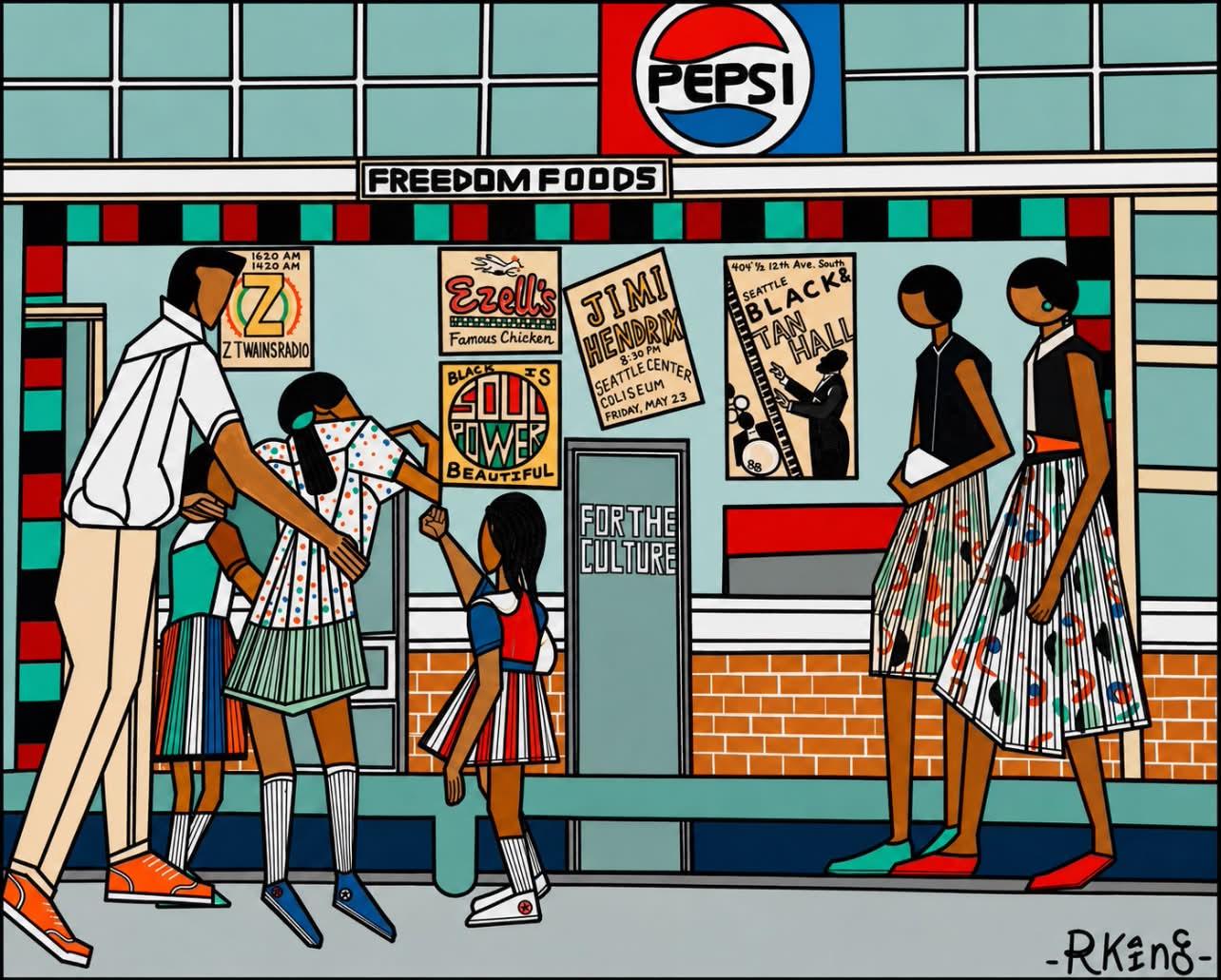
A visual storyteller with a distinctive style, Rodney King’s paintings could bring to mind distant echoes of artists like Basquiat, Jacob Lawrence, Ernie Barnes, or Piet Mondrian, but his biggest inspiration comes from local Black culture, history, and community.
King is a Pacific Northwest artist with work all over Pierce and King counties.
His family is one of many with historic connections to the Central District of Seattle but was forced to move out of the neighborhood and the city due to rising housing costs or other systemic pressures.
Today he stays connected to that community through art and events while also building connections farther south. He currently lives in Puyallup, and his day job is in Tacoma, but his artistic work has also been seen all over the city too.
So far this has included an installation in the Woolworth windows through Spaceworks, art on the walls of Intentions Juice and Smoothie Bar, as well as collaborations with ETC, Black Night Market, and the ACE program at the Tacoma Armory.
King’s style celebrates big, bold shapes and colors with meaningful details layered in.
Within his paintings, viewers are going to see “figures with different subliminals within the image . . . I like to have different Easter eggs in my paintings,” King said.
These details are often nods to the history of the area or of Black history around the country. Some details point to shared Black culture, getting specific enough to tell a story while also keeping figures, faces, and scenes ambiguous enough that they can connect many different people in different ways.
Painting is a powerful tool for storytelling because “the visual . . . it speaks louder than words, literally, because it can convey so many more emotions and reaches all ages,” King said.
Sometimes he’ll see someone looking at one of his pieces and start to share background information about the piece, only to find that the viewer already understands exactly what he was trying to communicate.
“In certain communities, they’re like, I know exactly what it is. This piece is my mom back in 1973 and this and that . . . because they identify so much with the piece,” King said.
King said he appreciates that while parents might identify with the details and story behind a piece, the bright colors and energetic geometry of the pieces also communicate across generations and allow younger audiences to connect to his work as well.
King’s work is currently displayed at several places in the Central District in Seattle, including Wally’s NW Soul, Cafe Avole, and Made Space.
King has also helped to start the Central District Art Walk every first Friday, which will celebrate its two-year anniversary in September.
He’s also spent months preparing for an upcoming gallery show at Slip Gallery, located at 2301 1st Avenue in Seattle. Slip is a “community-focused and community-funded gallery in the heart of Belltown” sponsored by nonprofit Belltown Art Walk.
The show is titled “Cut the Red Tape” and will be hosted by King and Jonarra Swanson starting on Sept. 11.
Much of King’s work features nods to history and balances calling out injustice with celebrating vibrancy and joy specifically in the Black community. This project focuses specifically on the historic practice of redlining: the systemic property assessment practice used to push segregation and limit access to homeownership by race.
Redlining is now used to refer to a variety of housing discrimination tactics, but specifically refers to the “Residential Security” maps of major American cities created by the Home Owners’ Loan Corporation (HOLC) in the 1930s. The maps were supposed to assess the riskiness of home loans in various neighborhoods, but in practice included clearly race-based assessments.
The economic impact of these practices can actually be assessed and measured.
A study by ECONorthwest found that “King County’s BIPOC households would hold between $12 and $34 billion in additional wealth today. The average forgone wealth translates to a range of $105,000 to $306,000 per Black household and between $32,000 and $85,000 per other non-white household (2019 dollars).”
In Tacoma and Pierce County, more than 5,400 properties specifically included racial restrictions in their deeds, according to research by the University of Washington.
In Tacoma’s History of Racial Exclusion, Segregation, and Housing from the UW, the history of the fight for racial equity in the region highlights how John Conna, from one of the first Black families in the city, “helped campaign for, write, and lobby the Public Accommodations Act,” which made it illegal to discriminate based on race.
Today, the regional history of discrimination as well as the legacy of strength and joy are preserved through research initiatives and through the visual language of artists like Rodney King.
In his research for the upcoming show at Slip Gallery, King shared that he’s deepened his knowledge of historic celebrations and community events, as well as of how the area has been systemically sabotaged in various ways throughout the years.
Art can be a really valuable tool for exploring these topics because it can build bridges between communities or start conversations in unexpected ways. This has definitely been true for King as his art career has blossomed in unexpected ways.
“What’s surprised me the most . . . it puts you in rooms that you would have never seen yourself in . . . it just connects you to people that you wouldn’t have been able to even talk to,” King said.
Through his gallery shows and the doors that his art has opened for him, he’s had the chance to see how much people outside of his community love his art too.
“You just don’t realize how that art speaks and resonates to different people,” King said.
While he does hope to live in the CD again someday, King celebrates the community he has built throughout Tacoma, Pierce County, and King County. Moving forward, he hopes to be blessed with the resources to focus on art full-time so he can put even more energy into his work.
To see more work from Rodney King visit his Instagram: @_kingspen