BY KEELIN EVERLY-LANG for WEEKLY VOLCANO | 8/21/2026
If you’ve ever been handed a list of resources, only to find out that many are outdated or irrelevant, you’re not alone.
Contact information and services, or even the existence of community and social programs, tend to ebb and flow, often changing faster than directories can keep up.
Either that or no comprehensive list exists at all, and those needing support find themselves on a scavenger hunt looking for help.
Pierce County is looking to solve this problem for young people and those who support them with the launch of its new, searchable youth services directory.
“This resource page is part of a broader shift in how we communicate across the County, which is built around one question: how do we connect people to the information or help they need, easily and quickly?” Pierce County Executive Ryan Mello said in a press release on Aug. 6.
“Helping youth to thrive is one of our most important Forward Together priorities and it’s important to share what that work looks like. Whether it’s a school counselor or a parent, people need to be able to find help in a few clicks, not a few weeks,” Mello said.
The directory has two goals: to connect people to resources and to provide transparency about how taxpayer money is being spent.
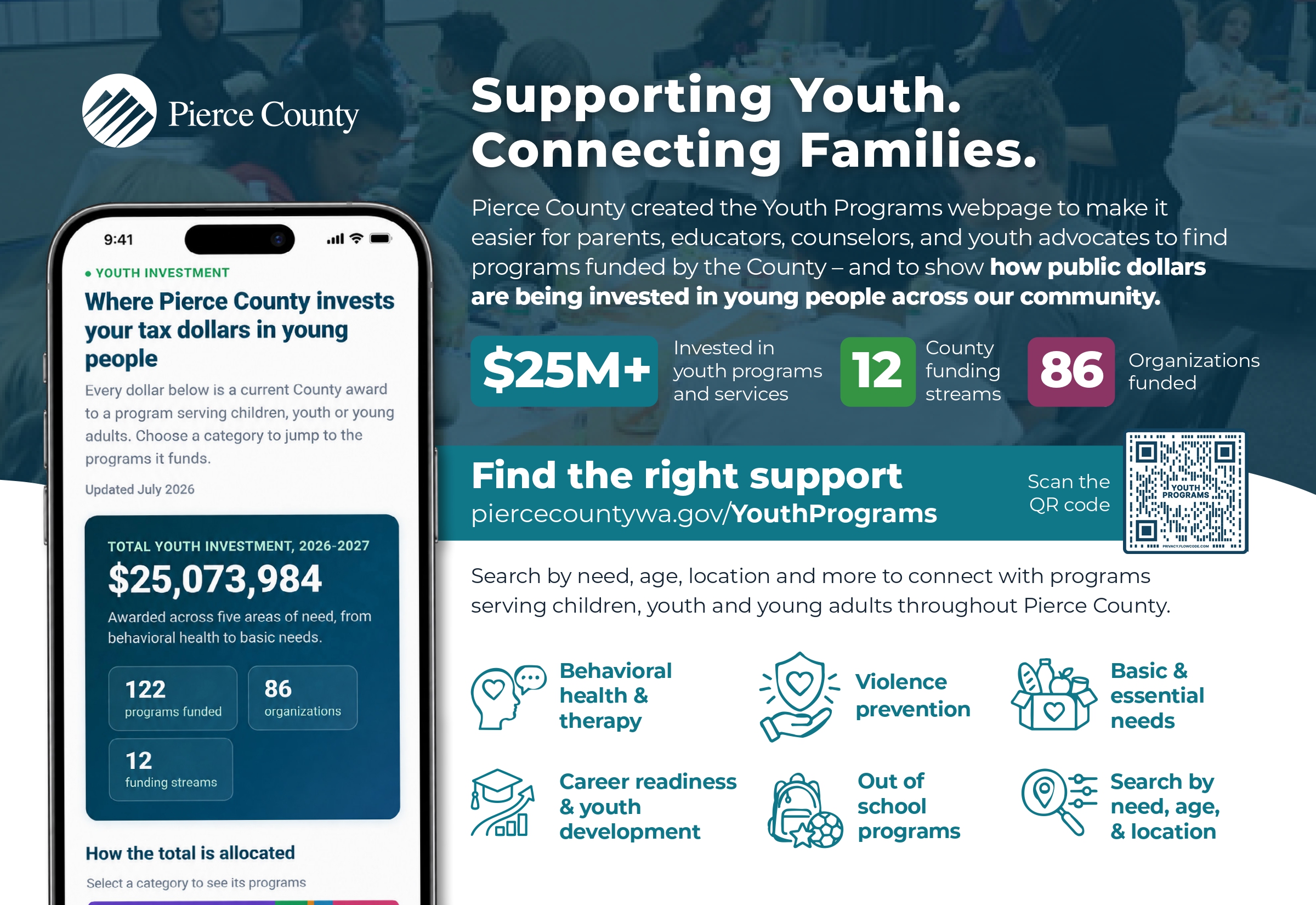
The Youth Programs and Services Resource Page includes more than $25 million in investments across 122 active programs operated by 86 organizations and supported through 12 funding sources.
Youth in Tacoma have a broad variety of needs, and there are many organizations working to help meet them.
County spokesperson Kari Moore described Pierce County’s youth landscape as “defined by a proactive, community-partnered network attempting to balance urgent crisis response (housing, behavioral health, violence prevention) with long-term resilience building (vocational training, arts, and free transit access).”
Seeing all these programs in one place makes the sheer creativity and diversity of the community stand out.
Programs are available for a wide range of ages, with some even serving those in their mid-20s. Young adulthood is often a time when young people can lose school or family support but still need resources, so this is great to see.
From paid environmental workforce opportunities like the Washington Conservation Corps to behavioral health programs that work to empower and uplift court-connected youth, to community gardens and culinary skills classes, to support programs for survivors of domestic violence, there is a huge variety.
As Moore said, some of these resources are critical tools that could make a life-changing difference for youth in crisis at an impactful moment.
Without a directory like this, some programs could be easily found with a quick Google search, but many of the smaller programs wouldn’t have come up at all. Transparency in government spending is also something that may exist on paper but is typically challenging for the average person to access and comprehend.
The directory has only recently launched, so the direct impact is hard to quantify, but there is research in other places on the impacts of directories that do not have an easily accessible interface or are not up to date.
While there isn’t a huge vault of research on exactly how harmful this can be, one evaluation of mental health navigation tools in Australia found that the variability of the tools could actually make access harder by creating more confusion.
Some specific issues that came up in the research included “inconsistencies in tool formats, resulting in variable information quality and validity; a lack of regularly updated service information, including wait times and availability for new clients; insufficient details on program exclusion criteria; and limited accessibility and user-friendliness.”
This means that whenever a resource is being created, remedies for these issues should be included in the planning.
In Pierce County, a press release about the new directory highlights the county’s intention to design it in a user-friendly way.
“This new resource is built to accommodate how users actually search for information, removing bureaucratic barriers,” the county said in its press release. “Specifically, the page groups programs into five service areas that young people and their families most often rely on, making it easier for them to search for exactly what they need.”
The five search categories include Behavioral Health and Therapy, Violence Prevention, Out-of-School Programs, Basic and Essential Needs, and Career Readiness and Youth Development.
Programs can also be filtered or sorted based on a variety of other factors, like age, area, availability, and funding source.
Each listing includes “the lead organization, eligible age groups, service area, funding source, award amount, and a direct link to the provider.”
Gathering all of this information wasn’t easy. County spokesperson Kari Moore told Weekly Volcano that the website “pulls from multiple funding streams, departments, and branches of government, so gathering the information directly from staff (compared to an automated system we plan to have soon) was more time consuming than we anticipated.”
To make sure the directory stays up to date, Moore shared that the county is currently working on a plan with the finance department to automate the information directly from approved contracts and awards that are already in its system.
They also anticipate “updating the resource a few times a year to ensure things are up to date.”
The new resource directory can be accessed at piercecountywa.gov/9107/Youth-Programs-and-Services-Resources.
This story is part of an editorially independent series of solutions-focused stories about resources in Pierce County, funded by our Resource Section sponsor Check-In With Yourself WA.
Reach out to keelin@weekly-volcano.com with story pitches or to share your experience as a young adult accessing resources in Pierce County.