BY AARDE WRITES for WEEKLY VOLCANO | 10/9/2026
Hey Aarde,
I do not like seeing myself in pictures. But my family demands I participate. What can I do to get more comfortable in front of the camera?
Signed,
Thicker than a Sticker
Hey Thicker than a Sticker,
I’ll bet that you’ve heard the adage that a camera puts on fifteen pounds, right? Well, a camera can distort images through composition, focal length, and distance, which can make the subject look bigger, but it can also do the opposite. If these factors are taken into consideration, they can actually be used to complement the subject.
Obviously, you don’t always control the photographer or their skill set, especially when they are usually a friend, child, husband, or stranger, and no one wants to shout directions at the cameraperson. But you can work around it: control your pose, find your own light, and get more comfortable with your smile, essence, and bravery.
There’s something else worth remembering: nobody in your life experiences you as a still image. They experience you in motion. Your face changes when you laugh, listen, talk, tease, concentrate, or light up when someone walks into the room. A photograph can catch a fraction of a second that doesn’t particularly resemble the whole of you. Don’t confuse one frozen millisecond with what you actually look like to the people who know you.
Your family is right to ask you to leave tangible evidence of your existence in their lives. Guaranteed, when they look at photos of you, they don’t see what you see. They smell the oatmeal recipe that only you can make. They hear your real laugh, the one that comes from your belly. They remember the time you taught them to drive, wringing hands on your lap. They see the time they watched you through a cracked bathroom door as you brushed your hair before bed. A photograph can show them the way you make them feel: safe, loved, challenged. And someday, when you’re gone, they will sit with a photo of you, hold it to their chest, and breathe in the love all over again.
You see, photos give your brain sensory information that a thought alone usually doesn’t. They act as a caveat to the details your memory might forget over time. You might spot the silver and turquoise ring you wore every day for a decade, sparking the memory of the time you lost it on a camping trip, and had the whole campground looking for it only to find it in the rolled hem of your pants.
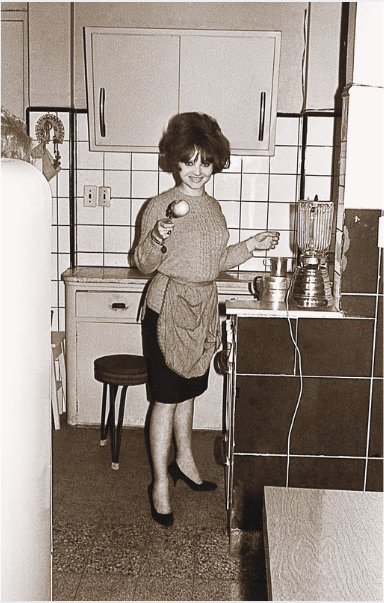
And it isn’t always about the person in the photo. Sometimes it’s the room, the house, or even the town where the photo was taken that brings everything rushing back. Haven’t you ever looked at a photo from childhood and suddenly had a cascade of memories? “This was taken the year my dad broke his leg, and we ate ice cream for a week straight. My brother graduated high school, and I was dating that BMX guy, Ronnie.” And somehow, all of that came flooding back because you saw a photo of your mom standing in the kitchen, wearing her silly “beach body bikini” apron.
So, let’s talk about ways you can leave the same experience for your loved ones by getting more comfortable in front of the camera.
Please read this twice: looking good and being worth photographing are two entirely different things. There is no shame in wanting to look good in a photo. However, it is self-deprecating to spout negative words or behavior about being in one. This isn’t vanity; it’s learning to love and appreciate yourself. You don’t have to abandon your desire to look good in a photo, so let’s improve your odds.
Turn, don’t square up. Instead of being a rectangle in the frame, try creating triangles. Use your arms and legs to create interesting angles. Bend an elbow, shift a hip, angle a leg.
Weight on the back leg. Bringing a relaxed leg forward and leaning back creates dimension.
Chin forward, then slightly down. Think forehead forward, chin down; this defines your face and catches better light.
Find the soft light. Hold up your palm and slowly turn. When it glows without harsh shadows, stop; you found it. Put your face there.
Back up; zoom in. Ask the photographer to step back and use 1× or 2× for less distortion and more natural proportions.
Keep the camera near eye level. Eye-level angles prevent distortion and create more natural-looking proportions. If someone is taking a photo from below, kindly ask them to bring it up for a more flattering result.
Give your arms some space. Create space with your elbows. Pockets, belts, scarves, collarbones, and hips give wandering hands something to do.
Move, don’t pose. Natural movement captures you better than holding a rigid pose. Shift, turn, laugh, look away, look back. Even supermodels need more than one shot.
Relax before you smile. Relax your jaw, exhale, and let your real smile emerge. Try closing your eyes until the countdown hits one.
Don’t inspect. Stay present instead of turning every photo into a self-scrutiny audit. You’re training yourself to fear the outcome.
It will help if you stop requiring every photograph to earn the right to exist by making you look beautiful. You don’t have to love how you look in every photo for that photo to still be worth having. And it takes practice to get comfortable being the focus, especially if you’ve spent much of your life putting other people’s needs ahead of your own. So, if it helps, think of that practice as a gift to the people who love you, one that will outlast your physical presence.
And, frankly, some pictures are just terrible. And we should laugh at them because they don’t truly represent us. They are a fleeting comedy in a lifelong string of events.
So, you beautiful sticker, be in the picture. Let your arms be there. Let your stomach be there. Let the smile you’ve spent years criticizing be the same smile your children recognize from across a crowded room. Someday, nobody who loves you will care whether the camera caught your best angle. They’ll just be grateful it caught you.
Do you have a question for Ask Aarde? Email jdaarde@gmail.com