BY KRISTIE WORTHEY for WEKLY VOLCANO
For vendors, opening the doors is less a beginning than the start of the second act.
They’ve packed boxes, loaded cars, and hauled tables across parking lots. Experienced vendors unpack with the efficiency of a well-rehearsed stage crew, making every square inch of display space count. Newcomers are still negotiating with the laws of physics. They shift merchandise, rearrange displays, and finally get everything just right. Then the card reader loses its signal.
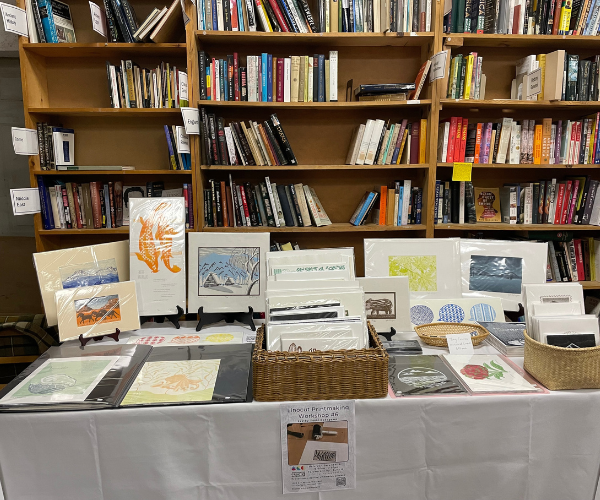
Shoppers arrive to find tables filled with original prints, handcrafted goods, and ideas brought to life months earlier. What they don’t see are the months spent designing, creating, and preparing those items, the money invested, and the hope that one of their creations will make someone stop, smile, and reach for their wallet.
Shoppers have their own frustrations: crowded stores offering the same choices and the annual struggle to find something for the person who already has everything. It’s little wonder so many of us retreat to Amazon and other online retailers, where holiday shopping can be accomplished without leaving the couch.
Step inside one of Tacoma’s November craft fairs or markets, and something is bound to catch your eye. A closer inspection might lead to a conversation with the person who made it, a new appreciation for their work, and the discovery of something you didn’t know you were looking for.
Arts at the Armory, Nov. 14-15, and the Tacoma Is For Lovers Artist Craft Fair at King’s Books, Nov. 21-22, give local makers an early opportunity to reach shoppers before the holiday market season gets into full swing.
Tacoma printmaker Yoshi Nakagawa has spent 27 years learning the business of making and selling her work. For years, she supported herself through horticultural work, landscaping, and agriculture, making prints whenever she could.
Then she moved to Oaxaca, Mexico, intending to teach English. Instead, she discovered a thriving printmaking community where artists shared presses, collaborated on exhibitions, and sold their work through galleries and markets.
Drawing on her experience at farmers markets, Nakagawa began organizing printmaking fairs where artists could sell directly to customers without surrendering gallery commissions.
Artists kept their earnings, and customers met the people who created the work. There’s something to be said for knowing the person who made your print as well as the farmer who grew your carrots.
Back in Tacoma, Nakagawa built a full-time career around printmaking, exhibitions, commissions, workshops, and markets. It isn’t quite the romantic occupation some people imagine.
“A lot of people are like, ‘Oh, you’re so lucky, you get to do the thing that you love to do.’ But actually, it’s a lot of office work, and I don’t produce as much as I did before, or as much as I’d like to,” Nakagawa said.
That office work includes choosing markets, calculating expenses, preparing inventory, and maintaining customer relationships.
Even applying for a market requires some homework. Application fees and booth fees aren’t necessarily the same thing, and vendors can find out the hard way that an application fee doesn’t necessarily guarantee them a space.
Nakagawa has learned to be selective. She avoids larger Seattle-area art fairs where booth fees can reach $1,000 or more: “Maybe I would sell enough art to make up for the booth fee, but it’s just not worth it for me.”
At Arts at the Armory, Nov. 14-15, Nakagawa will have a 10-by-10-foot space to display her work. On Nov. 22, she’ll participate in the Tacoma Is For Lovers Artist Craft Fair at King’s Books. Her holiday schedule continues Nov. 29 at the Tacoma Winter Market at Sons of Norway in Tacoma’s Hilltop neighborhood.
Because she produces original prints in limited editions, Nakagawa can replenish popular images rather than create an entirely new inventory for each market season. After an event, she packages the remaining work for the next.
Sales don’t always happen on schedule. Nakagawa remembers a customer who admired an original print priced at $120, but wasn’t ready to buy it. A year later, the customer returned, having spent the intervening months saving for that one print.
At Tacoma’s Springtide Press, Jessica Spring has found that collaboration can keep the creative juices and the printing presses running. Spring, who taught at Pacific Lutheran University for nearly 16 years, works in letterpress printing, creating artist books, posters, and other printed pieces. Her work is collected by libraries and special collections.
On Nov. 22, Spring will be at the Tacoma Is For Lovers Artist Craft Fair at King’s Books with “Queer Tails,” a series of limited-edition prints celebrating queer critters in the animal kingdom. The collaboration brings together illustrator Audra Laymon, researcher and King’s Books owner sweet pea Flaherty, and printer Spring, who produces the five-color prints at Springtide Press using reduction linocuts and handset wood and metal type.
She has also worked with Nakagawa on “Matsutake (Friendship),” combining printmaking, poetry, and letterpress.
“I feel that often the sum of a collaboration is so much better than any one part,” Spring said.
Her printing press also gives her a way to respond to current events. Since 2024, Spring has created a monthly series of protest posters using historic wood type, documenting the type in her collection while expressing her views.
Known historically as broadsides, such printed sheets have carried political messages and public announcements for centuries. Spring’s contemporary versions have found an audience among people who take them to demonstrations or appreciate their messages. She’ll have a selection available for purchase at the Nov. 22 craft fair.
For Spring, seeing a print in person is part of the experience.
“You can look at all the prints in books, and they’re beautifully photographed, but it’s just not the same experience as actually seeing it in person and having that sense that you’re just that far away from the person that created it,” Spring said.
When asked what advice she would offer someone wanting to sell their work, Spring answered: “I think the more important question is, how do you decide what to make?”
Her answer begins with making something that matters to its creator, whether it addresses an issue, solves a problem, or simply brings someone pleasure. Making something because “people really like foxes right now” might lead to a sale, but Spring questions whether that’s enough: “Maybe you’ll have one success that way, but I just don’t believe that that feeds your soul.”
Whether they’re making prints, pouring candles, carving wood, or assembling Christmas ornaments at the kitchen table, vendors face many of the same challenges. There are materials to buy, prices to calculate, inventory to prepare and, eventually, customers to find.
The wreaths, carols, and twinkling lights will have their turn. For now, Tacoma’s November markets offer a chance to meet the people whose work may eventually find its way beneath the tree … or on your wall … or being waved in the street.