BY AARDE WRITES for WEEKLY VOLCANO 5/15/26 |
Hey Aarde,
I have some trees along my property line with branches hanging over the sidewalk. As much as I love the English garden aspect of my yard, I think my neighbors have complained to the city, and I got a violation with directions to cut them back or face a fine! It just kills me to think about cutting them. I would hate to cut them back wrong and kill the trees! It also infuriates me that my neighbors couldn’t just talk to me directly and had to go tattle, especially when I offer a little library with a bench to rest, and a fresh bowl of dog water every day. Why can’t we all coexist with nature and each other?
Signed,
Annoyed Neighbor
Hey Annoyed Neighbor,
Boy, do I understand your predicament. You work hard to create a space that all creatures can enjoy, big and small, with compassion as the intent, and it goes unnoticed, or in this case, punished! It sounds like you’re enjoying the whimsical privacy that an English garden offers, yet still have to deal with outsiders who do not share your vision of a charming stroll under the dappled light of a maple tree. Alas, here is the issue. Even though we share our spaces with the many people who make up our city, each one comes with their own preferences for aesthetics, and all require safety of passage.
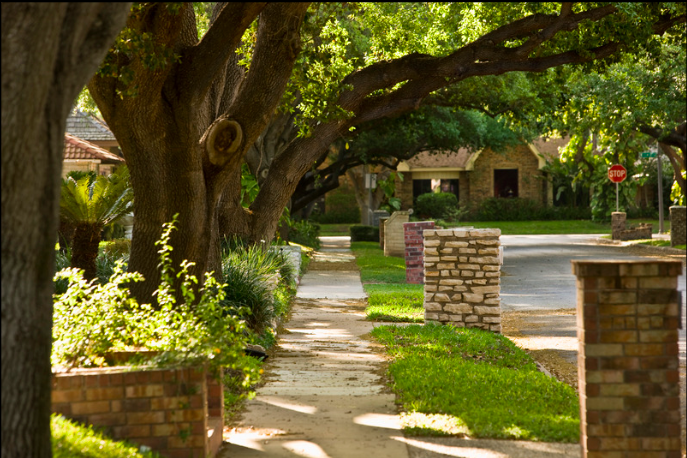
A tree with low-hanging branches might be a wonderful slice of nature. Still, when it’s over a sidewalk, it can create several practical and safety issues, mainly pedestrian clearance and accessibility. Not all passersby are on a stroll, and not all can duck accordingly. Taller walkers, children not paying attention, people carrying umbrellas or packages, special needs neighbors, or anyone on a bicycle will all face some level of discomfort while using a common space meant for all. Branches can also block visibility for pedestrians and drivers alike. Consider that during winter storms, a low branch may sag when wet or loaded with snow, creating an even lower barrier to traverse, or a weighted branch may break completely, becoming a trip hazard and impeding travel on that block. If your sidewalk is next to a parking lane, you now have to worry about branches scratching cars or interfering with mirrors.
Theoretically, the city may be responsible for accidents that occur on public land, such as city sidewalks, so it makes sense that they would have required minimum sidewalk clearances set. To limit the money spent settling cases, they ask residents to help maintain these spaces, especially when the problem is rooted on “your” property, say if the trunk is in your yard, yet the branches hang over the sidewalk. Keep in mind, there may also be conflicts with nearby utilities. Safety concerns may arise when a streetlight, power line, or phone line has obstructed access or functionality from lingering limbs.
As for your concern about hurting the tree, trees have been pruned for a long time and have survived, so it is about trimming them properly. You’re truly a nature lover when this is a concern, and I commend you for it. We have all seen the topped trees around town that make you cringe as if seeing an open wound, an aesthetic that no one wants. The goal in trimming the branches is to keep the tree looking as natural and loose as possible. Beyond hiring a professional certified local arborist, such as Apex Tree Services, Tacoma Tree Service, or Family Tree 253, here are some tips to research on how to properly remove branches while staying in line with your garden scape:
Find the branch collar, a slightly swollen area where the branch connects to the trunk or larger limb. Find the branch bark ridge, if you can, the rough, raised line that runs along the top where a branch joins the trunk.
Use sharp tools and techniques that avoid tearing the bark. Cut just outside the collar. Do not cut into the swollen area or leave a long stump.
Use a slight angle, not a steep one, when cutting the branch from the trunk or larger remaining limb. This prevents water from penetrating the tree’s exposed skin. Think of the cut as slightly downward and away from the branch collar.
Use the three-cut method to prevent bark tearing on larger limbs: make an undercut first, then a top cut farther out, and finally a final cut at the collar.
Remove only a few low branches at a time. Move slowly when identifying which branch is the culprit violator. Step back often while pruning to get a macro sense of each micro cut. Eliminate limbs that rub, cross, or congest the other limbs.
Keep soft edges by avoiding rigid geometric cuts and allowing some branches to arc naturally, leaving a few limbs gracefully draping where clearance allows. Thin individual branches first to preserve a softer, more natural shape instead of cutting everything to a flat line. Follow the tree’s natural growth habit and trim any excess sucker branches that impede the limbs that show longevity without encumbering the path. Raise the clearance enough for safe passage, but avoid stripping the lower canopy too aggressively.
To conclude, I have not forgotten to tackle the feelings associated with neighbors who tattle. Not everyone has the courage or social grace to knock on a stranger’s door and start a possibly uncomfortable conversation. Some people avoid confrontation entirely and rely on city systems instead. Community living is a constant balancing act between self-expression and shared responsibility. Your little library, bench, and dog water bowl tell me that you are someone who genuinely wants to contribute kindness and beauty to your neighborhood. That matters. And frankly, neighborhoods need more people who care enough to create warmth and charm in public spaces. So don’t let this experience harden you or make you feel unappreciated. Think of this less as the city condemning your garden and more as a gentle nudge to refine it so everyone can enjoy it safely.
And who knows? Once the branches are lifted just enough for safe passage, your neighbors may once again notice the things you intended all along: the shade, the birdsong, the flowers, the invitation to pause on the bench, and the small kindness of a fresh bowl of water for their pup on a hot day.