BY KEELIN EVERLY-LANG for WEEKLY VOLCANO | 7/24/2026
The Pacific Northwest has been home to master artists and craftspeople since time immemorial, and an upcoming event at the Washington State History Museum in Tacoma will celebrate some of those art forms.
By the People: Traditions in Dialogue: Indigenous Pacific Northwest Weaving is coming up at 2 p.m. on Sunday, July 26, and will feature six Indigenous weavers from across the Pacific Northwest who will explore the art and its cultural significance.
Weaving is a consistent and culturally important practice throughout the region, with many different techniques and styles practiced by different local nations.
Many of these art forms were almost lost during the attempted cultural genocide by European colonists in what is now the United States and Canada.
From 1883 to 1978, a web of legal code and persecution made it illegal and dangerous for Native people to take part in religious and cultural practices. Forced assimilation through residential schools and the “Sixties Scoop” added another barrier to passing down traditional knowledge, including weaving skills.
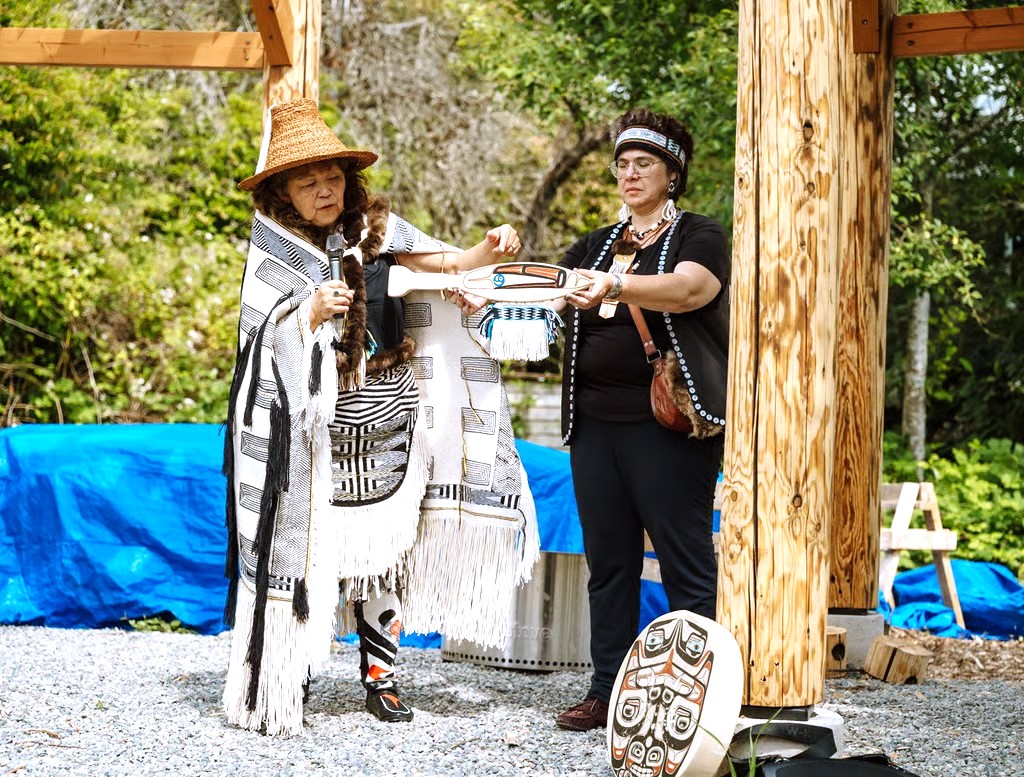
Janice Jainga-Lonergan (Tsimshian) is a master weaver and teaches Raven’s Tail and Chilkat weaving styles to keep the knowledge alive.
In her language, Sm’algyax, her name is Ksgooga Gwisgwaasgm Gyemk (translation: First born under the Blue Moon).
“For me, it’s five generations back that they were denied their language, their form of art, natural gathering, and food sustainability,” Jainga-Lonergan told Weekly Volcano.
She will join master cedar weaver Donna McNeil (Samish) and apprentice weavers Sia Aronica (Yakama), Janine Bufi (Samish), Dawn Davis, and Ashley Schmidt for the Washington State History Museum event to share their experiences of recapturing and reclaiming this art.
Jainga-Lonergan’s weaving journey spans 40 years and began with her aunt’s love of all types of crafting.
“She was very talented and would always be involved in different craft, crafting items, beading, weaving, and before we even knew about our Indigenous art forms, before we even knew it existed, we would always get together with her, or find a workshop, and we would go weave,” Jainga-Lonergan said.
As she and her siblings grew older, they began to do their own research to learn about traditional Tsimshian weaving techniques.
Many of the woven robes that do still exist are in museums and private collections around the world and inaccessible for members of that nation, which made it challenging to research them to reclaim the techniques used to create them.
One vital resource became the work of Cheryl Samuels, who is not Indigenous but was adopted by the Tlingit in Sitka and did her master’s and doctoral theses specifically on these weaving art forms of the region.
Jainga-Lonergan and her family began to teach themselves and develop their skill set, and at the beginning there were only a small handful of weavers alive who knew the Raven’s Tail and Chilkat styles of weaving.
Both include unique techniques, like utilizing a header board and weaving from the top down, where the warp is free-hanging. Rather than using tools like shuttles, threads are twined together by hand.
Raven’s Tail weaving features geometric patterns that twine across the warp from left to right, whereas Chilkat is often used to create the curving formline design style that is seen across the PNW.
“Chilkat is the only type of weaving that you can weave a circle in,” Jainga-Lonergan said, explaining that these weaving patterns typically utilize pattern boards to achieve the intricate and curving designs.
Their family has been doing everything to share this knowledge, taking on apprentices and teaching the next generation of young people.
“We’re trying to increase the numbers of weavers and bring this art back,” Jainga-Lonergan said.
The Tsimshian story is echoed in many other tribes as well, including the Puyallup, who have stewarded the land on which Tacoma was built since time immemorial.
The tribe hosts workshops and events to teach weaving techniques and bring Coast Salish weavers together. As just one example, in February of this year, the Cedar Circle and Center for American Indian & Indigenous Studies at the University of Washington Tacoma hosted a cedar heart weaving workshop, teaching both the physical technique and the spiritual practices that are part of the art. hosted a cedar heart weaving workshop
The spiritual and energetic part of weaving is a common thread through the many different weaving techniques and usually begins when the materials are collected and continues through the entire lifetime of the art piece.
In Tsimshian tradition, Jainga-Lonergan shared, “Our weaving and our art, they’re not items; they’re living beings. We see them as living ancestors, living beings that have their own spirits.”
For this reason, when they finish weaving a robe, there is a separate ceremony for the act of cutting it off of the loom.
There will then be another ceremony and a feast where everyone will gather and “dance the robe,” giving it its name and “dancing it to life.”
“It’s connecting us to our ancestors through a supernatural realm . . . by having that robe teach us how to come together and how to be respectful to each other and to lift each other up,” Jainga-Lonergan said.
Through weaving, Jainga-Lonergan connects to people all over the region, from a weaving group once a month at Evergreen Longhouse in Olympia to presentations at Tacoma-area schools on the urgent tragedy of Missing and Murdered Indigenous Women and People (MMIWP).
The upcoming event at the Washington State History Museum is one part of a series titled By the People: Conversations Beyond 250, which is a “nationwide initiative of community-driven programs exploring 250 years of American cultural life and imagining a shared future.”
Each of the featured weavers is a participant in the WACultures’ Heritage Arts Apprenticeship Program, which supports a master artist and an apprentice in “preserving cultural traditions important to their community.”
WACultures also promotes cultural traditions and tradition bearers through research and publications, and is a program of Humanities Washington and ArtWA.
If you can’t make it to this event, there is another fantastic opportunity to celebrate and learn about Native arts and culture coming up soon with the 21st Annual IN THE SPIRIT Arts Market & Northwest Native Festival from 10 a.m. to 5 p.m. on August 8.
That free event will take place at the Washington State History Museum as well as the Tacoma Art Museum and Museum of Glass and will include live music, artisan vendors, art exhibitions, interactive demonstrations, delicious food, and complimentary museum admission.