BY KRISTIE WORTHEY for WEEKLY VOLCANO | 10/9/2026
If you can’t go to Greece this fall, the Tacoma Greek Festival can get you a little closer.
Philoxenia. That’s your Greek word for today. It means, roughly, “friendship toward strangers.” Like a lot of good words, the translation doesn’t quite cover it.
Greek American chef and cookbook author Diane Kochilas, host of PBS’s My Greek Table, calls philoxenia a deeply held Greek cultural value, one inseparable from sharing food.
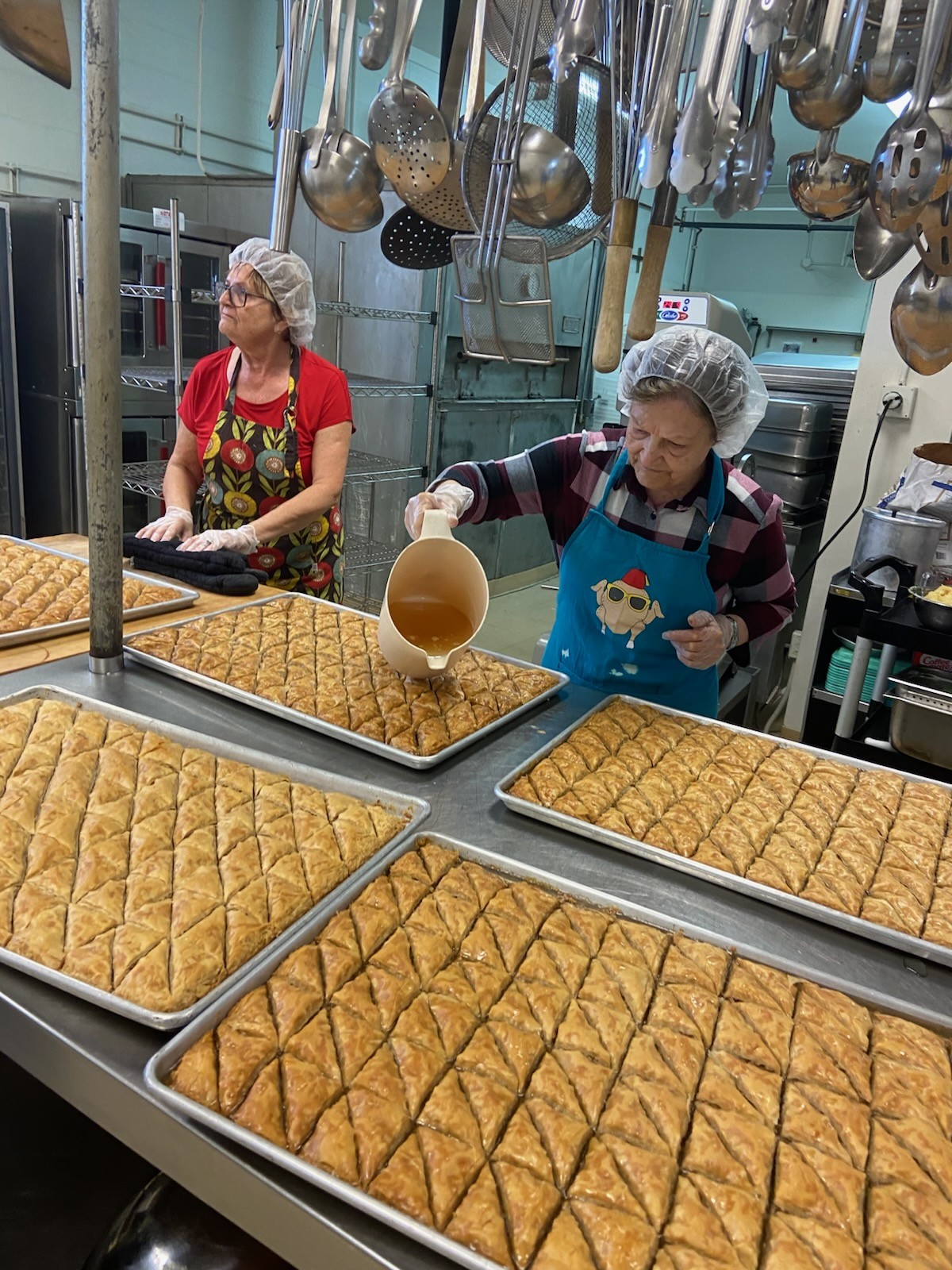
Which brings us to baklava. Because nothing says friendship toward strangers quite like layers of phyllo, nuts and honey.
Fr. Anthony Cornett, parish priest at St. Nicholas Greek Orthodox Church, says there’s a running joke among Orthodox priests about their festival online reviews. One person praises the warm, welcoming congregation. The next raves about the baklava.
“We don’t serve baklava every day of the week,” Cornett said with a chuckle. During the Greek Festival, they make up for it. The baklava and the welcome may have more in common than they seem.
Cornett describes philoxenia as the love of the stranger.
“Because there is the love of the stranger, the love requires sharing, and when you share, you make them family,” he said. “So, you don’t keep them a stranger. You make them a family member.”
For three days, Oct. 9-11, St. Nicholas will put that idea into practice as the Tacoma Greek Festival fills the church grounds with food, music, dancing and thousands of visitors.
More than 20 years ago, one of those visitors was Mark Robinson. A coworker knew Robinson enjoyed other cultures and suggested he take his family to the Greek Festival.
Inside the festival bookstore, Robinson met pediatrician Dr. Nick Bemelis and his wife. He still remembers Bemelis greeting his daughters with a pat on the head and the beautiful smile on Bemelis’s wife’s face.
He remembers people asking whether he was Greek. “No,” he told them. “I’m American.” He laughed. “That made no difference.”
Anyone whose picture of Greek Orthodoxy comes mostly from documentaries may carry a familiar collection of images: ancient churches, incense, icons, chanting, Greece, perhaps something culturally distant. The St. Nicholas Orthodox Church was founded more than a century ago by families from Asia Minor.
This is Tacoma, and Cornett himself is a California native.
“I am zero percent Greek,” he said. So is his wife. In fact, Cornett said most of the people in the congregation have no Greek ancestry.
Still, some of that ancient tradition is present at St. Nicholas. A century later, keeping those traditions alive takes a lot of hands. In the weeks leading up to the festival, volunteers from around Tacoma join parish members to bake, package pastries, rehearse dances, organize booths and eventually raise the tents. A recent festival work schedule included this Sunday instruction: “After liturgy. All hands pastry packaging. Pizza served.”
Even the newest artwork comes with a family history. Two new artisan mosaics now greet visitors at the church entrance. Installed in time for this year’s festival, they depict Christ and the Virgin Mary. They were created by Fr. Athanasios Clark and Fr. Tarsizios Clark, sons of Tom Clark, the iconographer whose work already appears in the church’s narthex and inner dome.
Cornett describes the figures as “kind of pointing the way into the doors and greeting people in.”
And there’s plenty waiting to greet them: music, costumes and dancers. Festival emcee Mr. George introduces the dances and explains where in the “Greek-speaking world” each tradition comes from. The music, costumes and movements change with the region. One dance may come from a wedding tradition, another from people gathering for battle.
Look at the shape the dancers make. A circle. “All of the dancing is done to bring camaraderie,” Cornett said. “People are arm in arm with one another and realizing that we need to rely upon one another to get through life.”
Of course, you’re going to get hungry. This could present a problem of abundance. Baklava may get celebrity billing. The pastry table keeps going: flogeres, galaktobouriko, karithopita, kataifi ekmek, kourambiethes, koulourakia, melomakarona, ouzo cake, pasta flora, paximathia, risogalo and rolled kataifi.
Don’t worry. There won’t be a pronunciation test. There may be competition for the last pastry. Festival favorites have been known to sell out. This year, the bakers started earlier and made more of everything. St. Nicholas makes no promises that your favorite will survive the weekend. So, plan accordingly.
Pastry is only the beginning. Greek-style chicken and pastitsio dinners come out of the kitchen along with tyropitakia, spanakopita and dolmathes. Head for the tent and you’ll find gyros, calamari, Greek fries, souvlaki, loukaniko and loukoumades.
And this year somebody decided baklava needed ice cream. There’s a new booth for that.
You could spend the entire festival eating but take an occasional break. Listen to the music. Watch the dancers. Look at the costumes. Walk through the church doors and take in the iconography. Find the new mosaics. Take a church tour. Ask where a dance comes from. Talk to somebody you don’t know.
Cornett describes hospitality as something that can spread from person to person.
“It’s a good kind of contagion,” he said.
The sharing continues after the tents come down. Cornett said St. Nicholas is supported by its stewards. Festival proceeds allow the church to make a sizable contribution to local charitable organizations. He returns to a simple example when he talks about helping someone in need. If a person asks for bread, wishing them well isn’t enough.
“We need to feed them the bread as well,” he said.
More than 20 years after a coworker suggested he take his family to the Greek Festival, Robinson is still at St. Nicholas. He’s the parish treasurer now, handling the bills for the festival that first brought him through the doors.
So, come hungry and curious. Taste something you can’t pronounce. Watch dances from across the Greek-speaking world. Step inside a church filled with Byzantine artistry. Meet some of the people who have spent months getting ready for you.
You may arrive as a stranger. By the time you leave, you may feel like part of the family. And if you happen to be looking for baklava, you’ve come on the right weekend.
Festival info:
WHERE: The Tacoma Greek Festival will be held at St. Nicholas Greek Orthodox Church, 1523 S. Yakima Ave., Tacoma.
PARKING: Festival organizes recommend parking at the Tacoma Dome Station garage and taking the Tacoma Link light rail to the St. Joseph stop, then walking about 1 ½ blocks downhill to South 16th Street and Yakima Avenue.
FREE ADMISSION: Festival sales are cashless; credit cards, debit cards and phone payments are accepted. Visitors who want to use cash can exchange it for a free festival Spending Card, with a minimum load of $10.
INFO: For more information visit stnicholastacoma.org