BY MATT KITE for WEEKLY VOLCANO | 10/16/2026
Sometimes it’s hidden behind clouds. And sometimes people are too busy to notice it.
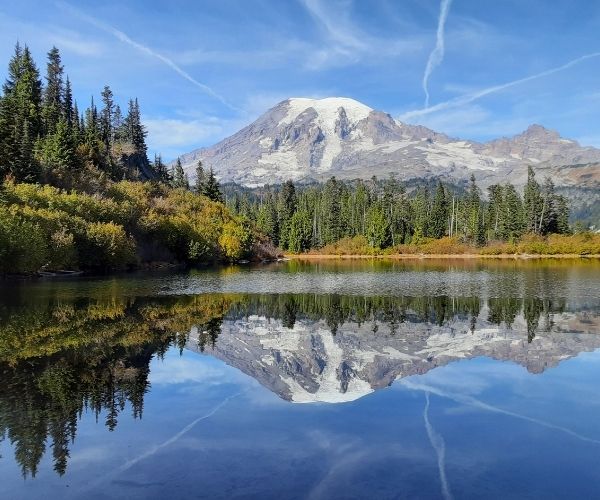
But it’s always there. All 14,410 feet of it.
Whether you call it Tahoma, an anglicized version of an ancient Lushootseed word that means “snow-covered mountain,” or Mount Rainier, whose namesake was a rear admiral in Britain’s Royal Navy, you probably take the hulking volcano in our backyard for granted. Most people do.
But if May 18, 1980, taught us anything, it’s that geological forces have a way of erasing whole mountaintops, turning thriving forests into dead zones, and depositing ash thousands of miles yonder.
I’m not trying to scare you. Just the opposite.
With this love letter to Tahoma, I’d like to remind everyone in Grit City and the 253 that nothing lasts forever, not even our favorite mountain. Don’t let another day go. Enjoy it while you got it.
Mind you, the thing could blow its top. It’s listed, after all, among the Decade Volcanoes. What, you ask, are the Decade Volcanoes? Well, there’s 16 of them in total. They comprise a list of the most dangerous volcanoes in the world. The International Association of Volcanology and Chemistry of the Earth’s Interior (IAVCEI) went to the trouble of determining which volcanoes posed the biggest threats to surrounding urban areas, and our beloved volcano made the list of the planet’s most deadly.
But other, less dramatic things can happen too. Consider the aging and no-longer-safe-to-cross Fairfax Bridge, a 104-year-old one-lane bridge on State Route 165. Last year, on April 22, the Washington State Department of Transportation permanently closed it. For everybody.
As a result, the Carbon River and Mowich Lake entrances to Mount Rainier National Park are no longer accessible. If you want to hike to Spray Park or camp at Ipsut Creek, you’re going to have to take the long way on foot via one of the park’s remaining three entrances: Nisqually, Sunrise, or Stevens Canyon.
WSDOT is in the process of studying what to do next about the obsolete bridge, which wasn’t sufficiently maintained due to poor funding and eventually became too costly and too far dilapidated to fix. But nothing will happen anytime soon.
Then there are smaller, slightly less spectacular acts of nature. Repeated floods, washouts, and glacier outbursts have trashed the Westside Road so many times that most of it is no longer accessible by automobile. If you want to hike to Lake George or Gobblers Knob, you’re going to have to park your car at a gate about three miles down the Westside Road. From there, you can hike or bike what’s left of the dirt road to the original trailhead. Such inconveniences add miles and eat valuable daylight, although they provide at least one benefit: reducing the number of hikers on the trail and making the destination feel more remote.
So what to do?
Grab your hiking boots, Yaktrax, or snowshoes and frolic while the frolicking is good.
Last week, when forecasters predicted one final dry, warm window of weather for the hiking season, I did what any self-respecting mountain lover would do: I rearranged my work schedule and sneaked out for a midweek hike.
I wasn’t the only one. The road past the Nisqually Entrance was littered with slow-moving SUVs and minivans with out-of-state license plates. Georgia. Virginia. California. It was all I could do not to yell out my window, “Stop gaping and start driving!”
But I couldn’t begrudge the tourists or their slack-jawed expressions. The winding road up to Paradise and beyond has a way of teasing you and then, just as you’re rounding another hairpin turn, assaulting you with an in-your-face view of the mountain in all its glory. It’s only natural to slow down and gawk, even if you know it’s coming and have seen it dozens of times.
Once I was on foot and following the undulating climb to Bench Lake and Snow Lake, just a few miles east of Paradise, the curmudgeon in me tried to be annoyed by the overabundance of bipeds on the trail. A couple asked if I’d take their picture near a viewpoint at the half-mile mark. A shirtless dude with bulging pecs walked by stiffly in a tight-fitting pair of designer blue jeans. A mother and her noisy young toddlers, one of them barely walking, seemed like they’d never leave Bench Lake’s otherwise serene beach.
Didn’t they know this was my mountain?
At least no one brought their dog to a national park.
But the longer I lingered on the trail, resolutely carving out little moments of solitude at Snow Lake beneath the craggy face of Unicorn Peak, the more I started to breathe with the mountain. Slow. Steady. Soft.
Memories of other hikes in the park took hold. I remembered one unseasonably mild November day when I managed to hike up to Comet Falls, Van Trump Park, and Mildred Point while treading on only a few small patches of snow. I encountered perhaps three or four people that entire day.
I remembered encouraging my young son to make the final push to Third Burroughs, about as close to the mountaintop as you can get without being on it, and climbing with my wife from verdant Summerland to Panhandle Gap, so covered in boulders it looked like a lunar landscape.
And I remembered making the descent from Spray Park to the far more remote Seattle Park one September afternoon. On my return, a blinding fog rolled in, seemingly out of nowhere. The mountain disappeared from view, disorienting me, and I struggled to fight off a surge of panic. The trail ahead looked exactly like the rocky moraine it bisected. “This,” I told myself, “is how people become lost out here.”
Fortunately, a handful of carefully placed cairns and yellow-painted rocks kept me on course, and by the time I reached Spray Park’s familiar alpine meadows, I no longer needed the mountain to guide me. The trail was easy to follow all the way back to Mowich Lake and my car.
One minute it’s there. The next it’s gone.
The same goes for all of us. Which is why today is a great day to feed your soul, catch up with an old friend, or take a moment to breathe deep. The mountain can help you do all three.