BY KEELIN EVERLY-LANG for WEEKLY VOLCANO | 10/16/2026
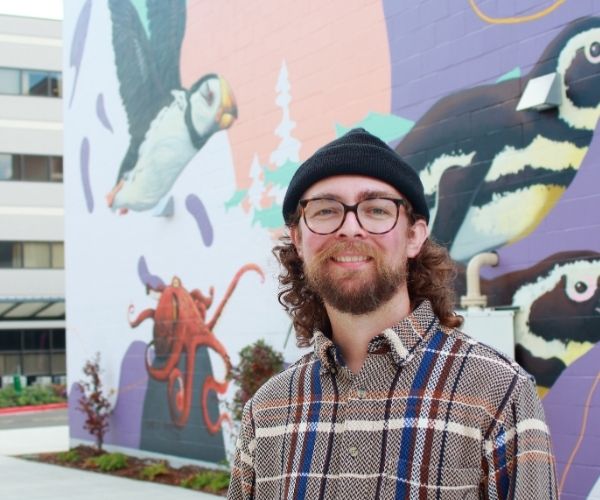
Whether creating art or reading to his fans about birds on the internet, Curtis Ashby finds joy in noticing the little things.
The Tacoma-based artist has completed several murals around Tacoma, including a recent one at Mary Bridge Children’s Hospital.
Throughout Ashby’s portfolio, you’re likely to notice a theme of celebrating the plants and animals that make this region so special.
Ashby said this comes from his love of learning about nature and wildlife – in the Pacific Northwest especially. He also loves sharing that knowledge with other people.
“I think through my art, I can kind of share that and show other people what we have around us,” Ashby said.
One of the reasons he likes to share this knowledge is to encourage people to notice the life around them.
Ashby grounds this hope in the Red Car Theory.
Formally known as the Baader-Meinhof phenomenon or frequency illusion, this is the cognitive effect where something you’ve recently learned or focused on seems to suddenly appear everywhere.
This is the same cognitive effect that causes a word you’ve recently learned to suddenly appear in the book you’re reading and is actually caused by the brain’s Reticular Activating System (RAS).
The RAS is in charge of selective attention, which filters out what stimulus we pay attention to and what we can “tune out.”
“That’s kind of my intention in my work is putting these native birds or other wildlife in my murals,” Ashby said. “Then people may see that in real life and say, oh, I recognize that. I’ve seen that before.”
This is especially meaningful to him because while he and his wife love to go camping or otherwise enjoy the natural landscapes, he knows not everyone has the ability to do that.
Still though, “even here in Tacoma, we have so many beautiful parks … and I mean you can see so much nature, even going there, or even just in the city. You know, if you start listening for birds, you’ll hear them,” Ashby said.
“You just gotta tune yourself to listen a little bit different … but I think once you start doing that, you pick up on things, and it’s kind of fun. I think it helps you appreciate the world around you a little bit more too,” Ashby said.
One way that Ashby has been changing his selective attention has been through learning about birds utilizing the German concept of “Lernen durch Lehren,” or learning by teaching. Head to his Instagram page and you’ll see a host of videos of Ashby reading aloud from guidebooks about birds.
If you’d like to also learn about birds, Ashby highly recommends the Merlin app, which allows users to identify birds by recording their song or even with a photo. The app can tell you what birds are likely to be nearby, and it keeps track of the birds you’ve had the good fortune to see or hear.
Birdwatching has become an increasingly popular activity. According to the U.S. Fish and Wildlife Service in 2024, “96 million people (or 3 out of 10 Americans) engaged in birding, making up 37% of the population aged 16 and older.”
In addition to being a nice way to get outside and connect with the natural world, Ashby said it can become a very rewarding activity, and said it’s “addicting,” with some people likening it to “real life Pokemon Go.”
Another way Ashby tunes into his environment is by noticing public art as he goes about his day, and he will often be the first to point out when a new piece appears.
When designing his most recent mural that now graces a large wall at Mary Bridge Children’s Hospital, Ashby said he made it specifically for the kids that have to spend time there. The mural is in a place that cars don’t typically drive, and at first, he thought that it might not be seen too much.
Then he looked across the alley and saw the windows of the hospital directly facing the mural and realized the potential for the mural to be a happy distraction for a child who may be experiencing something difficult.
Painting the mural was also inspiring when thinking about that concept of attention, Ashby said. One day in particular, a group including kids walked by and they shouted out “penguins!” when they saw the birds painted on the wall.
“That childlike wonder … those are the things they gravitate toward immediately, and sometimes I feel adults don’t … they might not either see it right away or just don’t express it the same way,” Ashby said.
Ashby was first introduced to the process of mural-making in about 2012, when he got his first mural assistant gig with the city.
“I was able to help out on a mural, working for the city … that opened my eyes to how, like, larger scale mural processes work, and I got to get involved and see how the design process works,” Ashby said.
A year later, he was able to get onto the Tacoma mural roster as a mural lead, and since then has been completing about a mural a year for the city.
Ashby also does other non-city-affiliated public art projects around Tacoma.
One of his favorite parts of the process is the moment when he gets to unveil what he’s created at someone else’s request.
“My favorite part is getting to draw people’s ideas and make them come to life … it’s just fun to see their reaction … it’s almost like a magic trick or like a special skill to make this happen,” Ashby said.