BY KRISTIE WORTHEY for WEEKLY VOLCANO | 9/25/2026
Kids are terrible at sitting still. Artistic director Maggie Knott doesn’t seem particularly bothered by that.
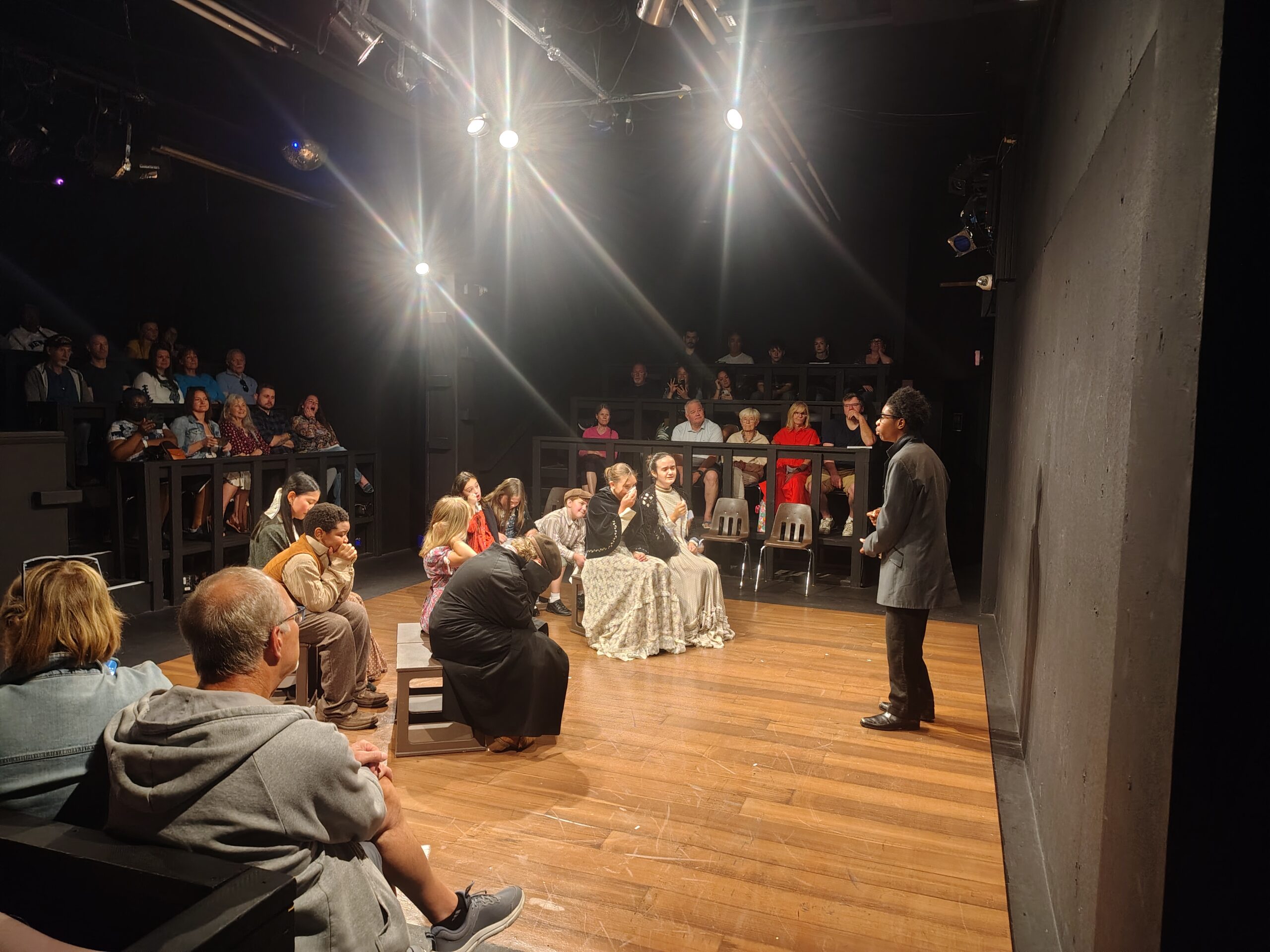
Walk into Tacoma Youth Theatre and you might find one kid painting a prop, another practicing lines in the lobby, and two more running a scene onstage. Somebody may be pacing while Knott talks. That’s fine, too. This isn’t a classroom where everyone sits quietly with their hands folded.
At the beginning of a new program, Knott says, “We don’t hand the actors a list of rules.” Instead, they create a group agreement, their own guidelines for how they’re going to work together. Her first goals are always the same: “Build trust and create a meaningful group agreement.”
“We talk a lot about being trustworthy,” she says. Trust matters in a theater. Forget a line, and someone standing onstage steps up for you. Miss an entrance, and another actor has to figure out what to do.
At Tacoma Youth Theatre, Knott says, “The kids aren’t just actors. They run the box office, operate lights and sound, and organize their own prop tables. It’s very much like a community theater run by children.” Which makes sense when you know Maggie.
I knew her when she was one of the kids.
Long before she became cofounder and artistic director of Tacoma Youth Theatre, I knew Maggie as a teenage actor at Lakewood Playhouse. We were both part of that peculiar little world where people spent evenings rehearsing plays, weekends building sets, and an unreasonable amount of time discussing what motivated imaginary people to do imaginary things.
But she had found theater even earlier, at Tacoma Little Theatre when she was about seven or eight. “It wasn’t the attention that attracted me. It was just like creating a different reality,” she said. As she got older, her curiosity deepened. She wanted to understand what it means to be a human being.
We agreed that journalism and acting have something in common. Both require you to keep asking questions. She never stops asking them. Then she discovered how much she liked exploring the answers with kids.
Tacoma Youth Theatre began because Knott noticed an empty room. After leaving Lakewood Playhouse in 2011, where she’d run the education program for thirteen years, she wasn’t even certain she would stay in theater. A new theater company was using a black-box space at night. During the day, it sat empty.
She had an idea. Could she use it for children’s programming?
She taught some classes that summer, figuring she might keep doing it part-time while looking for another job. That didn’t quite happen.
Eventually Knott and cofounder Scott Campbell landed at 924 Broadway. There was only one small problem. It wasn’t a theater. It was a former thrift store and deli.
“We built the whole theater,” Knott said. But she wanted to build more than a stage. She wanted a place where young people weren’t an education program attached to somebody else’s main stage theater. A place where young people are the priority.
It can look a little chaotic, but she likes it that way. And things do go wrong. And when they do, Knott has taught them the only rule they need: the actor’s job is to tell the story. No matter what, keep telling the story.
“If we lose our words, if we have a wiggle, we can just continue to be our characters and stay inside the story.”
After her decades of teaching theater, I asked Knott what was different about kids today.
“Nothing.” Not the answer I expected.
The world around them has changed. Knott figures it’s a rare ten- or eleven-year-old today who doesn’t have a device. At Tacoma Youth Theatre, the phones go away.
“I don’t confiscate them,” she says. Instead, she explains why it’s important to do so.
“If I check my phone and there’s a message from my sister about walking the dog, now I’m thinking about my sister and the dog. I’m not completely in the room,” she tells them. “I think it’s healthy and I think it’s restorative to be in a room where that’s not part of our experience.”
But the kids themselves haven’t changed because, as Knott puts it, they’re “natural pretenders.” They’re still close enough to imaginary play to step inside another person’s story.
“Theater is an empathy builder,” she said.
It isn’t always an economically sensible way to spend a life.
There’s “a lot of inequity and precarity in the arts,” Knott said. She appreciates what Tacoma does to support arts and culture and is especially grateful for Tacoma Creates, which currently makes up a large percentage of Tacoma Youth Theatre’s annual budget.
But after a lifetime in the arts, she wouldn’t mind eventually retiring “without living in a box on the street.” She laughs. “If I were financially motivated, this is probably not the field that I would be in. But … I’m able to work within my own integrity, and that’s a beautiful thing.”
I asked what Tacoma would lose if Tacoma Youth Theatre disappeared tomorrow.
Tacoma Youth Theatre focuses on plays rather than musicals, with acting programs for young people ages five to eighteen.
“Not everybody can sing,” she said, “but everybody can be a person.”
And after all these years, maybe that’s still what Maggie Knott is curious about.
What it means to be one.
To learn more about acting programs and upcoming productions at Tacoma Youth Theatre, visit TacomaYouthTheatre.org.