BY MATT KITE for WEEKLY VOLCANO | 8/14/2026
Nicole McCormick, an interpretive program specialist for the conservation engagement team at the Point Defiance Zoo & Aquarium, begins a staff-and-media tour of the facility by calling attention to the stuffed animal in her arms. The fluffy leopard shark is part mascot and part baton to be handed from one participant to the next. It’s the first indication that this tour is going to be a hands-on experience.
Fins for the Future, a behind-the-scenes shark tour at the Tropical Reef Aquarium, opened to the public earlier this week and runs once a day from Tuesday through Saturday. Each private tour is limited to six people, with ticket prices ranging from $35 per person for zoo members to $55 per person for nonmembers.
During her practice run, McCormick takes participants through a handful of hidden corridors and employee-only areas, offering an insider’s glimpse into the aquarium’s working spaces, including the kitchen and filtration system.
“We always talk about our mission being that we want to awaken a connection with wildlife for everyone in the Pacific Northwest,” she said. “This specific program, this whole building is designed to be really immersive, to let us tell stories that really connect with people and help them put in context the things that are going on in a very different part of the world.”
Peanut and Butter, a pair of resident Indo-Pacific leopard sharks, also known as zebra sharks, are the costars of the tour. Their eggs are being shipped to Raja Ampat, a remote archipelago in Indonesia, as part of a conservation program designed to stabilize their species’s population in the wild.
So far, seven fertilized eggs have made the long trip from Tacoma to Indonesia. According to McCormick, the flight time from Seattle to Indonesia takes about forty hours, including layovers. Then the eggs travel two and half hours by boat to an aquarium, where they are nurtured by conservationists and specialists known as “shark nannies.”
The young sharks typically measure eight to fourteen inches long when they hatch and are kept in a protected sea pen until they reach three feet in length, at which point they’re set free in the ocean.
“This program tells a specific story that connects us to real conservation work that this zoo is directly involved in,” McCormick said. “So the public gets to know the things that we’re doing and will connect that to the ocean and places that are far away. We’re all connected to everything in the world, and the aquarium is directly helping make the ocean a better place. So we want to tell that story.”
The StAR Project, as it’s dubbed, stands for Stegostoma tigrinum Augmentation and Recovery. Stegostoma tigrinum is the scientific name for the Indo-Pacific leopard shark, also known as the zebra shark. The zoo is partnering with ReShark, a global coalition, to bolster the endangered species.
McCormick worked with her conservation engagement team supervisor, Amy Hale, to develop the behind-the-scenes tour, which begins at the aquarium’s impressive-but-noisy filtration system.
Water from Puget Sound enters pretreatment at the Pacific Seas Aquarium. Next, it travels through three separate filters: mechanical, chemical, and biological. The water is then warmed to a comfy 78°F, which is just right for aquatic species living among tropical reefs. Every week, 10 percent of the water is cooled and sent back through the system to return to Puget Sound.
Once finished with her tutorial on the filtration system, McCormick leads the way to the kitchen, which prepares fresh, restaurant-quality seafood for the sharks, rays, and other fish. Here, McCormick dispels a popular myth: that introducing food to sharks triggers a feeding frenzy. In fact, Peanut, Butter, and the other sharks at the aquarium wait their turn and are fairly orderly during mealtime.
“Everyone really has this idea that sharks are going to be crazy in the water anytime food is around,” McCormick said, “and it’s so not that way. People always seem surprised by how organized our sharks are, how very calm the
experience is.”
Vitamins and supplements are hidden in meaty filets to ensure proper nutrition, and each shark enjoys a specialized menu tailored to its needs and preferences. To simulate the feast-or-famine nature of life in the wild, the sharks are fed more on some days and less on others.
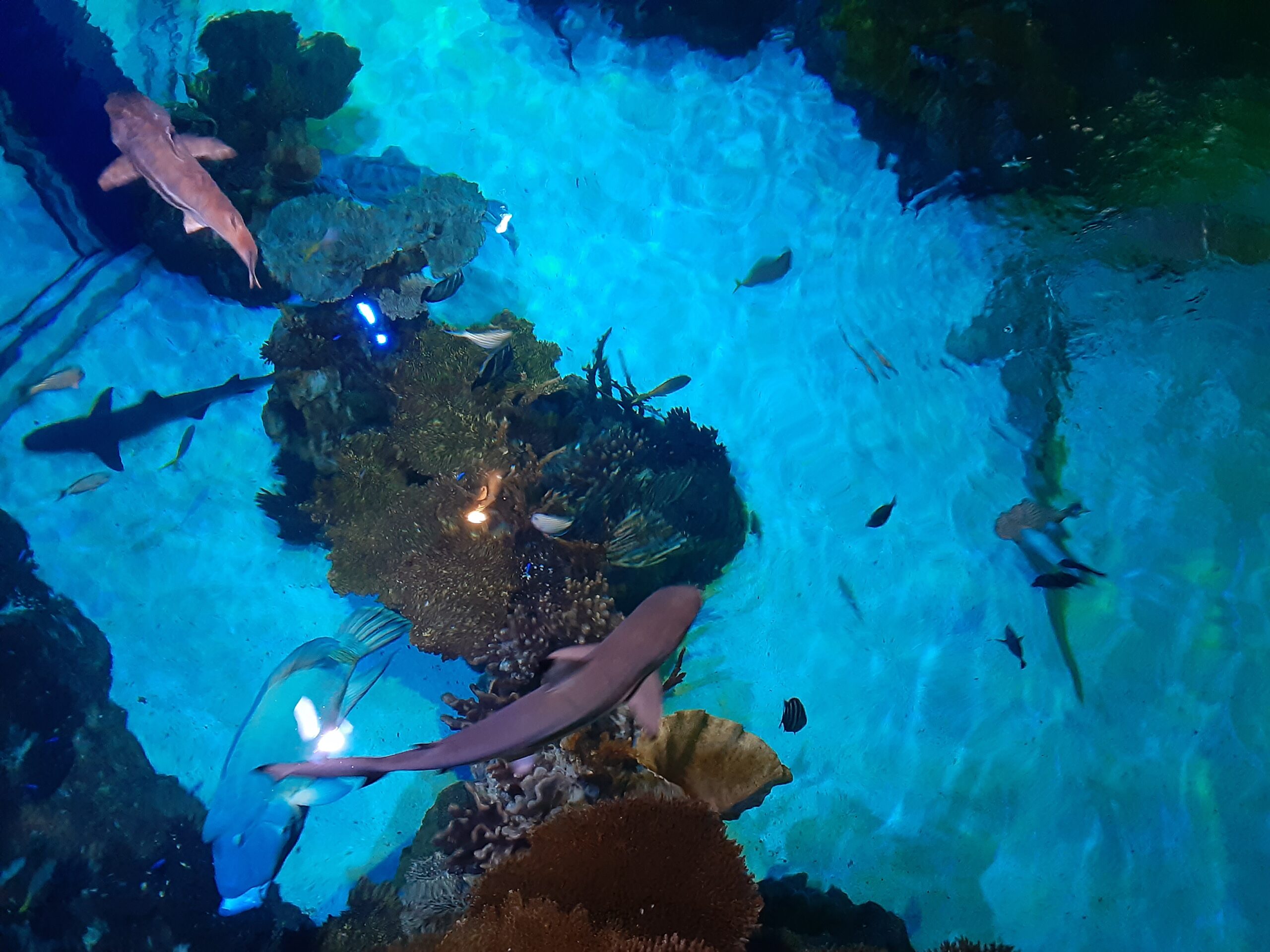
From the kitchen, the tour travels to an open space with an overhead view of the sharks that usually only employees see. Here, McCormick continues to explore other popular myths. Not all sharks, for example, have to keep moving to stay alive. Some, like one leopard shark that spends most of the tour snoozing at the bottom of the aquarium, like to rest on the ocean floor.
So why don’t the sharks eat the smaller fish sharing their aquarium? Well, occasionally, they do. But not very often. That’s because the sharks are well-fed, and the other fish are fast and recognize hunting behavior when they see it. In the same way that zebras and lions can share a watering hole on the African savannah, McCormick points out, sharks and prey can coexist peacefully. Most of the time.
Along with feeding them, the sharks’ caretakers are tasked with collecting eggs and scrubbing algae from the glass, among other duties. Tourgoers explore the tools of the trade, along with drysuits, floatation devices, and other gear. Drysuits, McCormick reminds her audience, don’t keep users dry. They keep them warm.
The tour finishes with a peek at a handful of shark eggs, most of them models. Using a bright flashlight, tourgoers are able to peer inside the eggs to see what, if anything, has begun to grow. All told, the tour takes about thirty minutes.
McCormick, who majored in biology and psychology at UCLA before earning her master’s degree in science education at the University of Washington in Seattle, grew up going to zoos and is eager to share that experience with others.
“As much as I wish we lived in a world where every kid could go out camping and explore all these wild spaces,” she said, “for a lot of people, that’s just not possible. But zoos make wildlife accessible to everyone, so I love that I come here, and it’s field-trip season, and it’s so chaotic and crazy. But a lot of those kids have never been to a zoo before. They’ve never seen these animals before, and that experience can really change how somebody sees not only wildlife and nature but also themselves and their relationship with wildlife and nature.”
McCormick added, “Every time you see that moment when a kid or an adult is making those connections, it’s just amazing.”
For more information on Fins for the Future, visit www.pdza.org/discover/zoo-for-you/tropical-reef-aquarium-behind-the-scenes/