BY MATT KITE for WEEKLY VOLCANO | 11/27/26
In an increasingly digital world, Parks Tacoma is determined to offer analog spaces for the community to gather and recreate.
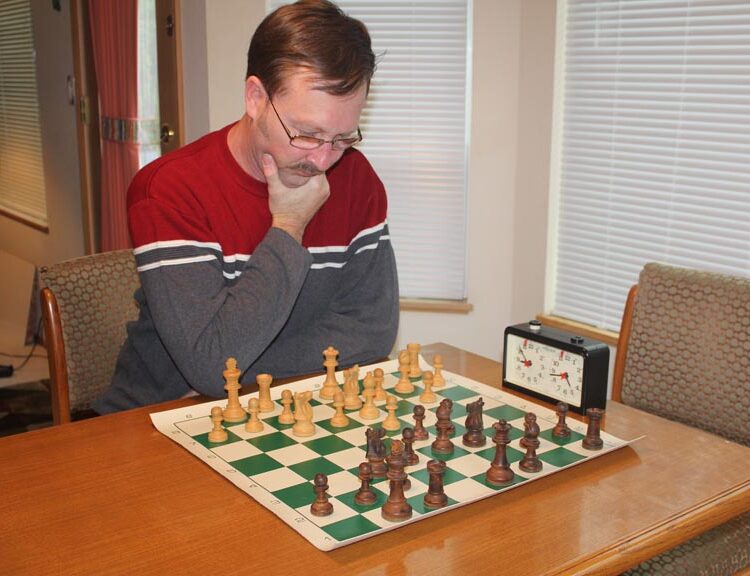
Case in point: Parks Tacoma’s drop-in chess club.
Hosted by the venerable Tacoma Chess Club, which was established 135 years ago in 1891, the drop-in chess club welcomes newbies and masters alike.
“The goal of this program is really to bring an underserviced community into the limelight,” says Noah Steele, an adult sports recreation coordinator at Parks Tacoma. “Personally, my goal is to value anybody I serve and make sure they’re heard. I think chess is unique, and it’s definitely growing again, and trying to grow that is the goal.”
The club gathers four times a week. On Tuesdays, Fridays, and Sundays, players convene at the Eastside Community Center, and on Thursdays, the fun moves to the STAR Center in South Tacoma. The Sunday sessions are for players 50 years and older and run from 4 to 8 p.m. All other sessions are open to all ages and run from 6 to 10 p.m.
Steele, 23, describes participation as straight-forward and barrier-free.
“Just show up,” he says. “You don’t have to be a chess expert or have your own board to get started.”
Indeed, chessboards and pieces come with a modest participant fee. A simple drop-in costs $3 per session. Those planning to make a habit of the game are encouraged to pay for monthly membership, which is a mere $5 per month and covers unlimited drop-ins. Seniors 65 and older can purchase a monthly membership for even less at $3. Children 12 and under play for free, but must be accompanied by an adult. Spectators pay no fee.
The vibe, Steele says, is decidedly low-key.
“The drop-in format gives folks the opportunity to play in a casual, social setting,” he says. “It’s beginner-friendly, and they are always accepting new players. This is also a good place to meet fellow chess aficionados too.”
Easy participation is built into the program, but beginners, in particular, are encouraged to show up to the Thursday session at the STAR Center. There they can receive expert tutelage from the mainstays of the program: Bill Rogers and the husband-and-wife team of Paul and Vivi Bartron.
“Paul is a master in chess,” Steele says, “so he’s very much into playing and teaching.”
On a typical Thursday evening at the STAR Center, anywhere from one or two youths to as many as eight or 10 are on hand to take advantage of the opportunity to learn from a master like Paul, who will walk each beginner through the various moves and explain the game one layer at a time.
The game of chess dates as far back as seventh-century India. Though perhaps not as popular as it once was, its legacy can be heard in popular idioms like “checkmate,” “opening gambit,” and “stalemate.” To “kibitz” is to offer unsolicited advice or observations to a player while you’re merely spectating.
While not all chess pieces are divided into white and black — some sets use beige and brown pieces, for example — white and black are nevertheless the official designations of the two sides of the board. The game always begins with an opening move by the player with the white pieces, and the players rotate the board between games so each one gets a shot at going first.
Each piece, from lowly pawns to the nearly all-powerful queen, is able to move only in specific ways. When it comes to tactics and strategies, there are no rules, per se, but most players open the game fairly conventionally by moving the king’s pawn two squares forward. Each opening move or corresponding response goes by a name, many of them intriguing, such as the Queen’s Gambit, Sicilian Defense, or Stonewall Attack.
Meanwhile, attacking patterns earn monikers like Fork, Skewer, and Sacrifice. A player might check his opponent’s king with a Scholar’s Mate, Smothered Mate, or Fool’s Mate. The latter describes a scenario where the player with the black pieces wins with just two moves.
If all of this sounds confusing or intimidating, the drop-in chess club was created precisely to give newbies the chance to earn a little real-world experience. Likewise, intermediate and advanced players can experiment with various approaches against similarly experienced players.
Tacoma Chess Club alumni include Tom Walker, a previous city and county champion, and Bryan Black, a Special Forces medical sergeant in the Army who served in Afghanistan in 2015 and was tragically killed two years later when his reconnaissance patrol was ambushed in Nigeria.
The unique nature of the program — with Parks Tacoma providing a space to a volunteer-run club and helping with the registration and promotion — resembles similar arrangements with the Tacoma Dodgeball Association and Skyhawks Sports. For its part, the Tacoma Chess Club first started meeting at Parks Tacoma’s old Portland Avenue Community Center in 2015. The club moved into the new Eastside Community Center after it opened in 2018.
As a community-building exercise, drop-in chess can’t be beat.
“Chess, much like our other adult drop-in programs, brings people back regularly to recreate,” Steele explains. “Over time, those familiar faces can become friends, and a weekly game can become something people look forward to. By partnering with established community groups like Tacoma Chess Club, we’re able to offer more ways for people to find their place in our community centers.”
While the mainstays of the program are well-seasoned masters, the steady influx of teenagers and younger participants points to a promising future.
“It was definitely slow for the last couple of years,” Steele says, “but with chess making a resurgence in the youth community, it’s exciting to see those participants show up. The hard part is getting them to stick.”
Homework, chores, and other obligations, Steele notes, make it harder for students to play every week.
To learn more, visit parkstacoma.gov/activities-and-sports/category/chess.