BY KORBETT MOSESLY for WEEKLY VOLCANO | 8/7/2026
California turned backyard units into one of every five new homes in the state, built by regular people on land they already own. Washington has opened the rules. Now the question is whether middle-income homeowners can actually get from permit to finished unit.
When we talk about the housing shortage, the conversation jumps between two poles: subsidized affordable housing on one end, big apartment buildings on the other. There is a third builder in the middle that policy keeps overlooking: the homeowner with a paid-down lot, a stable job, and room in the backyard.
That homeowner is the private sector too. Not a developer with a capital stack, but a teacher, a nurse, a retired longshoreman. And in the states that took them seriously, they became a housing production force.
1 in 5: New homes built in California is now an ADU, up from under 1% before 2017.
2 to 1: ADUs now outpace single-family homes in Seattle permitting, the reverse of 2019.
37%: Share of Seattle ADU permits from 2017 through 2021 that became a finished building.
62%: Jump in housing units permitted in Tacoma after the Home in Tacoma rezone.
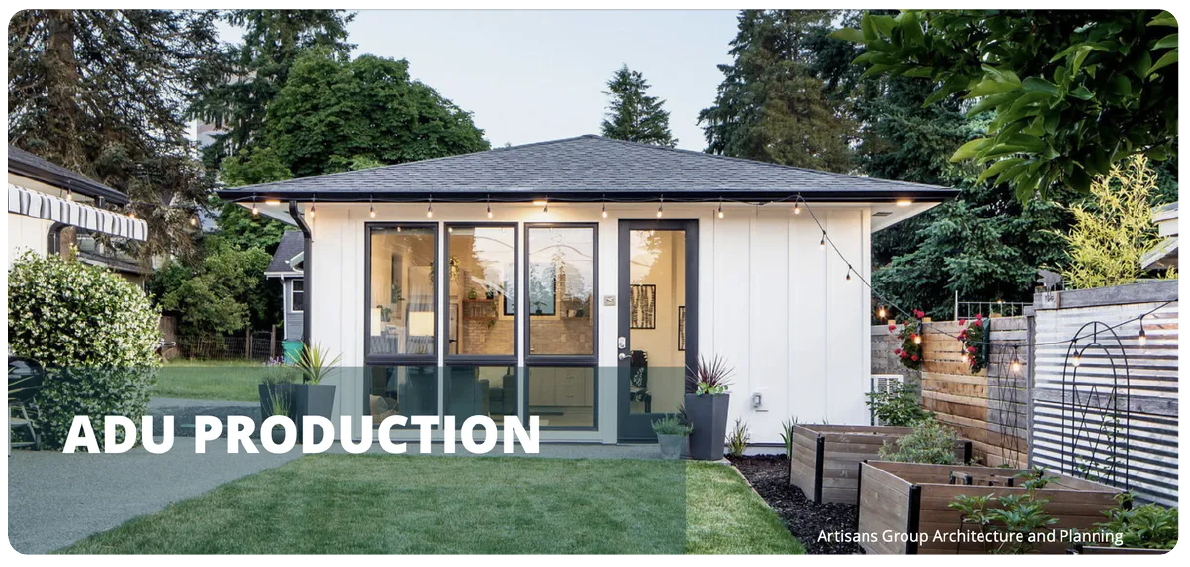
An accessory dwelling unit is a second, smaller home on the same lot as a main house: a basement apartment, a converted garage, or a detached backyard cottage, which accounts for the “D” in DADU. Since 2023, Washington law allows two on most residential lots.
Before 2017, backyard units were less than 1% of California’s new construction. Then the state stripped away the rules that made them impossible: parking mandates, owner-occupancy requirements and discretionary review. By 2023, Californians were completing more than 23,000 ADUs a year, one of every five new homes in the state. In the Bay Area, it is now closer to 28% of all housing permits.
Homeowners did it, creating the most distributed private-sector construction program in the country, running on land the public never had to buy.
And the units they build rent in the middle of the market: smaller, with no land cost baked into the rent and priced where a working household can reach them. This is middle-income housing produced without a per-unit subsidy, the category our housing debate keeps saying is impossible.
House Bill 1337 legalized two ADUs on most residential lots statewide, capped the fees cities can charge and banned most parking mandates near transit. Tacoma went further with its Home in Tacoma rezone and saw units in the permit pipeline jump 62% over the five-year average.
Seattle shows what a few years of sustained reform produces. The city’s 2024 ADU Annual Report counts more than 900 ADU permits a year from 2022 through 2024, and ADUs now outpace new single-family homes two-to-one, the exact reverse of 2019. Its pre-approved backyard cottage designs have been permitted 199 times since 2020.
Here is the number that should worry everyone: Of the ADU permits Seattle issued between 2017 and 2021, only 37% became a finished building, according to analysis by Cottage founder Alex Czarnecki. Nearly two out of three homeowners got the permit and then stopped.
The reasons are not mysterious. Construction costs rose. Interest rates hit a 20-year peak, and Seattle ADU applications fell nearly 40% in a single year. Utility hookup fees, the kind a big developer absorbs across 200 units, land on one household’s kitchen table. A civil engineer writing in The Urbanist called out water-connection charges alone as project killers. And even with pre-approved plans, Seattle’s median permitting time for a small project like a DADU still runs around 160 days, more than five months of carrying costs before a shovel hits dirt.
This is what separates California’s 23,000 completed units a year from a stack of approved drawings: the boring middle of the process, financing at terms a middle-income household can carry, predictable fees, pre-approved plans and someone to call when the file stalls.
If the goal is production, a modest grant program is the spark plug. Not because a grant pays for the whole unit, because it doesn’t, but because it de-risks the expensive first steps: feasibility, design, permits and utility connections. Several cities have already run the experiment.
Santa Cruz, California, 2020: Grants of up to $40,000. More than 50 homeowners applied; about 20 were funded to build or convert ADUs.
Portland, Oregon, 2018: Grants of up to $10,000. Twenty-five ADUs were built in low-income neighborhoods. Small dollars worked because Portland had years of permitting reform behind them.
Denver, Colorado, 2019: Grants of up to $25,000. More than 200 applied and 22 were funded, a nine-to-one demand-to-funding ratio.
Aim the grant at pre-development, not construction. $25,000 to $40,000 covers feasibility, design, permits and hookup fees, the exact costs that stop the two-thirds who quit after permitting. Construction financing can come from lenders; the grant buys the homeowner a real yes-or-no answer.
Use cohorts, not first-come-first-served. A first-come line rewards whoever hears about the program first. Intake through trusted community organizations gets the dollars to the neighborhoods where a new unit prevents displacement instead of accelerating it.
Attach a light affordability agreement. A grant is public money; a simple commitment to rent below market for a set period keeps the new unit doing public work without making the project unbankable.
The CalHFA experience is the cautionary tale and the proof at once: Demand is effectively unlimited, so a grant-only program will always run out. Pair a modest, targeted grant pool with the financing and permitting fixes below, and the grant stops being the whole strategy and starts being what it should be: the ignition.
The zoning fight is largely won. The advocacy now is about completion, closing the gap between the permit and the certificate of occupancy.
A pre-development grant program to spark production. Modeled on Santa Cruz, Denver and Portland, sized to the costs that kill projects before construction, allocated through community cohorts and with a light affordability commitment attached.
Count completions, not permits. Cities should publish how many permitted ADUs actually get built and how long the process takes. Seattle’s 37% number only exists because someone outside government did the math.
Make small-project fees proportional. Utility hookup and connection charges scaled for subdivisions should not land full-weight on a single backyard unit.
Pre-approved plans, everywhere. Tacoma already publishes four pre-approved DADU designs, from a 300-square-foot studio to a stacked duplex, and Seattle’s have been used 199 times since 2020. Every city with an ADU ordinance should have them.
A fast lane for the smallest builders. Tacoma’s permitting pilot gives seven- to 20-unit projects a dedicated reviewer and a single point of contact. The homeowner building one unit needs that more, not less.
Financing that fits the household. Community lenders in the Puget Sound region already offer home-expansion loans built for middle- and lower-income owners. Advocates should make sure homeowners know these products exist and push to keep them capitalized.
None of this is a subsidy program. It is the state treating a million homeowners as what they are: the largest, most local, most trusted private homebuilding workforce Washington has, one backyard at a time.
- Ask your city council whether it publishes ADU completion rates, not just permit counts, and how its connection fees compare for a single unit versus a subdivision.
- If you own a home and have considered a backyard unit, get a real feasibility picture before you spend money: lot, utilities and budget. Community lenders and pre-approved plans can change the math.
- Push Tacoma to extend its fast-track permitting pilot to homeowner-scale projects when the pilot reports out at the end of 2026.
This story was republished with permission from Opportunity Links. For more info visit olink.news.