BY MAUREEN PARKER for WEEKLY VOLCANO | 10/9/2026
OK so boom.
We have already established that I am definitely, DEFINITELY a lover of music. We have also determined that, in my upwardly mobile years, I don’t go outside a lot. But guess who dragged her geriatric ass outside on a school night to see Velocity at The Spar?
This girl!
And like they say on the socials, booooooi, we had a time last night!
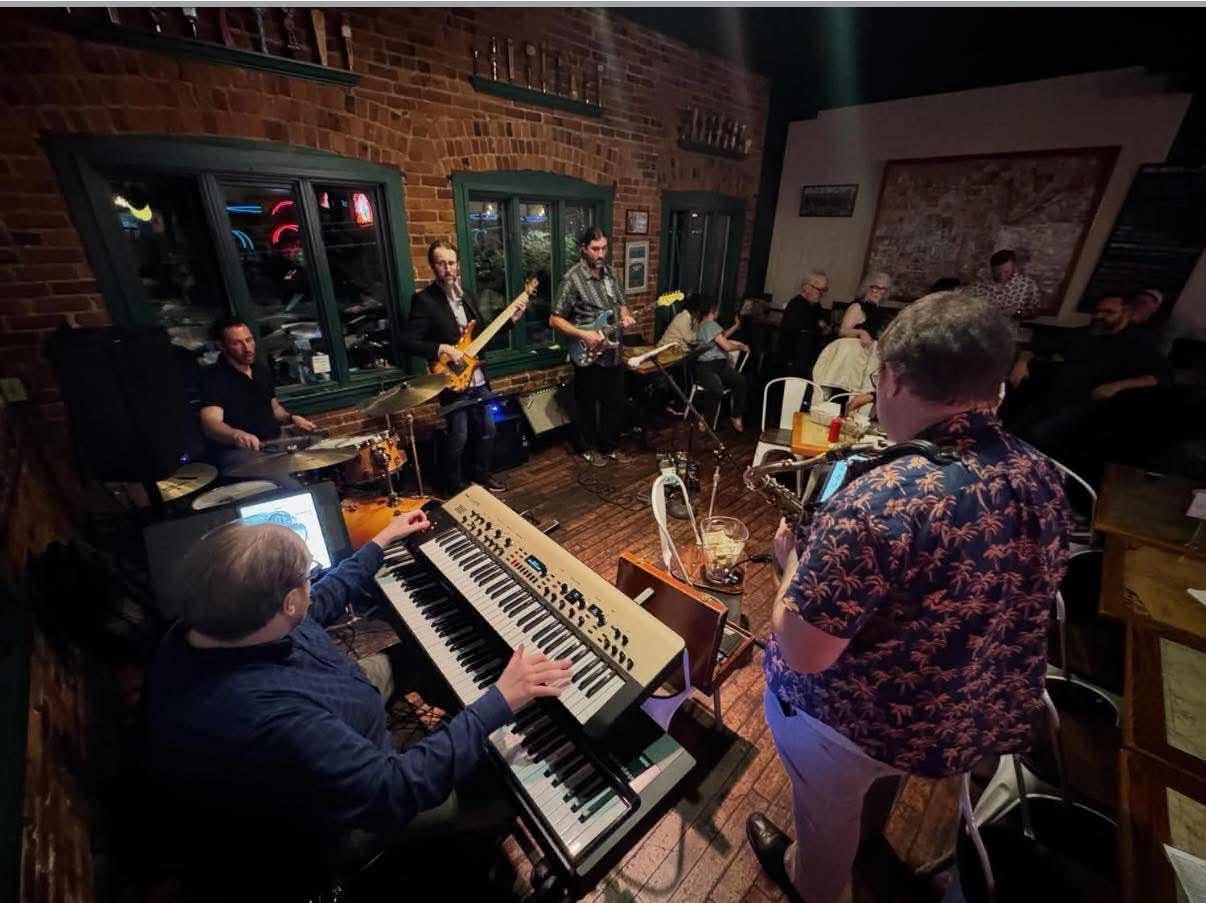
They opened with a groove called “Can Opener,” and let me tell you, it was juuuuust the right groove to let everyone in the room know they were here to play — and take us on a journey worth packing a bag for.
Next came “Sleepless Nights,” written by keyboardist Peter Adams. The title makes sense when you learn that his preferred composing hours fall somewhere between midnight and 4 a.m. Some people are sleeping. Peter is apparently coming up with things to keep his bandmates awake, too. More on that in a minute.
Now, who’s responsible for all this groove? Meet Velocity: Cliff Colón on saxophone, Peter Adams on keyboards, Bryan Smith on drums, Rob Hutchinson on bass, and Mason Hargrove on guitar. Five gentlemen who gave me a very good reason to leave the house.
Velocity plays jazz fusion, which might sound like something you need a music degree to understand. So I asked them to explain it.
Their answer? Think jazz rock: a blend of styles built around a strong backbeat, with jazz harmonies and room for adventurous improvisation. There’s funk in there, too — the kind that gives your head something to bob to while the musicians take the scenic route.
You can appreciate the technical work happening onstage, or you can simply sit there and let the groove do what it came to do.
Velocity’s beginnings go back to around 2010 or 2011, when musicians connected at a regular Tuesday-night jam session on Tacoma’s Sixth Avenue. Adams was writing original material and trying it out with fellow musicians. Those tunes sparked enough enthusiasm to turn a few musical ideas into something bigger.
One early composition, “Velocity,” eventually gave the band its name.
Adams’ approach is to write music with a strong groove and melodies listeners can latch onto, while keeping things interesting for the people playing it.
And by “interesting,” sometimes we mean sheet music that makes somebody question your intentions.
Naturally, I asked whether he had ever brought in something that made the others look at him like, “You want me to play WHAT?”
“There’s been some profanity,” came the reply.
Apparently, some of that commentary has even made its way onto the sheet music.
But underneath the jokes is a real appreciation for the challenge. Sometimes a composition requires the musicians to build their way up to playing it. That work is part of what keeps them engaged.
Now, watching them onstage, I noticed the cues, the attention, and the way everybody seemed to know where everybody else was headed. Surely this involved a whole lot of rehearsal.
So I asked how often they practice.
“Never.”
“We’re practicing right now.”
Excuse me?
They were having a little fun with me, but there was truth underneath it. Major shows and difficult new material get rehearsal time. Once a tune makes it onto the bandstand, though, the performance itself becomes part of the process of getting it settled into their hands.
They described it as “trial by fire on stage.”
Listen. That sounds like a stressful workplace situation to me, but clearly these gentlemen have a system.
That connection comes from years of playing, listening, and knowing one another. Members of the group have musical relationships stretching back well beyond this band, and they also perform in other ensembles throughout the region.
They’re friends, too. That matters.
The easy teasing during our conversation felt like an extension of what I had been watching onstage. They enjoy one another, they enjoy the music, and they understand how much attention these compositions require. As one member explained, things could fall off the rails pretty quickly if everybody weren’t on the same page.
Their individual routes into music were different. One began at four or five in a family full of musicians, playing “Tea for Two” with his father. Another picked up the saxophone in sixth grade after being inspired by “Back to the Future.” There were childhood piano lessons, a guitar that became a serious interest in high school, and a drummer who didn’t start until around age 29 or 30.
That last one deserves a moment. Sometimes you finally decide it’s time to do the thing you’ve always wanted to do.
With instrumental music, there’s no singer spelling out the story. I wanted to know how they create that emotional connection without lyrics.
Adams explained that some compositions move through different sections and moods, almost like movements within a larger piece. Others stay closer to a straightforward funk groove. Those shifts help take listeners somewhere, with the musicians bringing their own feeling to the journey.
And what do they want the audience to take home?
“Hopefully they like it.”
Fair enough, sir.
Beyond that, they want people to connect with the music: feel the groove, follow the changes, and share some of the excitement happening onstage.
At The Spar, I found myself watching that conversation unfold between them, one cue, one musical turn, one more reason to keep listening.
Catch Velocity opening for the True Loves at the Spanish Ballroom on Oct. 11, followed by a performance at the Olympia Eagles Club on Oct. 12. Their “Velocity Plays Weather Report” tribute show comes to the University of Puget Sound on Oct. 23. They return to The Spar on Dec. 16, then present “Quantum Christmas” on Dec. 19 as part of the Jazz on J Street concert series. All dates are in 2026.
I went outside on a school night for this, y’all.
Velocity made it worth putting on shoes!