BY KEELIN EVERLY-LANG for WEEKLY VOLCANO | 9/18/2026
A new mural at the Tacoma Dome tells a story about the past, present and future.
Anthony Duenas is the artist behind the new mural, titled x̌əčulb, which Duenas shared means to explain your lineage.
In the tradition of the Puyallup Tribe and many other Coast Salish nations, the proper way to introduce yourself includes sharing your recent lineage.
For Duenas, that goes like this: “My name is Anthony Duenas. My mother is Lynette Duenas. My father is Joe Duenas. My grandparents on my mother’s side was Jerry Maxim, and my grandmother is Jean Berys. My grandparents on my father’s side was Roque Duenas and Frances Conway, also known as Judy Wright.”
This tradition, like the mural, “shows connections. It shows relationships. . . . It keeps their stories alive,” Duenas told Weekly Volcano.
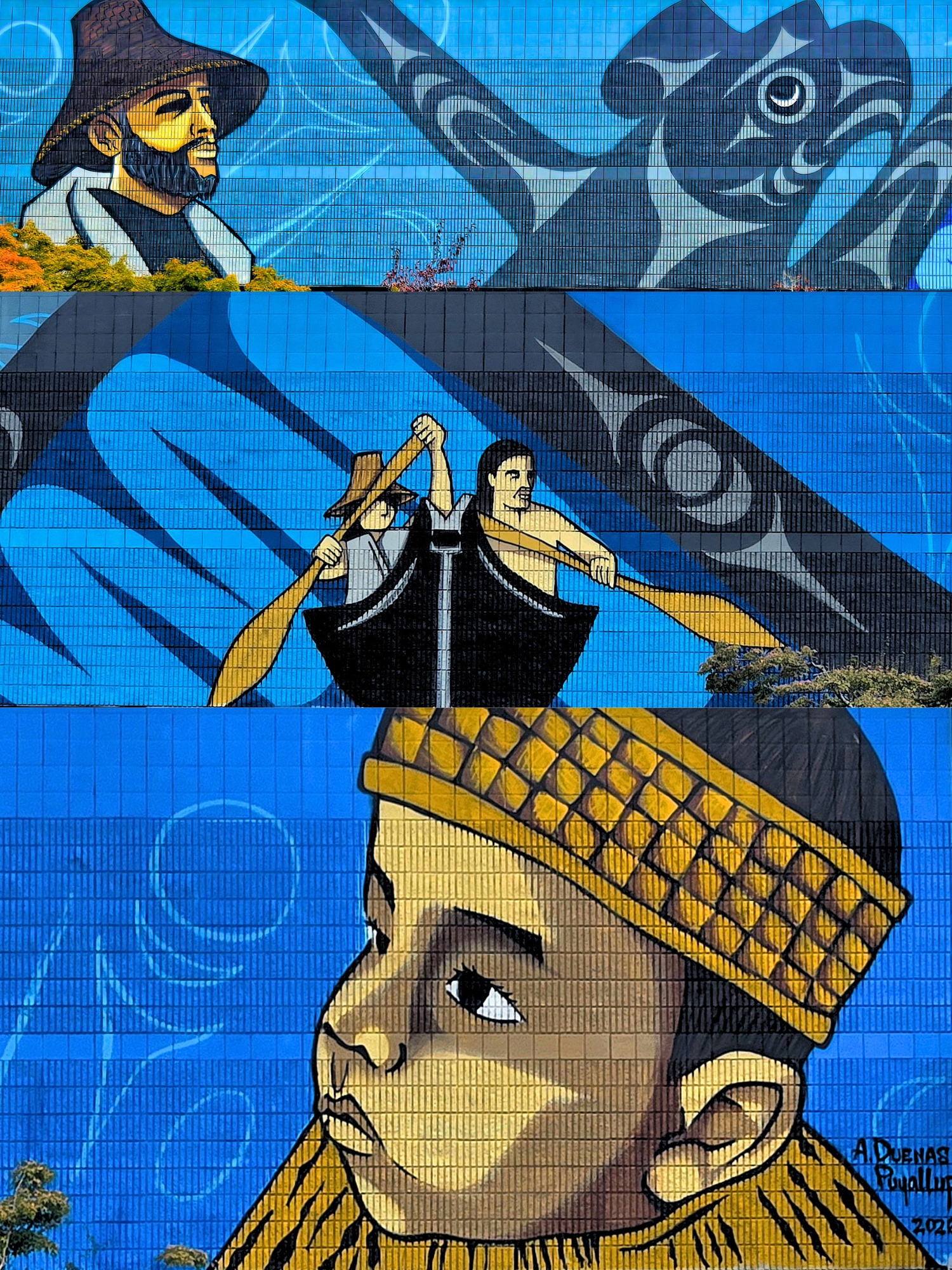
On the left side of the 120-foot mural is an elder who is looking toward the dome and toward the mountain.
Next to him is a formline depiction of the Thunderbird, which is the name of the last ancestral longhouse that burned down more than 170 years ago.
The first new longhouse in almost two centuries opened in July of this year with a first fish ceremony and was given that same name of x̌ʷiqʷadiʔalʔtxʷ, or Thunderbird House.
In the mural, the Thunderbird’s wing is both guiding and pushing the two figures in a canoe in the center of the mural.
“They represent all of our journey from where we are now to where we’re going to,” Duenas said.
The young child at the far end of the painting is looking back at the figures in the canoe, “seeing what he’s got to carry on and remember his responsibility to keep it moving, keep it going.”
That young figure is also looking toward the site of that last longhouse.
Painting the details of the cedar headband and cedar cape on that figure was a new challenge for Duenas, but it was important to him to include it.
Dancing behind the central images, the faint abstract shapes add a sense of motion and aliveness to the piece. Duenas explained he always pictures the trails of dust that hang in the air after dust is kicked up when he adds those free-flowing touches to his designs.
The final image of the mural was one of four designs he drew up after getting selected from the city of Tacoma’s call for artists. He shared those options with some family members and other members of the Tribe to get their feedback and see which option would represent the community the best, and the final version was chosen.
Duenas incorporated elements of formline, a traditional art style present throughout the Northwest Coast of North America. There is a variety of different styles within the art form, but when Duenas first started learning it and using it over twenty years ago, there was much less information about it readily available than there is now.
“There were only a handful of books . . . and a handful of websites that had it,” Duenas said. He ended up sitting with his cousin to learn the ropes and the differences between different styles.
Before learning formline, Duenas focused mostly on graffiti as his artistic medium and said he loved the thrill of the lifestyle during that time. Today he’s still leaving his mark on the city but in a whole new way.
Growing up, Duenas was immersed in both Puyallup culture and the thrills of growing up in the mid-’80s: comic books, drawing, hip-hop, skateboarding and all the other joys of city life. At the same time, he was dancing with his family at powwows.
Today the efforts to revitalize elements of the culture like language and other traditions have made him reflect on things he didn’t notice growing up.
“When we were younger, my mom would say some words here and there, and you know, we didn’t think anything of it,” Duenas said. They would just be words he didn’t quite understand, but today as he’s been learning some Twulshootseed here and there, he’s come across those words again and realized she had been sharing pieces of that language the whole time.
The revitalization has been a long time coming as generations recover from interruptions to their cultural life here since time immemorial. Colonization, treaty issues, residential schools, bans on cultural practices and more have impacted all Indigenous communities in what is now the United States, including the Puyallup.
Although Duenas does not like to dwell on it, he’s experienced some of these lingering negative attitudes and discrimination in his own lifetime and family history too. Many family members of his were activists in the era of the Fishing Wars, a time which the Tribe just recognized with a dinner and a viewing of the film As Long As the Rivers Run, which is available on YouTube.
Duenas said he remembers a time fishing with his uncle on the river when some other fishermen said something disrespectful to them. Instead of reacting, they just floated on.
His uncle taught him that if he let people get under his skin or react, he would just end up looking like the aggressor, then being judged both personally and for his identity on that perception.
Learning how to let these things go and not let them bother him was a helpful one, Duenas said, though he wishes people could leave their judgment and discriminatory attitudes in the past and move on.
Duenas has also learned more about his family history and the things his grandmother experienced after she passed away recently, when he found a large archive of documents and artifacts.
One that stands out is a framed flag made out to his great-great-grandfather from the organizers of the Puyallup Fair thanking them for the use of their horses, expressing that the fair wouldn’t be what it is today without them.
As his mural represents, there are times to remember and to celebrate this living history and times to focus on moving forward toward a bright future, carrying that wisdom forward.
Envisioning the future of the Tribe’s cultural emphasis in Tacoma, Duenas said he hopes to see even more presence of the language and other cultural traditions, like architectural styles and more sustainable ways of managing our resources.
He also encourages people who are not members of the Tribe to attend events that are open to the broader community, like the local powwows and the annual canoe journey, and suggested the leadership of the city, county, and state could find ways to be more deeply connected by hosting or supporting those events in new ways.
For Duenas, his art is his way to share the culture and make his mark on the land. Hopefully one hundred years from now his grandson’s grandkids can see the mural or his other art pieces around Tacoma, and ultimately his goal is “leaving something behind for everybody to enjoy.”