BY MATT KITE for WEEKLY VOLCANO | 7/17/2026
What is one recreational activity that seamlessly combines art, technology, and experimentation while simultaneously pushing practitioners to venture ever deeper into the natural world in search of the perfect creation?
Nature photography.
Craig Goodwin, a self-described fine-art nature photographer who moved with his wife from Spokane to Tacoma two years ago, has been making a full-time living shooting the great outdoors for the last eight years. Despite conventional wisdom, which insists that selling prints is the hardest way for a photographer to enter the professional ranks, Goodwin has been doing exactly that, showcasing his bold, almost dreamlike prints at stores and art shows all over the Pacific Northwest. His use of color, composition, and extraordinary lighting transports viewers to a stunning world of majestic landscapes and uncanny night skies.
“Somehow that has worked for me,” he says of his pursuit of fine art through a camera lens. “There are definitely more efficient ways to make money and make a living.”
Goodwin’s artwork can be found all over the Pacific Northwest, from businesses’ walls in Spokane to homeowners’ mantels in Portland, Oregon. In May, he traveled to Wabasha, Minnesota, to attend the unveiling of new postage stamps celebrating the bald eagle. His iconic photograph of a bald eagle and hatchlings in a nest decorated the selvage, or frame, around the stamps.
As part of his work, Goodwin treks through dark forests, over rugged mountain passes, and across alpine meadows, all on foot and with his gear slung over his shoulder. His commitment to the perfect shot keeps him in shape and out of his comfort zone.
“A huge part of it for me is to stay fit enough to be able to access these places,” he says, “to be able to day-hike the Enchantments, a twenty-four-mile day hike with six thousand feet of elevation gain, to get in and get out in one day, and get photos that are worth remembering.”
To capture larches turning brilliant yellow in the fall, Goodwin has to drive several miles of rugged logging roads to the trailhead and then set out with fifteen pounds of gear on his back and daylight at a premium. Often, he returns in the dark with only his headlamp to guide him.
The meticulous planning and uphill plodding are the price of admission. What he gets in return, he hopes, are conditions that show Mother Nature in all her glory and all but beg him to start snapping photos.
“I do find that without the motivation to get the photos up there I probably wouldn’t go on those adventures,” he says, “so I think that’s a real benefit, almost a necessity that’s built into my life. How can I figure out how to get up there and get those photos? I’m glad for that part of my life. It forces me to figure out how to get to these places and to physically pull it off.”
Goodwin acknowledges the recreational aspect of his photographic pursuits, but he’s careful to distinguish between what he does and simply having fun in nature. He’s also apt to point out that nature photography is just one direction a photographer can take. Many photographers explore the limits of their art without ever leaving the urban landscape.
“I’ve focused intentionally on nature and engaging with nature as my primary subject matter,” he says. “It always comes back to working with the outdoors and wild places and nature in one way or another. So much of it is the timing and the lighting and finding that great moment.”
Most hikers leave a mountain peak or an alpine lake well before sunset, but Goodwin knows that the art can be found in the lingering. The golden hour, dusk, and starlight all provide a kind of magic that many never encounter in person.
“I usually have a general idea of times that have more potential than others,” Goodwin says of when he leaves for a photo shoot, “but there is a wildness to nature that as a photographer I’m always collaborating with. I’m always adapting and adjusting to the conditions as they evolve. I might go out with a game plan, but the conditions change. There’s this wonderful back-and-forth that goes on creatively.”
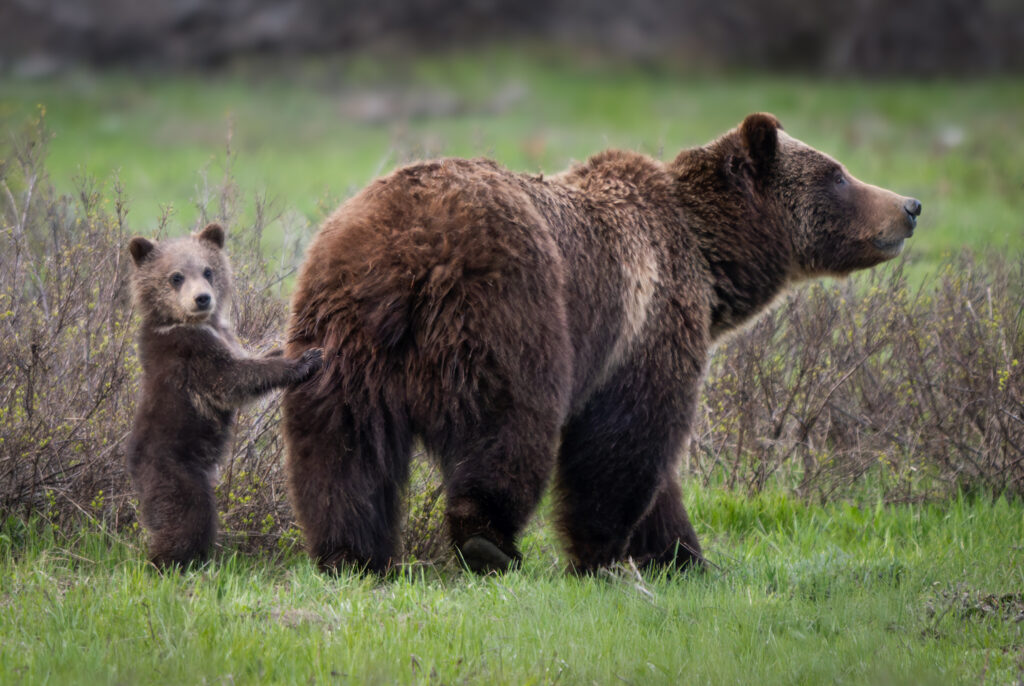
The weather, of course, can conspire to ruin or at least delay the perfect shot. Wind, snow, and fog can create a photogenic backdrop as easily as they can ruin it. The most vexing challenge is rain. Goodwin compensates by stowing his camera under a raincoat and waiting for the showers to pass. Getting soaked while waiting for a mama grizzly bear and her cub to make an appearance on the side of a grassy slope is all part of the experience.
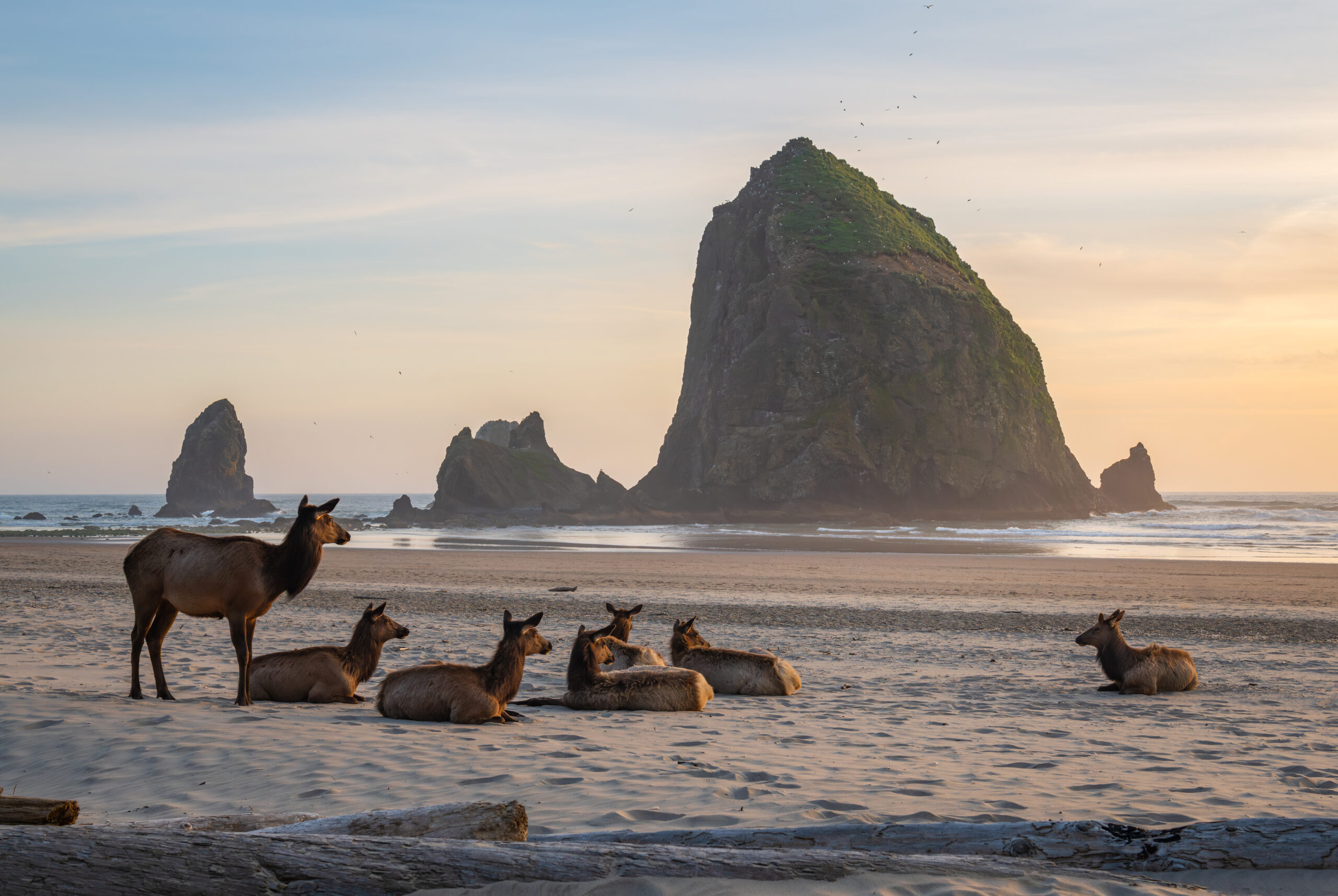
Sometimes nature surprises. During a recent shoot at Cannon Beach, Goodwin was joined by a herd of elk by Haystack Rock. His focus shifted from the sunset on the horizon to the majestic animals wandering the surf.
“I’ve done a lot of astrophotography, nighttime photography,” he says. “I’ve had times when I’ve hiked out at dusk, and then it gets dark enough to shoot the stars. Then, hiking back with my headlamp on, I’ve had glowing eyeballs looking back at me on the trail. I’ve never been attacked, but I’ve been terrified.”
Goodwin, who is self-taught, offers useful tips for budding nature photographers. First, spend less time thinking about gear and more time pondering the subject matter you want to shoot. The latter will help determine what you need of the former. Second, follow your passion wherever it takes you. Doing so will help you discover which techniques you need to learn. Third, experiment.
“There’s the old adage that the best camera for a situation is the one you have with you,” he says. “People can do a lot with an iPhone. You can take amazing photos with really bad gear that didn’t cost very much. The more you practice, the better you get. When it comes to recreation or nature, it’s such a rich environment for that practice of paying attention, noticing shapes, colors, light and dark. And I think that’s one reason why photography is such an amazing fit with hiking and being outdoors: because it can be a way to heighten awareness and the experience of being there, and it gives you a way to hold on to that, to remember that, and to share that. So those are all great parts of the photographic journey.”