BY KEELIN EVERLY-LANG for WEEKLY VOLCANO | 10/23/2026
Say the word “veteran,” and that can call to mind a certain age or image of who might have that identity, but the community is diverse and includes young adults that are transitioning into civilian life.
Tucked onto the 3rd floor of the Tioga Library Building on the UW Tacoma campus is the Veteran and Military Resource Center (VMRC).
The VMRC is one of many resources available for veterans and military families in Tacoma. About 20% of the students at UW Tacoma are military-affiliated, and with the Joint Base Lewis-McChord nearby, this is a large community in the area overall.
You don’t have to be a UW student to find the VMRC’s resource list useful (tacoma.uw.edu/vmrc/veteran-local-state-resources). On it, you’ll see a list of resources for veterans and military-affiliated community members for basic needs, behavioral health care, benefits, services and programs, business development/support, career services, support for children, community development/support, healthcare (including mental health), legal services, and re-integration services.
Kendall Burch is the Veterans’ Counseling Services Coordinator at the UWT campus, and works to help veterans and military-affiliated students access benefits as well as connect to community and support, whatever that looks like.
If anyone in that community is looking for support, Burch said there are programs for almost any need. It sometimes just starts with taking that step to look for it.
One need in the community that has been quite challenging to meet is one that is impacting many across the region: the high cost of childcare.
That being said, members of the military community are often eligible for many more benefits or programs than they may realize.
“Understanding the benefits landscape can be really complicated … there’s just a ton of misinformation out there,” Burch told Weekly Volcano.
Burch was in the U.S. Army for 10 years, including both active duty and as a reserve. For him, some of the biggest challenges about civilian life were the cultural differences and the abrupt lack of nearby friends and community.
“Everything changed at once, so it was kind of hard to figure out [things like] who am I gonna be friends with, and like what am I gonna do, and you know, where is everything?” Burch said.
The VMRC exists to help with any and all of these challenges.
Benefits through the VA is one area that many people can be intimidated by trying to access, Burch said, explaining that veterans will often be told to just look up the information, but that actually understanding can require sifting through long and complicated information.
“I’ve seen a lot of veterans be like…‘I’m not even gonna try to apply for this benefit because it just looks like too much of a hassle,’” Burch said.
A big part of his role is “figuring out how to make applying for benefits or accessing benefits not just actually doable, but actually feel doable and feel approachable,” Burch said.
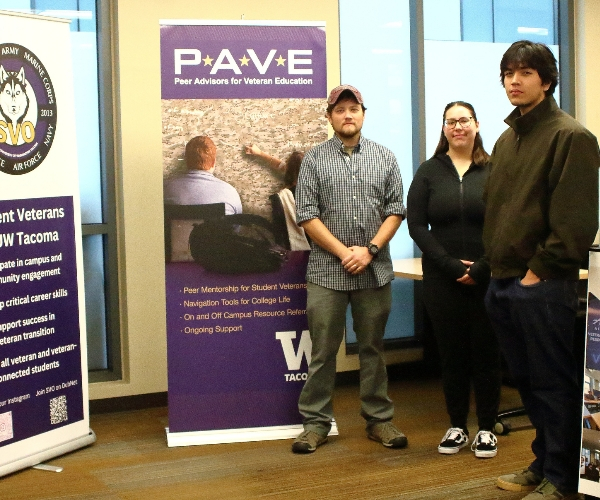
Isabelle Dominguez is Veteran’s Peer Advisor through the VMRC who was on active duty in the Army for 4 years and is now pursuing a degree in creative writing.
Peer Advisors for Veteran Education (PAVE) is a “peer support program that connects incoming student veterans with student veterans already on campus to help them navigate college life, identify challenges they face, refer them to appropriate resources on or off-campus, and provide ongoing support.”
As part of this team, Dominguez said she’s helped a lot of her peers learn that there are benefits they might qualify for. Navigating it all can be really challenging, she said.
As just one example she said off the top of her head that she could think of four different benefit types that are all “closely connected and have very similar requirements, so that can be very confusing, and sometimes they can use more than one, so it’s just about what’s right for them at the time and getting them set up.”
Dominguez said she also just wants students to stop by and check out the VMRC space. It includes lounge areas, TVs and video games, space to study, snacks and a variety of other activities in addition to being staffed with people who can help answer resource and benefit questions.
Another staff member you might run into there is Ethan Espinoza, who is not a veteran, but instead comes from a military family. He is a Vet Corps Navigator and helps students connect to the many resources that exist off-campus.
One resource that local veterans should know about is that veterans in crisis can access mental health services through VA American Lake, even if they haven’t enrolled in VA healthcare yet.
Burch also highlighted the VA Public Contact Team as a “tremendous resource that I wish more people knew about.”
The team’s physical office is in Seattle, but veterans and military-connected family members can make phone or virtual appointments to get help figuring out what benefits they’re entitled to, accessing specific documents they may need to get benefits, or navigating VA processes, Burch told Weekly Volcano.
When thinking about trying to access resources, Burch said he wants people to remember that the military community is very diverse. There are a wide range of opinions, backgrounds, experiences, and even a range of many different feelings about their time in the service or their identities within the military and outside of it.
One of those divides can be generational. Espinoza said that from what he’s observed, “they don’t have much of a connection to generations that are younger than them … a big struggle I’m noticing between generations is creating a connection … I’m trying to learn more about that to see how I can help out.”
While these divides can sometimes make it hard for those from different generations or different experiences within the military to relate to each other, this also underscores that there are resources and support for every type of person and situation.
Even with this wide range of personalities, backgrounds and beliefs within the military, Burch said, “there’s also at least a very high-level idea that at one point we both said, ‘Okay, I’ll take care of you if you’ll take care of me.’”
“There’s still this idea that like … I want to take care of things and make sure that you know people have what they need to to be successful,” Burch said.
This attitude is especially apparent in places like the VMRC and other organizations whose whole mission is to serve those that have served their country in one way or another.