BY KORBETT MOSESLY – OLINK.NEWS | 10/23/2026
By July 1, 2027, owners of apartment buildings, offices and other buildings between 20,000 and 50,000 square feet must show the state they are managing their energy use. The work behind that report is not glamorous. Someone has to pull the utility bills, walk the building with a checklist, find the waste and write the plan. Building by building.
In Wenatchee, that someone is a high school student. And the idea started here.
It Started in Tacoma
The program behind Wenatchee’s success is the Student Energy Managers internship, run by Advanced Energy Management. According to the program, its first student cohort came through Tacoma Public Schools in 2023. In January 2024, a boot camp at Tacoma’s School of Industrial Design, Engineering and Art turned more than 15 students into paid interns.
That spring, the program says, Wenatchee High School students traveled to Tacoma’s Science and Math Institute to learn the model from Tacoma students. By summer 2024, Wenatchee had its own boot camp, and the program shifted its main focus east of the mountains, where the school district, the utility and local employers lined up behind it.
Mariana Rivera was one of the Tacoma students who helped build it. She joined as a junior at Tacoma’s Science and Math Institute and is now in her fourth year with the program, studying at the University of Washington. She helped lead the Tacoma boot camp and the workshop where Wenatchee students first learned the model.
“One of the most unique aspects of this program is that it’s able to provide financial stability and really develop a career,” said Rivera, Science and Math Institute graduate, University of Washington junior.
Wenatchee did not need a new agency to make it work. It needed partners at one table: a school district with students ready to work, a utility with the data and a company that knows the work.
In Wenatchee, Students Saved Their District $433,000
Students in the Student Energy Managers program are hired into real, paid roles. They inspect buildings, collect utility data and track how much energy each building uses, with professionals reviewing their work.
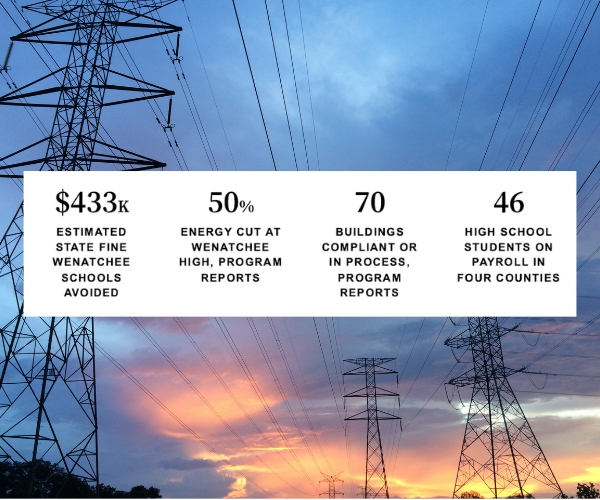
Their first big test was their own school. Wenatchee High is 278,000 square feet, which put it under the state’s first and strictest deadline in July 2026. In July, the district announced the state had notified it that the students’ work helped it avoid an estimated $433,000 fine. That is money that stays in classrooms instead of going to penalties.
Superintendent Kory Kalahar put it plainly: “Our students aren’t just learning about energy efficiency — they’re directly saving the district money.”
The fixes were mostly about habits, not new equipment. The students had the school’s big air handlers and fans shut down when the building was empty. The students say the school’s control system is too old to schedule holidays, so they set the schedule by hand. They also run “Power Down Playoffs,” campaigns that get staff to unplug and shut off before breaks.
The work has reached well past the school district. The program reports 29 buildings brought into compliance and 41 more in process, including both large and mid-size buildings. Students also monitor energy use for JCPenney stores across the country. For mid-size clients, the work can be covered through the state’s early adopter incentive, so owners pay nothing.
Congresswoman Kim Schrier visited the program in September, and the district says talks are underway about bringing the model to other communities.
“These students are developing skill sets that could change the trajectory of their lives,” said Taunya Brown, Wenatchee High School advisor, via Chelan PUD.
A Job That Can Pay for Itself
What makes this model last is that the savings are real money. Chelan PUD pays 6.5 cents for every kilowatt hour the students save. Program leaders say clients who cut their energy bills can share part of those savings to keep student payroll going. That means the program does not have to live grant to grant.
The program also has a rule for its students: family first, school second, work third. During the school year, that means hiring more students so no one has to choose a paycheck over class.
The Deadline Is Statewide. So Is the Money.
Clean Buildings Performance Standard: A Washington law that requires larger buildings to track and cut their energy use. The biggest buildings (Tier 1) came first. Mid-size buildings (Tier 2) are next, with reports due July 1, 2027.
Tier 2 covers buildings from 20,000 to 50,000 square feet, plus apartment buildings over 20,000 square feet. Owners must track a year of energy use, set up a maintenance program, write an energy management plan and name a qualified energy manager to sign off.
The state set aside help to pay for it. The Tier 2 Early Adopter Incentive holds $150 million, paid through participating utilities on a first-come, first-served basis. As of April 2026, the state reported about $5 million awarded. Most of the money is still on the table.
There is a renter piece here, too. Apartment owners who sign an anti-displacement agreement may qualify for a bigger incentive of 75 cents per square foot. Lower energy bills should not become a reason to push tenants out. This part of the program is built to prevent that.
Every Building Needs Someone. That Is the Job.
Every Tier 2 report needs a qualified energy manager. That is one role per building, statewide, on a date. Many owners do not have that person on staff.
Charlie, CEO of New Energy Technology, the company behind the program, says the law is pushing about 28,000 Washington buildings to start managing their energy. “The workforce does not exist in the market today,” he said.
The state offers the Qualified Energy Manager training free, through Commerce and the Smart Buildings Center. Full certification also takes experience, not just a class. That is what makes a paid internship so valuable: it is the experience. For newcomers, there is an introductory course for newer facilities staff, and Building Operator Certification sits further up the ladder.
The skills travel. Reading utility data, spotting waste and understanding how heating and cooling systems run carry into construction, facilities management and clean energy careers. And when an energy plan finds something broken, a contractor has to fix it. That is work for small local businesses.
Time to Bring It Home
The program says it already has students on payroll in Pierce County, and that it needs to hire more students for January as the workload grows.
Tacoma Public Schools Superintendent Josh Garcia is asking the right question. “How do we align sustainable funding to help keep this going?” he said. The savings model is one answer. Career and technical education dollars and state incentives can be another.
Pierce County has everything Wenatchee put at its table, and more. We have school career and technical education programs, community and technical colleges, utilities, WorkForce Central as the local workforce board, construction pre-apprenticeship programs and young adults who are out of school and looking for a real start.
OLINK first heard about this program from Tamar Jackson, senior director of community engagement at WorkForce Central. He sees more than buildings in it. When an owner pays a fine, that money comes from somewhere, and too often it comes out of the raises, bonuses and jobs of the people who work inside.
“In the long game, it has something to do with all of us because it does ultimately roll back into our community,” said Tamar Jackson, WorkForce Central.
The deadline will not move for us. The incentive money will not wait for us. This idea was built by Tacoma students once. They can build it again.