BY KORBETT MOSESLY for WEEKLY VOLCANO | 7/31/2026
Somewhere between the pasture and the payroll ledger, the Amara Farm is quietly answering a question that policy papers keep asking: What does community investment actually look like when it works?
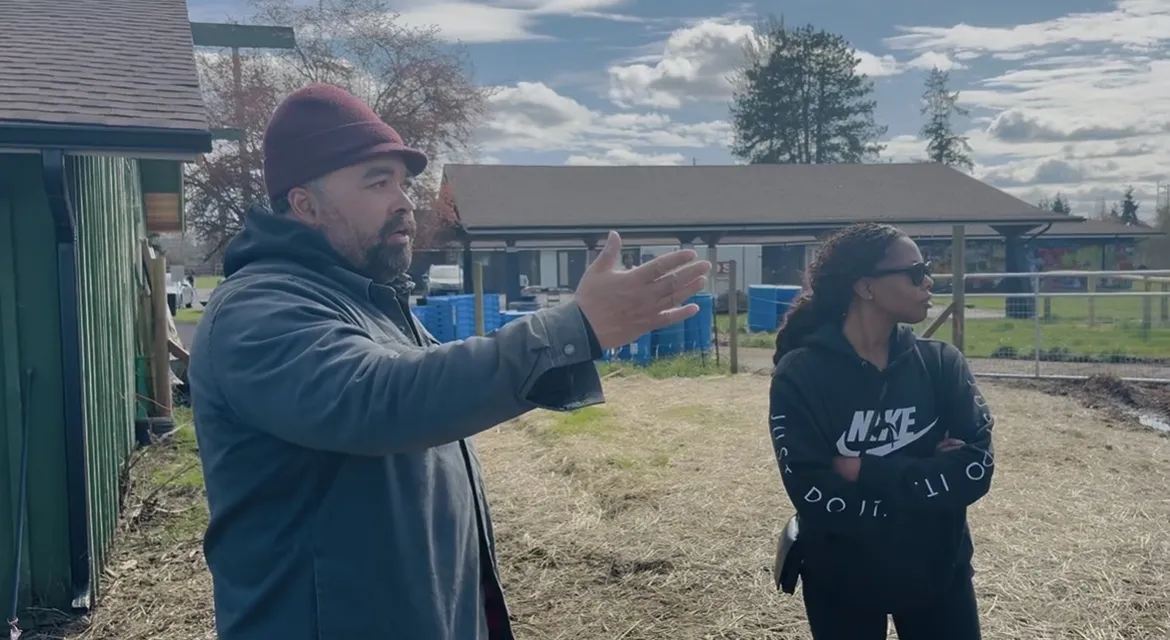
The farm is a partnership between Amara, a Washington nonprofit that has served children and families in the foster care and kinship care systems for more than a century, and The Bowed G Family Farms, a pasture-based family operation raising beef, lamb, and poultry across Pierce and Thurston counties. Under the guidance of the farmer known to everyone on-site as Farmer Ed, the land holds sheep and cattle today, with raised gardens, fruit production, healing spaces, and a farmers market on the way.
The Equipment Was the Unlock
For small producers, the choke point is rarely raising the animals; it’s everything after. Washing, grading, processing, and packaging are the unglamorous middle steps where a farm either scales or stalls. That’s where small farms hit the wall that big agriculture never sees.
Seed funding from Washington’s Community Reinvestment Program, delivered through Workforce Central, the workforce development board serving Pierce County, broke through that wall. The dollars became working equipment: a poultry plucker, a solar-powered mobile processing unit, an automated egg washer, and a solar-powered mobile henhouse.
Walk the farm, and the labor math is visible everywhere. The egg washer, which handles, washes, blow-dries, grades, and packages eggs on one conveyor, turned a two-person job into a one-person job, moving six to 10 cases, each holding 15 dozen eggs, through every week. The mobile henhouse carries a 750-pound automated feed hopper, a 60-gallon water tank, and solar-timed ramps that open at dawn and close at dusk on their own, so a single person can care for roughly 300 birds. The reservoir was always full: land, knowledge, and demand. The equipment was the missing pipe.
From Interns to Employees in One Season
With the equipment in place, the farm became a classroom with a payroll attached. Interns from foster-connected families run the full operation: morning and evening chores, feeding and watering the flock, collecting and washing the eggs, grading and packaging, and, as of the last few weeks, making the deliveries themselves.
“I should stop calling them interns. They’re now employees. They passed their paid internship program, and we were able to retain them on the farm with the revenue that was generated,” Farmer Ed said.
The egg business now generates enough income to cover those wages. The full arc, from investment to training to employment to sustainability, was completed inside a single growing season, on a timeline most workforce programs would consider impossible.
Three Systems That Usually Don’t Talk Found the Same Farm
The child welfare system, the workforce system, and public investment each run on their own budgets, their own metrics, and their own definitions of success. A foster youth aging toward independence typically encounters them one at a time, if at all, with each handoff becoming a place to fall through.
What happened at the Amara Farm is different in kind, not just degree. Amara brought the young people and the trust. Bowed G brought the land, the livestock, and generations of farming practice. Workforce Central brought the funding pathway that let seed dollars land as capital equipment and paid training at the same time. No single system could have produced the outcome alone, and none of them had to invent anything new. They coordinated.
The loop closes where it began: Ten percent of the eggs produced on the farm go, free of charge, to Amara’s food pantry for families who need support at a moment when egg prices strain every grocery budget. The same investment that pays the employees’ wages puts fresh food, laid 50 feet from where it’s washed, on the tables of foster-connected families. Reinvestment, literally.
What’s Growing Next
The vision on the ground keeps expanding: raised garden beds, fruit production, and healing spaces rooted in connection to the land, a recognition that for foster-connected families, economic opportunity and belonging are the same project. A farmers market is in the works, and when it opens, the surest form of community reinvestment will be the simplest one: showing up and buying food.
Models like this one could also shape what comes next statewide. The Community Reinvestment Program is currently gathering community input on its future agricultural investments through an Agricultural Community Input Survey, a chance for people with experience in farming and food access to help direct where future funds go and to point to what’s already working.
The research has said it for decades: Children do well when families do well, and families do better in supportive communities. The Amara Farm is what that finding looks like with boots on it.
This story was republished with permission from Opportunity Links. For more info visit olink.news.