BY MATT KITE for WEEKLY VOLCANO | 10/23/2026
Small but mighty, harbor porpoises are making a comeback in Puget Sound.
If you’re an avid whale watcher in South Puget Sound, you probably know something the rest of us are only just now noticing: cetaceans have made an impressive comeback in Puget Sound.
The cetacean family includes whales, dolphins, and porpoises. Most locals are aware that humpbacks and gray whales, in addition to orcas, are commonly spotted in the area. But some might be surprised to learn that porpoises, too, populate the local waters.
I caught up with three experts to learn more about porpoise populations in South Puget Sound.
Cindy Elliser, a marine mammalogist and educator, founded the nonprofit group Pacific Mammal Research (PacMam) and serves as the associate director and academic program director at Western Washington University’s Salish Sea Institute.
John Calambokidis, a senior biologist and co-founder of the nonprofit organization Cascadia Research Collective, often teaches courses on marine mammals at The Evergreen State College.
And Jen Mannas is a marine species lead biologist at the Washington Department of Fish and Wildlife.
Together, the three tell an encouraging tale of recovery. The harbor porpoise, our story’s protagonist, all but disappeared from Puget Sound several decades ago. But at the turn of the century, something interesting started happening: Harbor porpoises began making their home here once again. Today, a population of more than 11,000 calls the Salish Sea home.
The Salish Sea includes Puget Sound, the Strait of Juan de Fuca, and the Strait of Georgia. Although separated by political borders and dotted with islands, the sea is one body of water. Here in South Puget Sound, harbor porpoises can be spotted near Owen Beach, Chambers Bay, Dune Peninsula, and Tacoma Narrows, among other locales.
“It’s a long-term, building story,” Calambokidis says.
Elliser calls it a “complicated” one.
Back in the 1940s, harbor porpoises were common residents in Puget Sound, but by the 1960s, they had all but disappeared. Why? The research, everyone seems to agree, is incomplete. But most experts suspect a combination of gillnet fishing, pollution, and habitat destruction pushed out the harbor porpoises. Not until we began to regulate industries, fishing, and other human activities in our waters did the harbor porpoise return.
While harbor porpoises were gone, Dall’s porpoises became more common. But these days, you’re far more likely to see a harbor porpoise in Puget Sound than a Dall’s porpoise or a Pacific white-sided dolphin, both of which are rare in local waters.
“It’s really just the last 20 years that they’ve made this steady return to Puget Sound,” Calambokidis says of harbor porpoises. “We had done surveys back in the 1990s and 2000s showing lots of harbor porpoises in the Strait of Juan de Fuca and waters outside Puget Sound. Now in the last 20 years, they’ve made it back all the way to waters extending to South Puget Sound.”
Averaging about five feet long and 150 pounds, harbor porpoises are one of the smallest cetaceans in the world
“There’s a river dolphin that’s also pretty small,” Elliser says, “but harbor porpoises are the second smallest cetacean in marine waters. Small but mighty.”
Stocky and mostly gray, harbor porpoises blend in well with their surroundings and are generally wary of humans. They tend to move in small groups, although they’re occasionally spotted alone or in much larger gatherings
For those hoping to spot one, the Tacoma Narrows is one of a handful of hot spots where sightings are common.
Armed with binoculars, Elliser and her team in Anacortes do most of their research from the beach. Riding the ferry or cruising in a motorized boat also yield sightings. But nothing beats being in a kayak or on a paddleboard and noticing a trio of harbor porpoises surface nearby.
“I’ve seen them while on a paddleboard out on the Sound,” Mannas says. “We were off of Des Moines, just off the shore, and saw a group of three swimming through.”
Although not as gregarious or overtly curious as dolphins, harbor porpoises are no less interesting. Because Elliser and her team have been studying some individuals for a decade or more, their research gives us a better understanding of their behaviors. They vocalize with clicks, not whistles, and forage cooperatively. They exhibit playful behavior by riding the wakes of boats, they rub against one another socially, and they engage in some behavior that suggests they babysit for one another.
“This is a question we’re just now able to answer because we know the individuals we’re looking at,” Elliser says. “We know the calves and moms and things like that.”
What should recreationists and wildlife observers do if they encounter a harbor porpoise in close proximity?
“It’s best to give space if you see marine mammals around,” Mannas advises. “Our rule of thumb for watching wildlife, whether it’s in your yard or a park or the water, is if it changes its behavior, you’re too close. Give them space and enjoy them as they swim on by. Stay quiet and give them space as they go about their natural life.”
All marine mammals, including harbor porpoises, are federally protected by the Marine Mammal Protection Act, which prohibits hunting, fishing, trapping, or otherwise harassing them. Harbor porpoises are still harmed on occasion by gillnet fishing, and they also have to contend with orcas. According to Calambokidis, Puget Sound’s resident orcas prey mostly on salmon, but transient killer whales feed on other mammals like harbor seals and harbor porpoises.
For their part, harbor porpoises feast mostly on herring, hake, and sand lance, although they occasionally hunt squid. Females, especially reproductively active ones, also take salmon, according to Elliser.
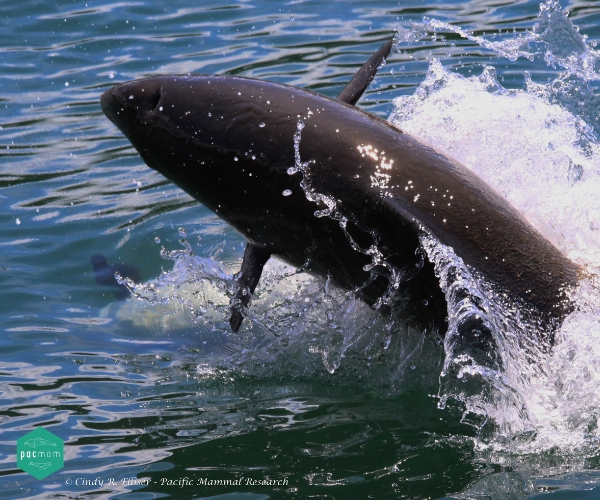
Though not as acrobatic as dolphins, harbor porpoises are known to not only surface but jump. Onlookers who spot the latter behavior might be observing more than they realize. Males often approach females on the left to mate and will do so in midair.
“If you’ve ever seen the full body of a harbor porpoise coming out of water,” Elliser says, “it was probably a mating attempt. Some people have seen it and didn’t know what they were looking at.”
Harbor porpoises surprise in other ways. They have a high metabolism and live in cold waters, Elliser points out, which means they can starve in just a few days. The females typically are bigger than their male counterparts and can be pregnant and lactating every year of their life starting at the age of three. The lifespan of females and males ranges from eight to 24 years.
Members of the public can contribute to the steadily growing body of research, Elliser says, by reporting their findings to nonprofit research groups. Doing so will help researchers better understand what has been one of Puget Sound’s happiest success stories in recent years.
If harbor porpoises are an indicator species, their return bodes well for the future of our waters.
“If you give nature a chance,” Elliser says, “it will come back. You just need to give it time to do so.”
Want to learn more about harbor porpoises and other marine mammals in Puget Sound? Several groups are doing important research, including Cascadia Research Collective (cascadiaresearch.org), Pacific Mammal Research (pacmam.org), Encyclopedia of Puget Sound (eopugetsound.org), Be Whale Wise (bewhalewise.org), the Whale Trail (thewhaletrail.org), and Sea Doc Society (seadocsociety.org). The Department of Fish and Wildlife also offers a quick primer on wildlife viewing (wdfw.wa.gov/species-habitats/wildlife-viewing).