BY KEELIN EVERLY-LANG for WEEKLY VOLCANO 5/22/26 |
Youth from around Pierce County gathered to share stories of a positive climate future and current climate actions through art at the YESS Spring Youth Climate Festival on May 17 at UW Tacoma’s William Philip Hall.
YESS stands for Youth Engaged in Sustainable Solutions. At the heart of the festival is “the belief that climate change isn’t only a scientific issue but a human one that we all feel and experience,” the event’s page said.
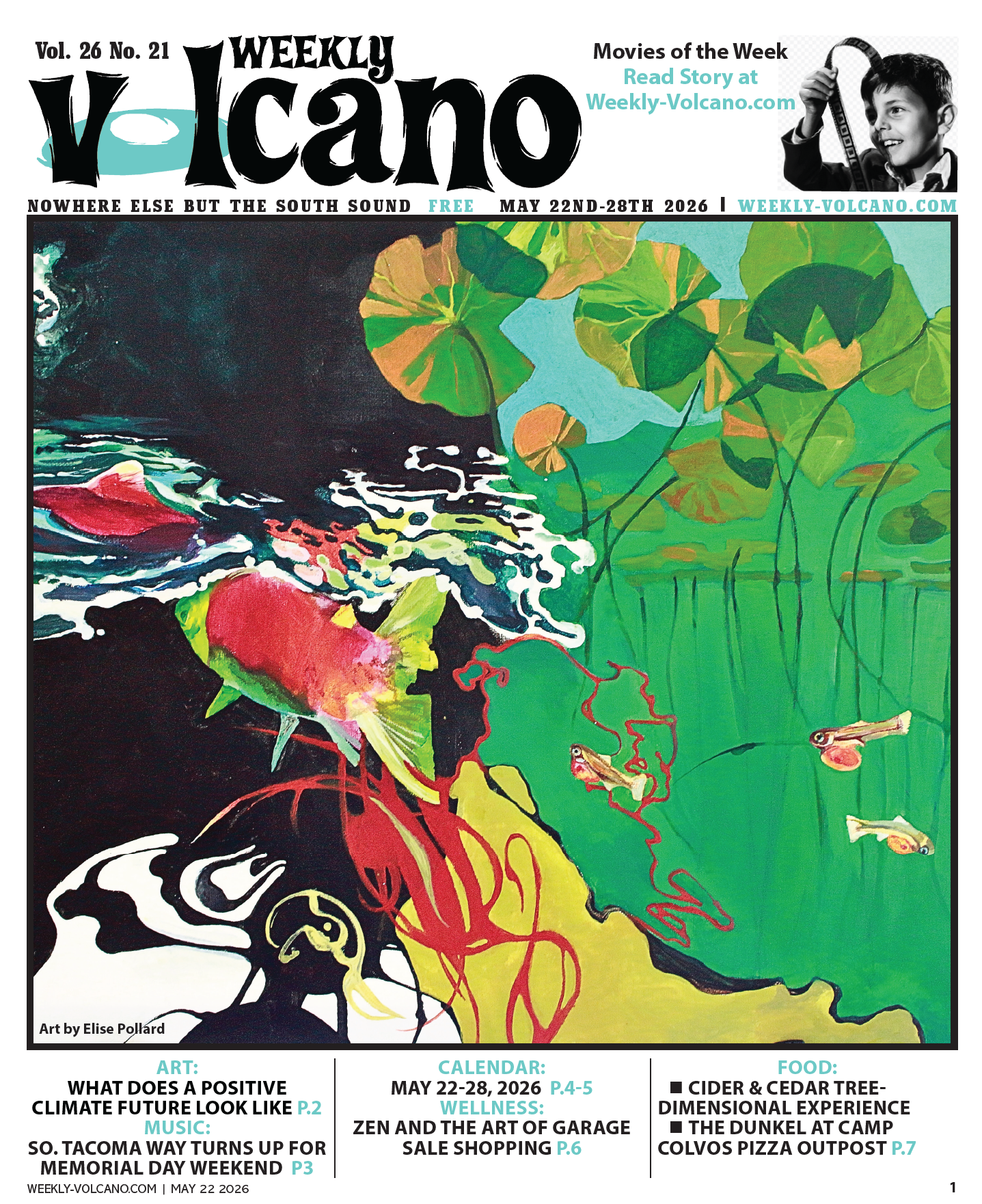
This week’s cover art was created by the winner of the artistic storytelling category, Elise Pollard, who used acrylic paint and colored pencil on canvas to create an abstract interpretation of the life cycle of a salmon, “capturing the tumultuous nature of it.”
Like many of the other young artists, she drew from her experiences with the natural world and seeing local solutions in action.
“I was inspired by Pierce County’s salmon recovery project and my own earliest childhood memories of my grandma taking me to a salmon hatchery, where I was first enchanted by these fish,” Pollard said.
There are many salmon recovery projects in Pierce County, many of which focus on restoring passage for the animals to complete their migration back upstream to their home streams to spawn after spending years in the ocean, part of the journey Pollard depicted in her winning piece.
“Let’s keep working to do right by these beautiful animals, removing man-made hardship whenever we can,” Pollard said.
This is the third year of the YESS Climate Festival, but the first to feature categories of artistic storytelling and words and live expression, as well as a climate action poster symposium.
Youth from the Lincoln Heights Climate Change Club shared posters presenting on the actions they are taking throughout their school, including a recent push to reduce food waste by acquiring food mills through the World Wildlife Fund.
In previous years, the festival focused on short films, which were definitely the largest category, with 30 total films submitted.
Officially titled the moving image and digital media category, the top six entries were shown at the festival. Several focused on the power of individual small actions to have a positive impact on our environment and the health of our global ecosystems that can add up to a large change.
Others explored particular aspects of our current systems, including a celebration of human creativity in contrast with AI and another that explained how plastic is actually made, from oil, through paper stop-motion animation.
The winner in this category was an animation by Elizabeth Silveria titled Fragile World, which told a dreamlike sequence contrasting an experience in a sunny, green, natural environment with a cityscape, while the actions that would lead to positive changes or catastrophe flashed across the backdrop of their urban world.
While the visuals were simple computer drawings with a Microsoft Paint aesthetic, the sophisticated editing and storytelling merged the two worlds in a unique way and told an emotional and moving story as a son and mother travel through the twin possibilities of our shared future.
In the words and live expression category, both entries shared multimedia pieces.
Sullafa Obini presented both a visual piece of art and a written piece, together titled “Land Ethic of Wonder,” exploring what an ethical framework grounded in the living land really looks like.
“Modern living teaches us to move through the world with our senses narrowed by urgency. We are trained into productivity so firmly that even our attention begins to feel owned by it. … Environmentalism, when it reaches all of us, often arrives in the same spirit as a catalog of crisis skills, statistics, and impossible obligations. … The scale of it all can feel so large that the only honest response to it is paralysis,” Obini said in her piece.
“But I do not think the land ethic begins in paralysis. I do not think it begins in policy. I think the land ethic begins in perception. Before I can say what responsibilities humans have toward the land, I have to say what I mean by land,” Obini continued. “It is a living convergence of soil, water, land, plants, animals, infrastructure, history, weather, and time. It is not only what grows, but it is also what remains, and is habitat, witness, archive, relation. …
“I want both to make wonder feel like a way of approaching the world with humility instead of hunger, and I want them to remember that attention is a form of care,” Obini said.
Nateli Sanderson read aloud a children’s book she published, titled “Secrets of the Salish Sea,” and won first place.
Pierce County Environmental Educator Hannah Newell worked with the eight-person youth leadership team to support its development of the festival.
One youth leader, Soraiya, described the goal of the event as an opportunity to both educate people about climate change and focus on “how we can move forward as a community” and about how actions that seem small “can impact a lot.”
“Us teens, a lot don’t care, but we need to become informed. If you live somewhere, you need to take care of it,” Soraiya said.
Art in particular is a good vehicle for this work because “art appeals to everyone of every age and culture around the world,” Soraiya said, using music as just one example.
Focusing on positive change helps people know that “people are trying to do better” and “even if it starts small, that’s how big things always happen,” she added.
Newell said it is youth like Soraiya, the rest of the planning committee, the attendees, and the artists who give her hope for the future.
She first became aware of the impacts of climate change as a child in Jakarta, Indonesia, where she witnessed “a lot of poverty and lack of infrastructure.”
There, she saw firsthand how our current systems fail to manage waste in a sustainable way and recalled always “feeling so uncomfortable that that was the only option.”
While she was never interested in being a scientist, her career path through public relations and into her current role as an environmental educator is just one example of the many types of talents, skills, and passions that can be part of building a better world.
This festival is important because it creates a space to “bring youth together to develop a network and create spaces of joy” so that they don’t “burn out.”
“What we’re finding is that most people don’t talk about climate change, but most people are worried about it,” Newell said.
This causes people who do work on the issues to often come at it from a “place of despair or anger.” Programs like this one help those entering activism work around environmental issues to “get ahead of that and find joy.”
To Newell, the most important thing about the festival is the emphasis it puts on “the power that all our youth have,” not just in Tacoma but in all of Pierce County.
“They have a really strong voice, they just need the spaces to be heard,” Newell said.