BY MATT KITE for WEEKLY VOLCANO | 11/13/26
If you’ve lived in the Pacific Northwest long enough, you’ve probably noticed that Bigfoot sightings tend to cycle. The phenomenon, much like the mythical beast itself, is mercurial.
Like surfers riding the waves, sometimes we’re in the trough, and sometimes, like now, we’re atop the peak. From TV to social media, Bigfoot is everywhere these days. And the epicenter of activity, as it often seems to be, is Pierce County, particularly the dark and shaggy forests that flourish in the shadow of Tahoma.
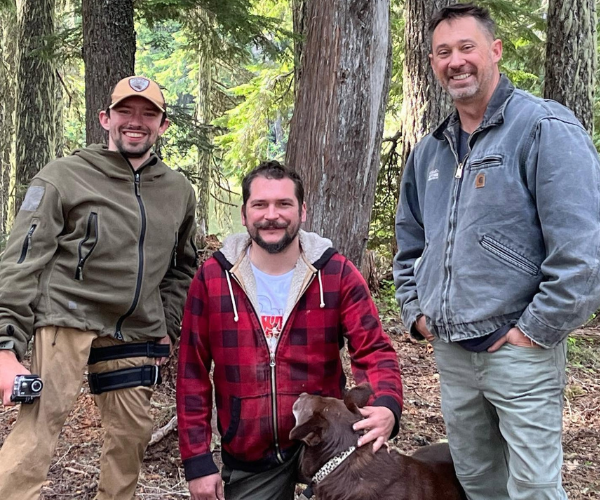
But a pair of experts on the subject urge caution when assessing whether the prevailing trend reflects reality. Jeremiah Byron, who runs the popular Bigfoot Society Podcast, and Tanner Hoskins, co-founder of Pacific Northwest Bigfoot Search, paint a more complex picture.
“I’m careful about saying encounters are increasing,” Byron explains. “People sometimes wait decades to share an experience. A newly published interview may describe something that happened last month or thirty years ago. Establishing an increase would require consistently tracking encounter dates and how reports were collected.”
Adds Byron: “What I can speak to directly is that people continue to come forward. Some tell me listening to another witness helped them feel comfortable sharing. They are no longer afraid to do so. They are empowered. The recent government UFO document drop included information from witnesses about Dogman, Little People, and Pterodactyl. There is more out there than we realize, and it is time for people to come forward so we can figure this out.”
Hoskins offers a similar take.
“Honestly,” he says, “I don’t believe encounters are increasing as much as some people think. Reports do follow a seasonal pattern. Activity tends to peak in October and November, when hunters and anglers are out in greater numbers. We receive reports year-round, and our largest spike came during the COVID-19 pandemic. We attribute much of that spike to people who were new to the outdoors and were seeing bears and other wildlife for the first time. In and around Pierce County, the areas we hear about most consistently are the Mt. Rainier region, the wilderness near Black Diamond and the Muckleshoot Reservation, and the Olympic Peninsula nearby.”
Technically speaking, neither Byron nor Hoskins are local to Tacoma or Pierce County. But their work has shrunk the distance between themselves and the region.
Byron runs his podcast from central Iowa. He grew up watching “In Search Of” and “Unsolved Mysteries” with his dad and went on to collaborate with Andrew Peterson, a Des-Moines-based filmmaker, and Small Town Monsters, an independent company that churns out documentaries on cryptids and other mysterious creatures.
“My connection to Washington has grown through the people I’ve interviewed and the accounts I’ve documented,” Byron says.
Byron launched Bigfoot Society in 2019, and has recorded 1,200 episodes while interviewing more than 1,000 witnesses. His YouTube channel is closing in on 100,000 subscribers.
Several episodes were inspired by the experiences of Pierce County residents. Episode 876, which recounts an encounter in the late 1960s, involves a family in Puyallup’s South Hill. Episode 904 revisits an eerie experience on the outskirts of Tacoma in 2013. And in Episode 508, a witness named Daniel recalls a frightening childhood encounter with a large female sasquatch in Graham.
Other Bigfoot Society episodes explore encounters at Fort Lewis, Packwood, and Ashford.
“I’ve also spent time researching around Oakridge in Oregon’s Cascade Mountains and have had experiences there myself,” Byron says. “The Pacific Northwest has become an important part of my work.”
Hoskins, meanwhile, trained with the Portland Police Bureau as a high school cadet and went on to a career in private security and law enforcement. He is a husband, father, right-leg amputee, and lifelong outdoorsman.
“Being in the wilderness has always been part of who I am,” he says, “and Pacific Northwest Bigfoot Search grew naturally out of that. My great grandma grew up in Grangemont, Idaho, in a family of loggers. Some of their logging co-workers and friends would vanish from the field with their saws and axes still wedged into trees. Loggers spoke of ‘hide-behinds’ that roamed these areas and would kidnap humans. She warned me to never go into the woods alone and that there’s things out there that science isn’t aware of, but they definitely exist.
In addition to his work with PNW Bigfoot Search, Hoskins helped found Pacific Northwest Missing Persons Project (PNWMPP), which tracks cold cases and strange disappearances.
“PNWMPP began when two close friends, Kelly and Mike, had an unexplained experience in the Gifford Pinchot National Forest,” he says, “and we set out to understand what happened to them. As we shared our fieldwork on social media, families of people missing in the wilderness began asking us to keep an eye out for their loved ones’ belongings and gear while we were out searching. That request became a second mission. Over about four years, the requests kept coming, and we realized the work was bigger than we could fund ourselves. That’s what led us to establish PNWMPP as a 501(c)(3) nonprofit.”
Hoskins and his team have logged several Bigfoot encounters that he calls “compelling,” including reports from Department of Energy personnel, law enforcement officers and other first responders, and U.S. Forest Service employees — people, he says, who have much to lose in going public with their experiences.
And like Byron, Hoskins and his crew have recorded their own experiences, including hearing unusual vocalizations and documenting large barefoot tracks in rugged terrain where few humans would dare venture.
Although ostensibly focused on unexplained phenomena, Byron and Hoskins engage in decidedly humanitarian work. Byron provides a safe, nonjudgmental place for people to share their uncanny experiences, and Hoskins is on a mission to bring answers to long-suffering families who lost loved ones to the wilderness.
Both men recognize the anecdotal and subjective nature of much of their work. Perhaps as a result, they’re able to connect Bigfoot sightings to a larger field of experience.
“I think Bigfoot speaks to our curiosity about what might still be beyond our understanding,” Byron says. “For the witnesses I interview, there’s also a very personal side. An experience may change how someone feels about a familiar campsite, road, or property. That human part of the subject matters a great deal to me. Also, I feel it greatly important that there be a renewed focus on talking to First Nations communities, as they can share and teach us many things about the subject we would never find on our own.”
Hoskins likewise points to the long-standing oral traditions of Coast Salish and Nehalem people, each of which tell stories of Sasq’ets and Wild Men.
“Today,” he says, “Sasquatch shows up everywhere: in advertising, film, and pop culture, and it’s often treated as something lighthearted. For me, it means more than that. Sasquatch is a reminder of how much we still don’t know about our forests, our mountains, and our oceans. There’s a great deal of the natural world left to explore, and I think we should approach it with curiosity and respect.”To learn more about these two organizations, visit www.pnwbigfootsearch.com and www.bigfootsocietypodcast.com. Both sites encourage user interaction and outreach.