BY MATT KITE for WEEKLY VOLCANO | 10/30/2026
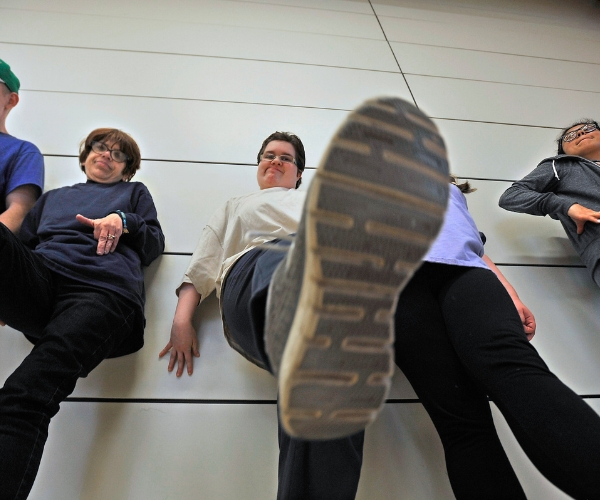
All kinds of people enjoy participating in sports, hobbies, and other leisure activities, which is why Parks Tacoma offers unique programming for adaptive and specialized recreation.
“Our program is a little bit different from several others just because it covers arts, sports, socializing, nature walks,” says Katt Merilo, the adaptive and specialized recreation coordinator at Parks Tacoma. “We try to provide a little bit of everything because people with disabilities have as many interests as other people without disabilities.”
For those unfamiliar with the term, adaptive recreation is designed for people with physical disabilities, which can range from mobility issues to impaired hearing or vision. Specialized recreation, meanwhile, is geared toward people with cognitive or developmental disabilities.
“Someone can have both,” Merilo explains, “but that’s how we parse out those. The programming covers two different populations with two very different needs. Of course, people with disabilities can participate in general recreation as well. We provide reasonable accommodations for them, and we continue to offer disability-based programming for those who prefer the pacing of adaptive or specialized recreation, or prefer being with others with similar experiences.”
Programming runs the gamut from softball and wheelchair basketball to cooking lessons and arts and crafts. Participants can register online, over the phone, or in person at Parks Tacoma headquarters or any of Tacoma’s four community centers.
“Anyone who can participate independently with reasonable accommodations is welcome to do so,” Merilo says.
Caregivers can also join, typically without cost unless the programming includes a field trip or something similar that requires a special fee.
Merilo notes that many participants and their caregivers are surprised by the depth and variety of the programming. She and her small team are determined to offer a wide range of activities, including sports leagues, adaptive kayaking, camping, and karaoke nights.
A transplant from Texas, Merilo adopted the Pacific Northwest in 2011 and has called Tacoma home for a decade. She’s been at Parks Tacoma for four and a half years and earlier in her career served six years as a special education teacher in Auburn.
“For five of those years I was in the transition assistance program,” she says of her teaching stint.
Her specialty at the time was helping young adults with disabilities who had aged out of high school, but still needed guidance.
“It was wonderful and great,” she recalls, “but I got tired of having to do those post-secondary surveys and hearing from my former students who had so much promise and were now sitting around at home. I wanted to be the reason they got out of the house.”
At Parks Tacoma, Merilo works with all kinds of people. One participant might be wheelchair-bound, and another might have autism or Down syndrome.
“The diagnosis of disability is not irrelevant,” she says, “but what really matters the most is the supports a person needs and what they’re hoping to get out of the experience. We may have somebody, for example, who utilizes a wheelchair for mobility sign up for a hike on uneven terrain. We would tell them the nature of the program and then give them the opportunity to say, ‘Yeah, I can do that with this kind of accommodations.’ If not, what else can we offer?”
In such cases, Merilo and her team try to determine what the person’s goals and needs are. Do they just want to be out in nature? Do they want to socialize? Knowing the answers to such questions helps determine the type of activity that best suits them.
Programming for adaptive and specialized recreation makes use of universal design, which plans for the highest possible need Merilo and her team can support. Such planning benefits high-needs participants and everybody else.
“Not all of our hikes are on paved areas,” she says, “but when we can, we select paved over non-paved if it fits the goals.”
Merilo’s team faces several challenges. The most difficult one is actually twofold: first, reaching people who are often isolated, and second, earning their trust.
“The disabilities community has experienced so many barriers,” she says. “We’re here to try to remove barriers as much as possible. That can be hard to prove without them experiencing it for themselves.”
Adds Merilo: “For me personally, I would love for Parks Tacoma to become somebody’s third space, so you have work and home and that other place where you’re comfortable.”
Being comfortable, Merilo points out, is foundational to learning. It’s tough to acquire a new skill or gain fitness without first feeling a baseline of comfort and security. But watching participants transition from nervousness to confidence is one of the most rewarding aspects of her job.
The program’s participants and the community that supports them continually inspire Merilo.
“There’s no competition in serving the underserved,” she says. “Even other organizations that are doing similar programming are excited to see we’re doing this. We refer to others, and they do the same. We’re all trying to serve the community, and I find that really inspiring.”
Those hoping to learn more about the program are encouraged to visit Parks Tacoma online (parkstacoma.gov). Volunteers can apply online, as can those seeking part-time employment.